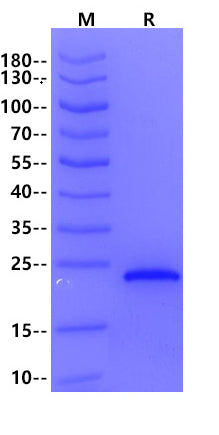
2μg (R: reducing condition).
KRAS His Tag Protein, Human (Load GDP/GMPPNP)
KRAS His Tag Protein, Human (Load GDP/GMPPNP)
Price:
Regular price
$245 USD
Regular price
Sale price
$245 USD
Unit price
per
For shipping services or bulk orders, you may request a quotation.
Secure checkout with

View full details
Product Details
Product Details
Product Specification
| Species | Human |
| Synonyms | K-Ras 2, Ki-Ras, c-K-ras, c-Ki-ras, GTPase KRas, KRAS2, RASK2 |
| Accession | P01116-2 |
| Amino Acid Sequence | Thr2-Cys185 with His Tag at the C-Terminus |
| Expression System | E.coli |
| Molecular Weight | 20-25kDa (Reducing) |
| Conjugation | Unconjugated |
| Tag | His Tag |
| Physical Appearance | Liquid |
| Storage Buffer | 10mM HEPES pH7.5,150mM NaCl,1mM MgCl2,10%Glycerol |
| Stability & Storage | Stable for 12 months upon stored at -80℃ from the date of receipt. And avoid repeated freeze-thaws cycles. |
| Reference | 1.Gremer L, Merbitz-Zahradnik T, Dvorsky R, Cirstea IC, Kratz CP, Zenker M, Wittinghofer A, Ahmadian MR. Germline KRAS mutations cause aberrant biochemical and physical properties leading to developmental disorders. Hum Mutat. 2011 Jan;32(1):33-43. |
Background
GTPase KRas, a product of the KRAS oncogene, is a molecular switch that cycles between inactive GDP-bound and active GTP-bound states to regulate cell proliferation. Upon growth factor stimulation, it activates downstream pathways like MAPK and PI3K-AKT. Its activity is tightly controlled by GTPase-activating proteins (GAPs) and guanine nucleotide exchange factors (GEFs). However, cancer-associated point mutations at codons 12, 13, or 61 impair GTP hydrolysis, locking KRas in a constitutively active state that drives uncontrolled cell growth.
Picture
Picture
SDS-PAGE