WB result of KLK2 Recombinant Rabbit mAb
Primary antibody: KLK2 Recombinant Rabbit mAb at 1/500 dilution
Lane 1: DU 145 whole cell lysate 20 µg
Lane 2: LNCaP whole cell lysate 20 µg
Negative control: DU 145 whole cell lysate
Secondary antibody: Goat Anti-Rabbit IgG (H+L), HRP conjugated at 1/10000 dilution
Predicted MW: 29, 25 kDa
Observed MW: 29, 25 kDa
KLK2 Recombinant Rabbit mAb,PBS Only (SDT-4461-80)
KLK2 Recombinant Rabbit mAb,PBS Only (SDT-4461-80)
Price:
Regular price
$920 USD
Regular price
Sale price
$920 USD
Unit price
per
For shipping services or bulk orders, you may request a quotation.
Secure checkout with

View full details
Product Details
Product Details
Product Specification
| Host | Rabbit |
| Antigen | KLK2 |
| Immunogen | Synthetic Peptide |
| Accession | P20151 |
| Clone Number | SDT-4461-80 |
| Antibody Type | Recombinant mAb |
| Isotype | IgG |
| Application | WB, IHC-P |
| Reactivity | Hu |
| Positive Sample | LNCaP |
| Purification | Protein A |
| Concentration | 1 mg/ml |
| Conjugation | Unconjugated |
| Physical Appearance | Liquid |
| Storage Buffer | PBS |
| Stability & Storage | 12 months from date of receipt / reconstitution, 4 °C as supplied |
Dilution
| application | dilution | species |
| WB | 1:500 | Hu |
| IHC-P | 1:2000 | Hu |
Background
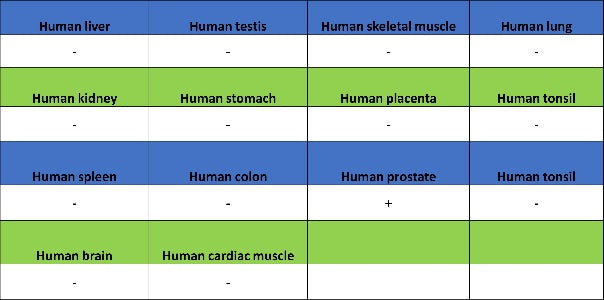
KLK2, or human kallikrein-related peptidase 2, is a trypsin-like serine protease that is predominantly expressed by prostate tissue and secreted into semen. Physiologically, KLK2 activates and complements its homolog KLK3 (prostate-specific antigen, PSA), participating in the cleavage of semen coagulum proteins to facilitate semen liquefaction. At the pathological level, KLK2 plays a critical role in prostate cancer—it is a gene regulated by the androgen receptor (AR) signaling pathway, with its expression levels closely correlating with disease progression and significantly elevated in metastatic lesions. In recent years, due to its cell-surface expression on prostate cancer cells and its highly tissue-specific nature (normally expressed only in prostate tissue), KLK2 has emerged as a highly attractive therapeutic target. A variety of cutting-edge therapies targeting KLK2 have entered clinical trials, including bispecific T-cell engagers (such as Pasritamig/JNJ-78278343), chimeric antigen receptor T-cell (CAR-T) therapies, and radionuclide-conjugated antibody-drug conjugates, all aimed at providing more precise treatment options for patients with advanced prostate cancer.
Picture
Picture
Western Blot
Immunohistochemistry
IHC shows positive staining in paraffin-embedded human prostate. Anti-KLK2 antibody was used at 1/2000 dilution, followed by a HRP Polymer for Rabbit IgG (ready to use). Counterstained with hematoxylin. Heat mediated antigen retrieval with Tris/EDTA buffer pH9.0 was performed before commencing with IHC staining protocol.
IHC shows positive staining in paraffin-embedded human prostatic cancer. Anti-KLK2 antibody was used at 1/2000 dilution, followed by a HRP Polymer for Rabbit IgG (ready to use). Counterstained with hematoxylin. Heat mediated antigen retrieval with Tris/EDTA buffer pH9.0 was performed before commencing with IHC staining protocol.
Negative control: IHC shows negative staining in paraffin-embedded human liver. Anti-KLK2 antibody was used at 1/2000 dilution, followed by a HRP Polymer for Rabbit IgG (ready to use). Counterstained with hematoxylin. Heat mediated antigen retrieval with Tris/EDTA buffer pH9.0 was performed before commencing with IHC staining protocol.