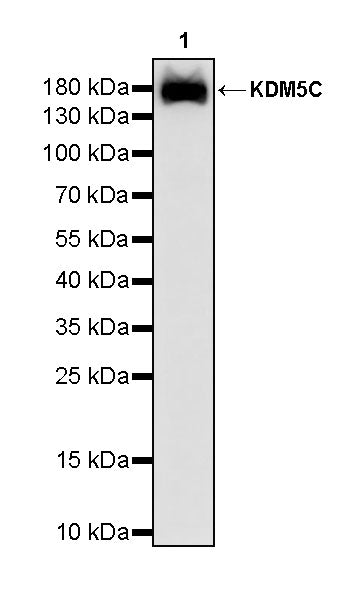
WB result of KDM5C Recombinant Rabbit mAb
Primary antibody: KDM5C Recombinant Rabbit mAb at 1/1000 dilution
Lane 1: NCCIT whole cell lysate 20 µg
Lane 2: Jurkat whole cell lysate 20 µg
Secondary antibody: Goat Anti- rabbit IgG, (H+L), HRP conjugated at 1/10000 dilution
Predicted MW: 175 kDa
Observed MW: 175 kDa
KDM5C Recombinant Rabbit mAb (S-2958-146)
KDM5C Recombinant Rabbit mAb (S-2958-146)
Price:
Regular price
$100 USD
Regular price
Sale price
$100 USD
Unit price
per
For shipping services or bulk orders, you may request a quotation.
Secure checkout with

View full details
Product Details
Product Details
Product Specification
| Host | Rabbit |
| Antigen | KDM5C |
| Synonyms | Lysine-specific demethylase 5C; Histone demethylase JARID1C; Jumonji/ARID domain-containing protein 1C; Protein SmcX; Protein Xe169; [histone H3]-trimethyl-L-lysine(4) demethylase 5C; DXS1272E; JARID1C; SMCX; XE169 |
| Immunogen | Synthetic Peptide |
| Location | Nucleus |
| Accession | P41229 |
| Clone Number | S-2958-146 |
| Antibody Type | Recombinant mAb |
| Isotype | IgG |
| Application | WB |
| Reactivity | Hu, Ms, Rt |
| Positive Sample | NCCIT, Jurkat, F9 |
| Purification | Protein A |
| Concentration | 0.5 mg/ml |
| Conjugation | Unconjugated |
| Physical Appearance | Liquid |
| Storage Buffer | PBS, 40% Glycerol, 0.05% BSA, 0.02% sodium azide |
| Stability & Storage | 12 months from date of receipt / reconstitution, -20 °C as supplied |
Dilution
| application | dilution | species |
| WB | 1:1000-1:2000 | Hu, Ms, Rt |
Background
KDM5C (also known as lysine-specific demethylase 5C) is a JmjC-domain-containing histone demethylase encoded by the KDM5C gene that relies on iron and α-ketoglutarate as cofactors. It is primarily localized in the nucleus and exerts epigenetic regulatory functions by specifically removing di-methyl and tri-methyl modifications from lysine 4 on histone H3 (H3K4me2/me3), which are typically markers of transcriptional activation. Thus, KDM5C plays a critical repressive role in regulating the expression of genes involved in neuronal development. Functionally, KDM5C is indispensable for embryonic development, neurogenesis, and learning and memory processes, and its dysfunction leads to intellectual disability by affecting synaptic plasticity and neural circuit formation. Clinically, KDM5C gene mutations are one of the common genetic causes of X-linked intellectual disability, with affected patients often presenting with a syndromic spectrum characterized by moderate to severe intellectual developmental delay, language impairment, growth abnormalities, and distinctive facial features. As an X-chromosomal gene, males are more likely to exhibit the full phenotype due to the hemizygous state, while female heterozygous carriers display significant phenotypic diversity due to X-chromosome inactivation. Currently, KDM5C has emerged as a frontier target in epigenetic research related to intellectual disability, and small-molecule inhibitors targeting its demethylase activity are being explored as potential therapeutic strategies for neurological disorders.
Picture
Picture
Western Blot
WB result of KDM5C Recombinant Rabbit mAb
Primary antibody: KDM5C Recombinant Rabbit mAb at 1/1000 dilution
Lane 1: F9 whole cell lysate 20 µg
Secondary antibody: Goat Anti- rabbit IgG, (H+L), HRP conjugated at 1/10000 dilution
Predicted MW: 175 kDa
Observed MW: 175 kDa