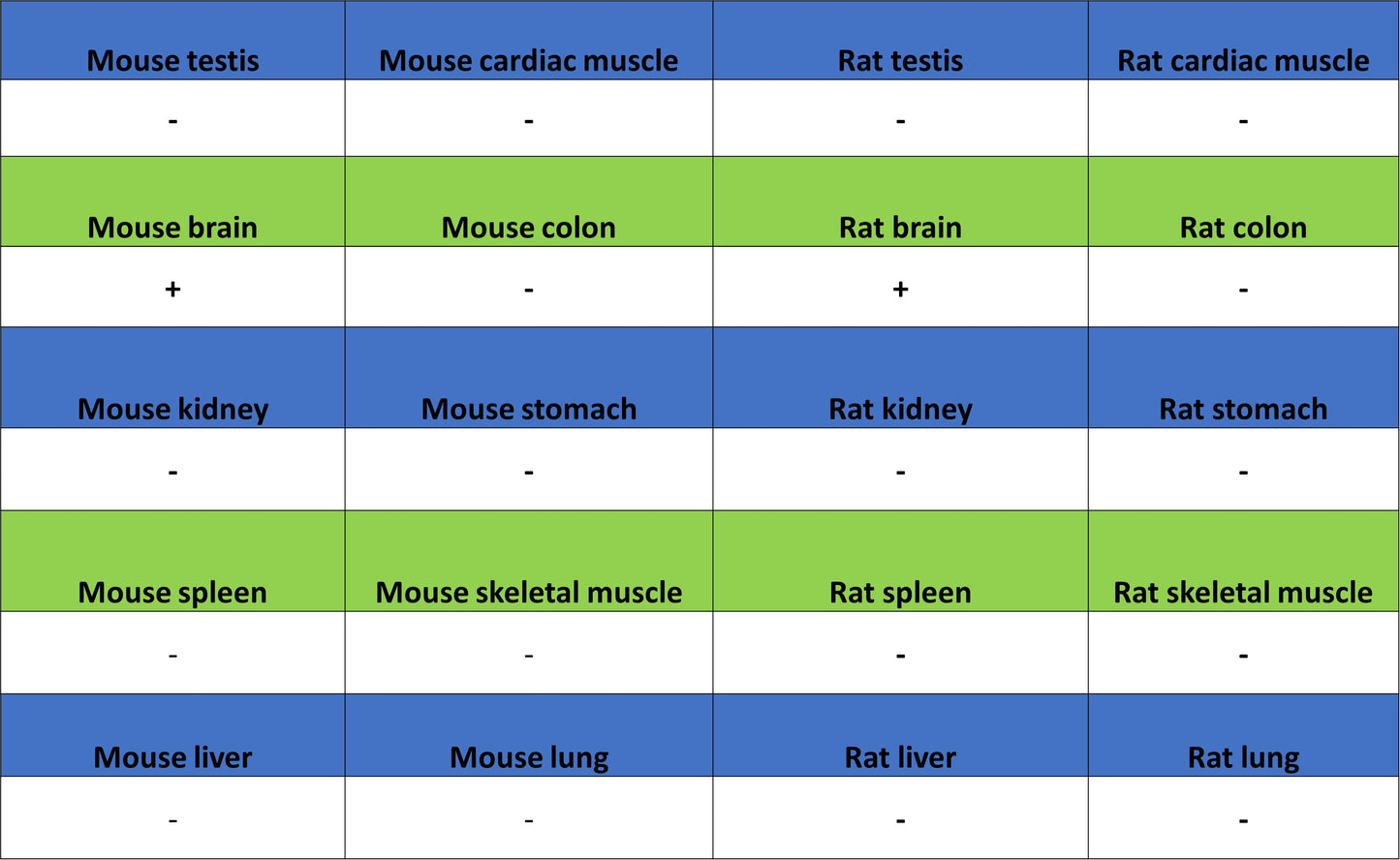
WB result of KCNA2 Recombinant Rabbit mAb
Primary antibody: KCNA2 Recombinant Rabbit mAb at 1/1000 dilution
Lane 1: mouse kidney lysate 20 µg
Lane 2: mouse brain lysate 20 µg
Negative control: mouse kidney lysate
Secondary antibody: Goat Anti- rabbit IgG, (H+L), HRP conjugated at 1/10000 dilution
Predicted MW: 57 kDa
Observed MW: 100 kDa
KCNA2 Recombinant Rabbit mAb (S-3939-53)
KCNA2 Recombinant Rabbit mAb (S-3939-53)
Price:
Regular price
$100 USD
Regular price
Sale price
$100 USD
Unit price
per
For shipping services or bulk orders, you may request a quotation.
Secure checkout with

View full details
Product Details
Product Details
Product Specification
| Host | Rabbit |
| Antigen | KCNA2 |
| Synonyms | Potassium voltage-gated channel subfamily A member 2; MK2; Voltage-gated potassium channel subunit Kv1.2; Kcna2 |
| Immunogen | Synthetic Peptide |
| Location | Cell membrane, Synapse |
| Accession | P63141 |
| Clone Number | S-3939-53 |
| Antibody Type | Recombinant mAb |
| Isotype | IgG |
| Application | WB, IHC-P, IF |
| Reactivity | Hu, Ms, Rt |
| Positive Sample | Mouse brain, rat brain |
| Purification | Protein A |
| Concentration | 0.25 mg/ml |
| Conjugation | Unconjugated |
| Physical Appearance | Liquid |
| Storage Buffer | PBS, 40% Glycerol, 0.05% BSA, 0.03% Proclin 300 |
| Stability & Storage | 12 months from date of receipt / reconstitution, -20 °C as supplied |
Dilution
| application | dilution | species |
| WB | 1:500-1:1000 | Ms, Rt |
| IHC-P | 1:1000-1:2000 | Hu, Ms, Rt |
| IF | 1:500 | Ms, Rt |
Background
KCNA2, also known as Kv1.2, is a voltage-gated potassium channel alpha subunit encoded by the KCNA2 gene in humans, playing a pivotal role in regulating neuronal excitability and action potential repolarization. As a member of the Shaker-related subfamily of potassium channels, it typically forms homo- or heterotetrameric complexes with other Kv1 family members, such as Kv1.1 or Kv1.6, to create functional ion channels that facilitate the selective outward flow of potassium ions in response to membrane depolarization. Predominantly expressed in the central and peripheral nervous systems, particularly in axons and nerve terminals, KCNA2 helps control the threshold for action potential initiation, firing frequency, and neurotransmitter release, thereby influencing synaptic transmission and neural circuit stability. Dysfunctions or mutations in KCNA2 have been implicated in various neurological disorders, including episodic ataxia, epilepsy, and neuromyotonia, highlighting its critical importance in maintaining proper electrical signaling in neurons and its potential as a therapeutic target for treating channelopathies.
Picture
Picture
Western Blot
WB result of KCNA2 Recombinant Rabbit mAb
Primary antibody: KCNA2 Recombinant Rabbit mAb at 1/1000 dilution
Lane 1: rat kidney lysate 20 µg
Lane 2: rat brain lysate 20 µg
Negative control: rat kidney lysate
Secondary antibody: Goat Anti- rabbit IgG, (H+L), HRP conjugated at 1/10000 dilution
Predicted MW: 57 kDa
Observed MW: 100 kDa
Immunohistochemistry
IHC shows positive staining in paraffin-embedded human cerebellum. Anti-KCNA2 antibody was used at 1/1000 dilution, followed by a HRP Polymer for Rabbit IgG (ready to use). Counterstained with hematoxylin. Heat mediated antigen retrieval with Tris/EDTA buffer pH9.0 was performed before commencing with IHC staining protocol.
IHC shows positive staining in paraffin-embedded mouse cerebellum. Anti-KCNA2 antibody was used at 1/1000 dilution, followed by a HRP Polymer for Rabbit IgG (ready to use). Counterstained with hematoxylin. Heat mediated antigen retrieval with Tris/EDTA buffer pH9.0 was performed before commencing with IHC staining protocol.
IHC shows positive staining in paraffin-embedded rat cerebellum. Anti-KCNA2 antibody was used at 1/1000 dilution, followed by a HRP Polymer for Rabbit IgG (ready to use). Counterstained with hematoxylin. Heat mediated antigen retrieval with Tris/EDTA buffer pH9.0 was performed before commencing with IHC staining protocol.
Immunofluorescence
IF shows positive staining in paraffin-embedded mouse cerebellum. Anti- KCNA2 antibody was used at 1/500 dilution (Green) and incubated overnight at 4°C. Goat polyclonal Antibody to Rabbit IgG - H&L (Alexa Fluor® 488) was used as secondary antibody at 1/1000 dilution. Counterstained with DAPI (Blue). Heat mediated antigen retrieval with EDTA buffer pH9.0 was performed before commencing with IF staining protocol.
IF shows positive staining in paraffin-embedded rat cerebellum. Anti- KCNA2 antibody was used at 1/500 dilution (Green) and incubated overnight at 4°C. Goat polyclonal Antibody to Rabbit IgG - H&L (Alexa Fluor® 488) was used as secondary antibody at 1/1000 dilution. Counterstained with DAPI (Blue). Heat mediated antigen retrieval with EDTA buffer pH9.0 was performed before commencing with IF staining protocol.