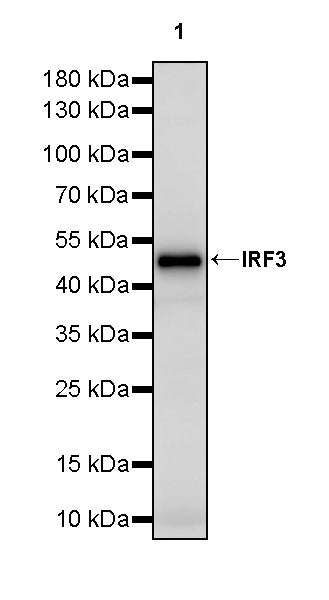
WB result of IRF3 Rabbit pAb
Primary antibody: IRF3 Rabbit pAb at 1/1000 dilution
Lane 1: NIH/3T3 whole cell lysate 20 µg
Lane 2: RAW264.7 whole cell lysate 20 µg
Secondary antibody: Goat Anti- rabbit IgG, (H+L), HRP conjugated at 1/10000 dilution
Predicted MW: 47 kDa
Observed MW: 40 kDa
IRF3 Rabbit Polyclonal Antibody
IRF3 Rabbit Polyclonal Antibody
Price:
Regular price
$70 USD
Regular price
Sale price
$70 USD
Unit price
per
For shipping services or bulk orders, you may request a quotation.
Secure checkout with

View full details
Product Details
Product Details
Product Specification
| Host | Rabbit |
| Antigen | IRF3 |
| Synonyms | Interferon regulatory factor 3; Irf3 |
| Immunogen | Synthetic Peptide |
| Location | Cytoplasm, Nucleus |
| Accession | P70671 |
| Antibody Type | Polyclonal antibody |
| Isotype | IgG |
| Application | WB |
| Reactivity | Ms, Rt |
| Positive Sample | NIH/3T3, RAW264.7, mouse spleen, mouse testis, rat spleen |
| Purification | Immunogen Affinity |
| Concentration | 2 mg/ml |
| Conjugation | Unconjugated |
| Physical Appearance | Liquid |
| Storage Buffer | PBS, 40% Glycerol, 0.05% BSA, 0.03% Proclin 300 |
| Stability & Storage | 12 months from date of receipt / reconstitution, -20 °C as supplied |
Dilution
| application | dilution | species |
| WB | 1:1000 | Ms, Rt |
Background
Interferon Regulatory Factor 3 (IRF3) is a pivotal transcription factor within the innate immune system that serves as a master regulator of type I interferon (IFN-I) production in response to viral and bacterial infections. Under basal conditions, IRF3 resides in the cytoplasm in an inactive, auto-inhibited state, but upon recognition of pathogen-associated molecular patterns (PAMPs) by pattern recognition receptors such as TLR3, TLR4, or cytosolic sensors like RIG-I and MDA5, it undergoes phosphorylation at multiple serine and threonine residues in its C-terminal domain by upstream kinases including TBK1 and IKKε. This phosphorylation triggers a conformational change that promotes IRF3 dimerization, nuclear translocation, and subsequent binding to interferon-stimulated response elements (ISREs) in the promoters of target genes, thereby initiating the transcription of critical antiviral cytokines like IFN-β and various interferon-stimulated genes (ISGs) that establish an antiviral state; furthermore, IRF3 activity is tightly controlled through negative feedback mechanisms involving ubiquitination and proteasomal degradation to prevent excessive inflammation, highlighting its essential role as a central node in host defense signaling pathways.
Picture
Picture
Western Blot
WB result of IRF3 Rabbit pAb
Primary antibody: IRF3 Rabbit pAb at 1/1000 dilution
Lane 1: mouse skeletal muscle lysate 20 µg
Lane 2: mouse spleen lysate 20 µg
Lane 3: mouse testis lysate 20 µg
Negative control: mouse skeletal muscle lysate
Secondary antibody: Goat Anti- rabbit IgG, (H+L), HRP conjugated at 1/10000 dilution
Predicted MW: 47 kDa
Observed MW: 40 kDa
WB result of IRF3 Rabbit pAb
Primary antibody: IRF3 Rabbit pAb at 1/1000 dilution
Lane 1: rat spleen lysate 20 µg
Secondary antibody: Goat Anti- rabbit IgG, (H+L), HRP conjugated at 1/10000 dilution
Predicted MW: 47 kDa
Observed MW: 47 kDa