WB result of IRF-5 Recombinant Rabbit mAb
Primary antibody: IRF-5 Recombinant Rabbit mAb at 1/1000 dilution
Lane 1: Jurkat whole cell lysate 20 µg
Lane 2: THP-1 whole cell lysate 20 µg
Negative control: Jurkat whole cell lysate
Secondary antibody: Goat Anti- rabbit IgG, (H+L), HRP conjugated at 1/10000 dilution
Predicted MW: 56 kDa
Observed MW: 60 kDa
IRF-5 Recombinant Rabbit mAb (S-3056-28)
IRF-5 Recombinant Rabbit mAb (S-3056-28)
Price:
Regular price
$100 USD
Regular price
Sale price
$100 USD
Unit price
per
For shipping services or bulk orders, you may request a quotation.
Secure checkout with

View full details
Product Details
Product Details
Product Specification
| Host | Rabbit |
| Antigen | IRF-5 |
| Synonyms | Interferon regulatory factor 5; IRF5 |
| Immunogen | Recombinant Protein |
| Location | Cytoplasm, Nucleus |
| Accession | Q13568 |
| Clone Number | S-3056-28 |
| Antibody Type | Recombinant mAb |
| Isotype | IgG |
| Application | WB, IHC-P |
| Reactivity | Hu |
| Positive Sample | THP-1 |
| Purification | Protein A |
| Concentration | 0.5 mg/ml |
| Conjugation | Unconjugated |
| Physical Appearance | Liquid |
| Storage Buffer | PBS, 40% Glycerol, 0.05% BSA, 0.03% Proclin 300 |
| Stability & Storage | 12 months from date of receipt / reconstitution, -20 °C as supplied |
Dilution
| application | dilution | species |
| WB | 1:1000 | Hu |
| IHC-P | 1:250 | Hu |
Background
IRF-5 (Interferon Regulatory Factor 5) is a 54 kDa transcription factor that contains an N-terminal DNA-binding domain with a characteristic tryptophan pentad repeat, a C-terminal IRF-association domain essential for homo- and heterodimerization with other IRFs or cofactors, and multiple phosphorylation and ubiquitination sites that regulate its stability and subcellular localization; upon TLR7/8 or TLR9 signaling in myeloid cells, or RLR signaling in fibroblasts, IRF-5 is phosphorylated by IKKα/β and TBK1, leading to its nuclear translocation where it binds to IFN-stimulated response elements (ISREs) and initiates transcription of type I interferons (especially IFN-α subtypes), pro-inflammatory cytokines such as IL-6, TNF-α, and IL-12p35, and genes involved in antiviral and antitumor responses, thereby positioning IRF-5 as a central node in the innate immune response that links pathogen sensing to polarization of macrophages toward the M1 phenotype and differentiation of Th1 cells, while genetic variants and altered expression of IRF-5 have been associated with autoimmune diseases including systemic lupus erythematosus, rheumatoid arthritis, and multiple sclerosis, and with prognosis in certain cancers, making IRF-5 a potential therapeutic target for modulating immune balance.
Picture
Picture
Western Blot
Immunohistochemistry
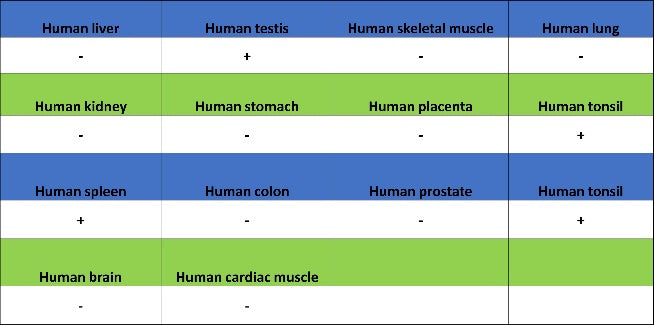
IHC shows positive staining in paraffin-embedded human tonsil. Anti- IRF-5 antibody was used at 1/250 dilution, followed by a HRP Polymer for Mouse & Rabbit IgG (ready to use). Counterstained with hematoxylin. Heat mediated antigen retrieval with Tris/EDTA buffer pH9.0 was performed before commencing with IHC staining protocol.
IHC shows positive staining in paraffin-embedded human endometrial cancer. Anti- IRF-5 antibody was used at 1/250 dilution, followed by a HRP Polymer for Mouse & Rabbit IgG (ready to use). Counterstained with hematoxylin. Heat mediated antigen retrieval with Tris/EDTA buffer pH9.0 was performed before commencing with IHC staining protocol.
IHC shows positive staining in paraffin-embedded human colon cancer. Anti- IRF-5 antibody was used at 1/250 dilution, followed by a HRP Polymer for Mouse & Rabbit IgG (ready to use). Counterstained with hematoxylin. Heat mediated antigen retrieval with Tris/EDTA buffer pH9.0 was performed before commencing with IHC staining protocol.