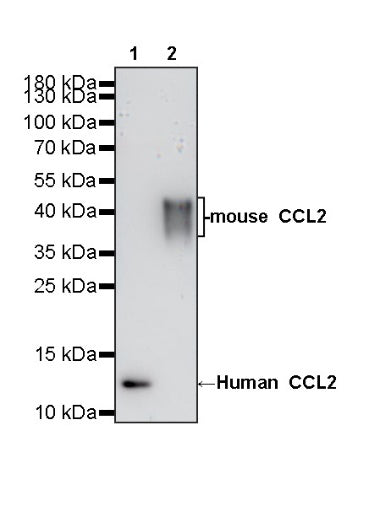
WB result of Invivo Anti-Mouse/Human/Rat CCL2 Recombinant mAb
Primary antibody: Invivo Anti-Mouse/Human/Rat CCL2 Recombinant mAb at 1/1000 dilution
Lane 1: MCP-1/CCL2 Protein, Human 1 µg
Lane 2: CCL2/JE/MCP-1 Protein, mouse 1 µg
Secondary antibody: Goat Anti-Armenian hamster IgG (H+L), HRP conjugated at 1/10000 dilution
Predicted MW: 8.7, 15.5 kDa
Observed MW: 13, 36-41 kDa
Invivo Anti-Mouse/Human/Rat CCL2 Recombinant mAb
Invivo Anti-Mouse/Human/Rat CCL2 Recombinant mAb
Price:
Regular price
$175 USD
Regular price
Sale price
$175 USD
Unit price
per
For shipping services or bulk orders, you may request a quotation.
Secure checkout with

View full details
Product Details
Product Details
Product Specification
| Host | Armenian hamster |
| Antigen | CCL2 |
| Location | Secreted |
| Accession | P13500、P10148、P14844 |
| Clone Number | S-5572 |
| Antibody Type | Recombinant mAb |
| Isotype | Armenian hamster IgG |
| Isotype Control | S0B7062 |
| Application | ELISA, WB, in vivo neutralization |
| Reactivity | Hu, Ms, Rt |
| Purification | Protein A |
| Concentration | 5 mg/ml |
| Purity | >95% (Determined by SDS-PAGE) |
| Endotoxin | <1EU/mg |
| Conjugation | Unconjugated |
| Physical Appearance | Liquid |
| Storage Buffer | PBS pH7.4, containing no preservative |
| Stability & Storage | 2 to 8 °C for 2 weeks under sterile conditions; |
Dilution
| application | dilution | species |
| WB | 1:1000 | Hu, Ms, Rt |
Background
CCL2, or C-C motif chemokine ligand 2, also known as monocyte chemoattractant protein-1 (MCP-1), is a small chemokine molecule composed of 76 amino acids with a molecular weight of approximately 13 kDa, and its gene is located on human chromosome 17. As a classic pro-inflammatory chemokine, CCL2 is primarily secreted by monocytes, macrophages, and various stromal cells (such as fibroblasts and endothelial cells), and its expression can be upregulated by inflammatory factors including TNF-α and IL-1β. Its most important physiological function is to bind to its primary receptor, the G protein-coupled receptor CCR2, thereby chemoattracting and recruiting immune cells such as monocytes, T cells, and natural killer cells to sites of inflammation or injury, participating in immune surveillance and tissue repair. However, within the tumor microenvironment, the CCL2/CCR2 axis often undergoes a "betrayal" of function: CCL2 secreted by tumor cells and stromal cells massively recruits monocytes and polarizes them into M2-type tumor-associated macrophages (TAMs). These TAMs subsequently create a favorable "soil" for tumor growth, invasion, and metastasis by suppressing anti-tumor immune responses (such as those mediated by CD8⁺ T cells), promoting angiogenesis, and inducing epithelial-mesenchymal transition (EMT) in tumor cells. Consequently, high expression of CCL2 in various malignancies, including hepatocellular carcinoma, prostate cancer, and breast cancer, is closely associated with poor patient prognosis, making it a promising therapeutic target and biomarker.
Picture
Picture
Western Blot