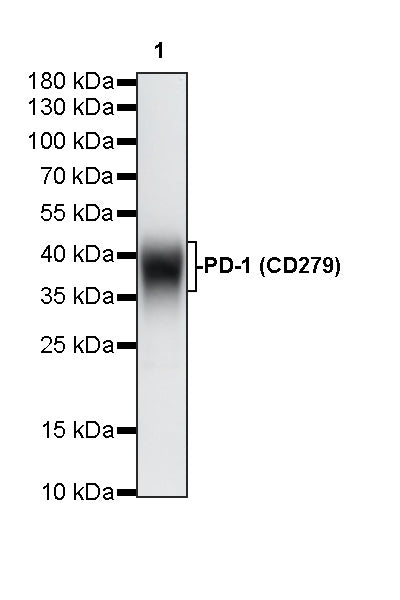
WB result of Invivo Anti-Mouse PD-1 (CD279) Recombinant mAb
Primary antibody: Invivo Anti-Mouse PD-1 (CD279) Recombinant mAb at 1/1000 dilution
Lane 1: PD-1 His Tag Protein, Mouse lysate 4 µg
Secondary antibody: Goat Anti-Armenian hamster IgG (H+L), HRP conjugated at 1/10000 dilution
Predicted MW: 32 kDa
Observed MW: 37-41 kDa
Invivo Anti-Mouse PD-1 (CD279) Recombinant mAb
Invivo Anti-Mouse PD-1 (CD279) Recombinant mAb
Price:
Regular price
$175 USD
Regular price
Sale price
$175 USD
Unit price
per
For shipping services or bulk orders, you may request a quotation.
Secure checkout with

View full details
Product Details
Product Details
Product Specification
| Host | Armenian hamster |
| Antigen | PD-1 (CD279) |
| Location | Cell membrane |
| Accession | Q02242 |
| Clone Number | S-5682 |
| Antibody Type | Recombinant mAb |
| Isotype | Armenian hamster IgG |
| Isotype Control | S0B7062 |
| Application | WB, in vivo blocking |
| Reactivity | Ms |
| Purification | Protein A |
| Concentration | 5 mg/ml |
| Purity | >95% (Determined by SDS-PAGE) |
| Endotoxin | <1EU/mg |
| Conjugation | Unconjugated |
| Physical Appearance | Liquid |
| Storage Buffer | PBS pH7.4, containing no preservative |
| Stability & Storage | 2 to 8 °C for 2 weeks under sterile conditions; |
Dilution
| application | dilution | species |
| WB | 1:1000 | Ms |
Background
Programmed cell death protein 1 (PD-1), also known as CD279, is a type I transmembrane protein and a member of the CD28 immunoglobulin superfamily, encoded by the _PDCD1_ gene. It is primarily expressed on the surface of various immune cells, including T cells, B cells, macrophages, dendritic cells, and natural killer cells. PD-1 plays a crucial role in regulating immune responses by binding to its ligands, PD-L1 (B7-H1) and PD-L2 (B7-DC), which are expressed on antigen-presenting cells and tumor cells. When PD-1 interacts with its ligands, it triggers inhibitory signals that downregulate T cell activity, preventing excessive immune responses and promoting self-tolerance. However, this pathway can also be exploited by cancer cells to evade immune surveillance, leading to tumor progression. As a result, PD-1 has become a key target in cancer immunotherapy, with several anti-PD-1 antibodies approved for treating various cancers, achieving significant and durable efficacy in some patients.
Picture
Picture
Western Blot