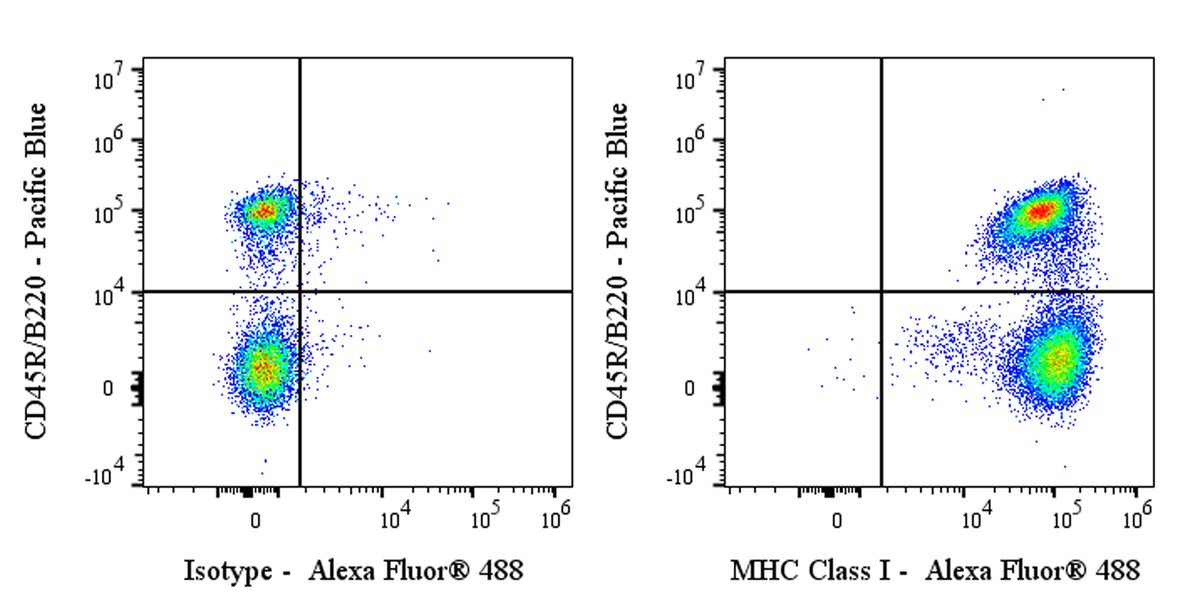
Flow cytometric analysis of C57BL/6 mouse splenocytes labeled with Anti-Mouse MHC Class I (H-2) antibody at 1/500 dilution (1 μg) / (right panel) compared with a Rat IgG2a, κ Isotype Control / (left panel). Goat Anti-Rat IgG Alexa Fluor® 488 was used as the secondary antibody. Then cells were stained with SDT CD45R/B220 - Pacific Blue antibody (S0B5627) separately. Flow cytometry and data analysis were performed using Agilent NovoCyte Quanteon and FlowJo™ software.
Invivo Anti-Mouse MHC Class I (H-2) Recombinant mAb
Invivo Anti-Mouse MHC Class I (H-2) Recombinant mAb
Price:
Regular price
$175 USD
Regular price
Sale price
$175 USD
Unit price
per
For shipping services or bulk orders, you may request a quotation.
Secure checkout with

View full details
Product Details
Product Details
Product Specification
| Host | Rat |
| Antigen | MHC Class I (H-2) |
| Location | Cell membrane |
| Clone Number | S-5545 |
| Antibody Type | Rat mAb |
| Isotype | Rat IgG2a, κ |
| Isotype Control | S0B0932 |
| Application | FCM, in vitro blocking |
| Reactivity | Ms |
| Positive Sample | C57BL/6 mouse splenocytes |
| Purification | Protein G |
| Concentration | 5 mg/ml |
| Purity | >95% (Determined by SDS-PAGE) |
| Endotoxin | <1EU/mg |
| Conjugation | Unconjugated |
| Physical Appearance | Liquid |
| Storage Buffer | PBS pH7.4, containing no preservative |
| Stability & Storage | 2 to 8 °C for 2 weeks under sterile conditions; |
Dilution
| application | dilution | species |
| FCM | 1:500 | Ms |
Background
Mouse MHC Class I, known as H-2 class I molecules, are transmembrane glycoproteins encoded by classical loci (such as H-2K, H-2D, and H-2L) within the H-2 complex on mouse chromosome 17, and are expressed on the surface of virtually all nucleated cells. Their core structure consists of a highly polymorphic heavy chain (α chain, containing α1, α2, and α3 domains) non-covalently associated with a β2-microglobulin light chain (encoded by chromosome 2), with the α1 and α2 domains together forming a groove that binds and presents endogenous antigens (such as viral proteins and tumor antigens) as peptides. Functionally, H-2 class I molecules present antigenic peptides on the cell surface for recognition by the T-cell receptors (TCRs) of CD8⁺ cytotoxic T lymphocytes (CTLs), representing a core mechanism for the clearance of infected or tumor cells, and they exhibit the classic phenomenon of MHC restriction. In addition to these highly polymorphic classical molecules, the mouse H-2 complex also contains non-classical class I molecules (such as Qa-1) located in the Q, T, and M regions. Although structurally similar, these molecules are less polymorphic and play more specialized roles in immune regulation, reproductive development, and even intestinal immunity.
Picture
Picture
FC