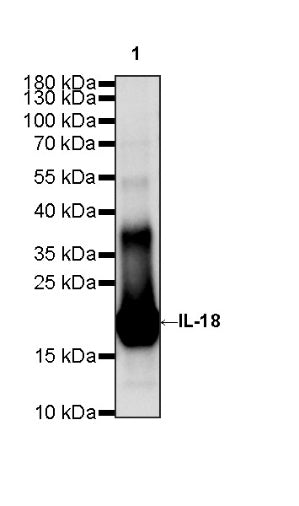
WB result of Invivo anti-Mouse IL-18 Recombinant mAb
Primary antibody: Invivo anti-Mouse IL-18 Recombinant mAb at 1/1000 dilution
Lane 1: IL-18 Protein, Mouse lysate 1 µg
Secondary antibody: Goat Anti-Rat IgG (H+L), HRP conjugated at 1/10000 dilution
Predicted MW: 22 kDa
Observed MW: 18 kDa
Invivo anti-Mouse IL-18 Recombinant mAb
Invivo anti-Mouse IL-18 Recombinant mAb
Price:
Regular price
$175 USD
Regular price
Sale price
$175 USD
Unit price
per
For shipping services or bulk orders, you may request a quotation.
Secure checkout with

View full details
Product Details
Product Details
Product Specification
| Host | Rat |
| Antigen | IL-18 |
| Location | Cytoplasm, Secreted |
| Accession | P70380 |
| Clone Number | S-5576 |
| Antibody Type | Rat mAb |
| Isotype | Rat IgG2a, κ |
| Isotype Control | S0B0932 |
| Application | ELISA, WB, in vivo neutralization, in vitro neutralization |
| Reactivity | Ms |
| Purification | Protein G |
| Concentration | 5 mg/ml |
| Purity | >95% (Determined by SDS-PAGE) |
| Endotoxin | <1EU/mg |
| Conjugation | Unconjugated |
| Physical Appearance | Liquid |
| Storage Buffer | PBS pH7.4, containing no preservative |
| Stability & Storage | 2 to 8 °C for 2 weeks under sterile conditions; |
Dilution
| application | dilution | species |
| WB | 1:1000 | Ms |
Background
IL-18, or interleukin-18, is a pleiotropic pro-inflammatory cytokine belonging to the IL-1 family, originally termed "interferon-γ-inducing factor." It is encoded by the IL18 gene on human chromosome 11 and is widely expressed in various cells including macrophages, dendritic cells, and epithelial cells. It is synthesized as an inactive precursor (pro-IL-18) and requires cleavage by inflammatory caspases (primarily caspase-1 or caspase-4/5) to be secreted extracellularly and exert its functions. In immune regulation, IL-18 possesses a unique dual role: when synergizing with IL-12, it strongly induces CD4⁺ Th1 cells and natural killer cells to produce IFN-γ, thereby enhancing immune responses against intracellular pathogens (such as viruses and Listeria) as well as anti-tumor immunity. However, in microenvironments lacking IL-12, IL-18 instead promotes Th2 cell polarization, contributing to the progression of allergic and inflammatory diseases. Furthermore, IL-18 can activate NF-κB and MAPK signaling pathways, promoting the expression of various adhesion molecules and chemokines, thereby further amplifying inflammatory responses. In terms of pathological relevance, aberrant elevation of IL-18 has been confirmed to be closely associated with numerous autoimmune diseases (such as rheumatoid arthritis and inflammatory bowel disease), metabolic syndrome, and cardiovascular diseases. In tumor immunity, IL-18 exhibits a "double-edged sword" effect—on one hand, it can exert anti-tumor activity by activating NK and T cells; on the other hand, it may promote an immunosuppressive microenvironment by inducing myeloid-derived suppressor cells (MDSCs) or polarizing tumor-associated macrophages. Based on its prominent biological functions, drugs including recombinant IL-18 protein and IL-18 binding protein (IL-18BP) inhibitors have entered multiple clinical trials for the treatment of cancers, autoimmune diseases, and hemophagocytic lymphohistiocytosis (HLH). However, precisely regulating its dual activities in vivo remains one of the core challenges in translational medicine.
Picture
Picture
Western Blot