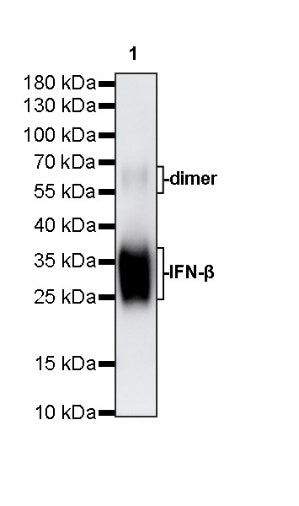
WB result of Invivo Anti-Mouse IFN-β Recombinant mAb
Primary antibody: Invivo Anti-Mouse IFN-β Recombinant mAb at 1/1000 dilution
Lane 1: IFN-β Protein, Mouse 1 µg
Secondary antibody: Goat Anti-Armenian hamster IgG (H+L), HRP conjugated at 1/10000 dilution
Predicted MW: 46 kDa
Observed MW: 25-38 kDa
Invivo Anti-Mouse IFN-β Recombinant mAb
Invivo Anti-Mouse IFN-β Recombinant mAb
Price:
Regular price
$175 USD
Regular price
Sale price
$175 USD
Unit price
per
For shipping services or bulk orders, you may request a quotation.
Secure checkout with

View full details
Product Details
Product Details
Product Specification
| Host | Armenian hamster |
| Antigen | IFN-β |
| Location | Secreted |
| Accession | P01575 |
| Clone Number | S-5238 |
| Antibody Type | Recombinant mAb |
| Isotype | Armenian hamster IgG |
| Isotype Control | S0B7062 |
| Application | ELISA, WB, in vivo neutralization, in vitro neutralization |
| Reactivity | Ms |
| Purification | Protein G |
| Concentration | 5 mg/ml |
| Purity | >95% (Determined by SDS-PAGE) |
| Endotoxin | <1EU/mg |
| Conjugation | Unconjugated |
| Physical Appearance | Liquid |
| Storage Buffer | PBS pH7.4, containing no preservative |
| Stability & Storage | 2 to 8 °C for 2 weeks under sterile conditions; |
Dilution
| application | dilution | species |
| WB | 1:1000 | Ms |
Background
IFN-β, or interferon-beta, is a pleiotropic cytokine belonging to the type I interferon family, encoded by the IFNB1 gene on human chromosome 9 and primarily induced by various cells—such as fibroblasts and plasmacytoid dendritic cells—upon viral or bacterial infection. Its core function serves as the first line of innate immunity: upon binding to its cell-surface heterodimeric receptor (composed of IFNAR1 and IFNAR2 subunits), IFN-β activates the JAK-STAT signaling pathway, which in turn induces the expression of hundreds of interferon-stimulated genes (ISGs). The proteins encoded by these genes exert broad-spectrum antiviral effects (e.g., blocking viral replication, degrading viral RNA), inhibit cell proliferation, and modulate immune responses. Beyond its critical role in antiviral infection, IFN-β also possesses important immunomodulatory functions—it promotes the maturation and activation of dendritic cells and T cells, enhances natural killer cell cytotoxicity, while simultaneously restraining excessive inflammatory responses through mechanisms such as regulating Treg cells, thereby exerting a bidirectional regulatory role in immune homeostasis. Based on these properties, recombinant human IFN-β has been widely applied in clinical practice, with its most notable indication being multiple sclerosis, where it delays disease progression through anti-inflammatory and neuroprotective effects. Additionally, IFN-β has been explored in the treatment of certain solid tumors, such as melanoma. However, its clinical use is constrained by significant side effects (e.g., flu-like symptoms, myelosuppression) and potential resistance mechanisms within the tumor microenvironment, prompting ongoing research into combination therapies and novel delivery strategies to optimize its therapeutic efficacy.
Picture
Picture
Western Blot