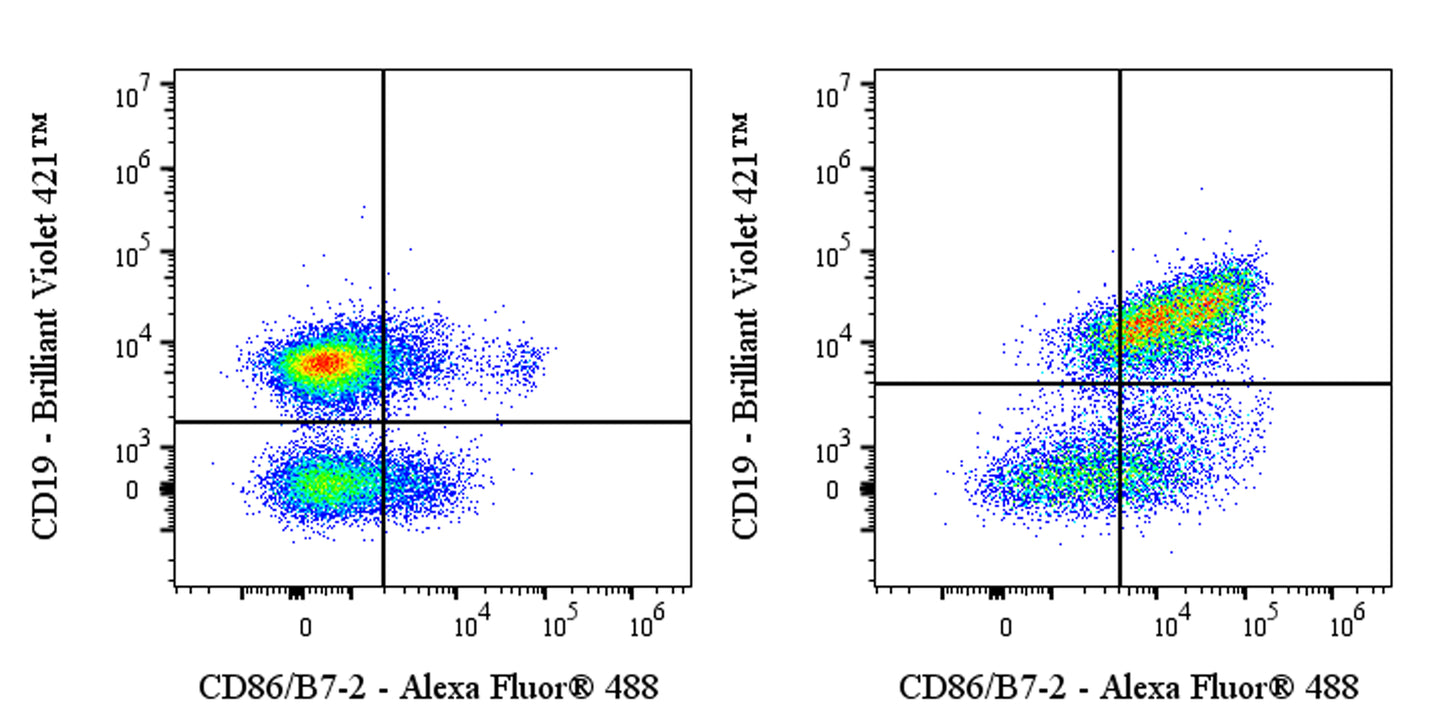
Flow cytometric analysis of CD86/B7-2 expression in BALB/c mouse splenocytes. Mouse splenocytes were treated with 500ng/ml LPS for 3 days (right panel) or untreatred (left panel) and labeled with CD86/B7-2 antibody at 1/500 dilution (1 μg). Goat Anti-Rat IgG Alexa Fluor® 488 was used as the secondary antibody. Then cells were stained with CD19 - Brilliant Violet 421™ antibody separately. Flow cytometry and data analysis were performed using Agilent NovoCyte Quanteon and FlowJo™ software.
Invivo anti-Mouse CD86/B7-2 Recombinant mAb
Invivo anti-Mouse CD86/B7-2 Recombinant mAb
Price:
Regular price
$175 USD
Regular price
Sale price
$175 USD
Unit price
per
For shipping services or bulk orders, you may request a quotation.
Secure checkout with

View full details
Product Details
Product Details
Product Specification
| Host | Rat |
| Antigen | CD86/B7-2 |
| Synonyms | T-lymphocyte activation antigen CD86; Activation B7-2 antigen; Early T-cell costimulatory molecule 1 (ETC-1); Cd86 |
| Location | Cell membrane |
| Accession | P42082 |
| Clone Number | GL-1 |
| Antibody Type | Rat mAb |
| Isotype | Rat IgG2a,k |
| Isotype Control | Invivo rat IgG2a isotype control, anti-trinitrophenol |
| Application | FCM, in vivo CD86 blockade |
| Reactivity | Ms |
| Positive Sample | BALB/c mouse splenocytes |
| Purification | Protein G |
| Concentration | 5 mg/ml |
| Purity | >95%(Determined by SDS-PAGE) |
| Endotoxin | <1EU/mg |
| Conjugation | Unconjugated |
| Physical Appearance | Liquid |
| Storage Buffer | PBS pH7.4, containing no preservative |
| Stability & Storage | 2 to 8 °C for 2 weeks under sterile conditions; |
Dilution
| application | dilution | species |
| FCM | 1:500 | Ms |
Background
CD86, also historically referred to as B7-2, is a type I transmembrane protein belonging to the immunoglobulin superfamily that serves as a critical costimulatory molecule primarily expressed on the surface of professional antigen-presenting cells (APCs) such as dendritic cells, macrophages, and B cells. Functioning as a ligand for the CD28 and CTLA-4 (CD152) receptors on T cells, CD86 plays a pivotal role in regulating the adaptive immune response by providing the necessary "second signal" required for naive T cell activation, proliferation, and differentiation upon engagement with CD28, while its interaction with CTLA-4 delivers an inhibitory signal that helps maintain immune tolerance and prevent autoimmunity. Although it shares functional redundancy with its counterpart CD80 (B7-1), CD86 is typically constitutively expressed at low levels and is upregulated more rapidly than CD80 following APC activation, making it the dominant costimulatory molecule during the early phases of immune responses, which underscores its significance as a therapeutic target in various clinical contexts, including cancer immunotherapy, autoimmune diseases, and transplant rejection management.
Picture
Picture
FC