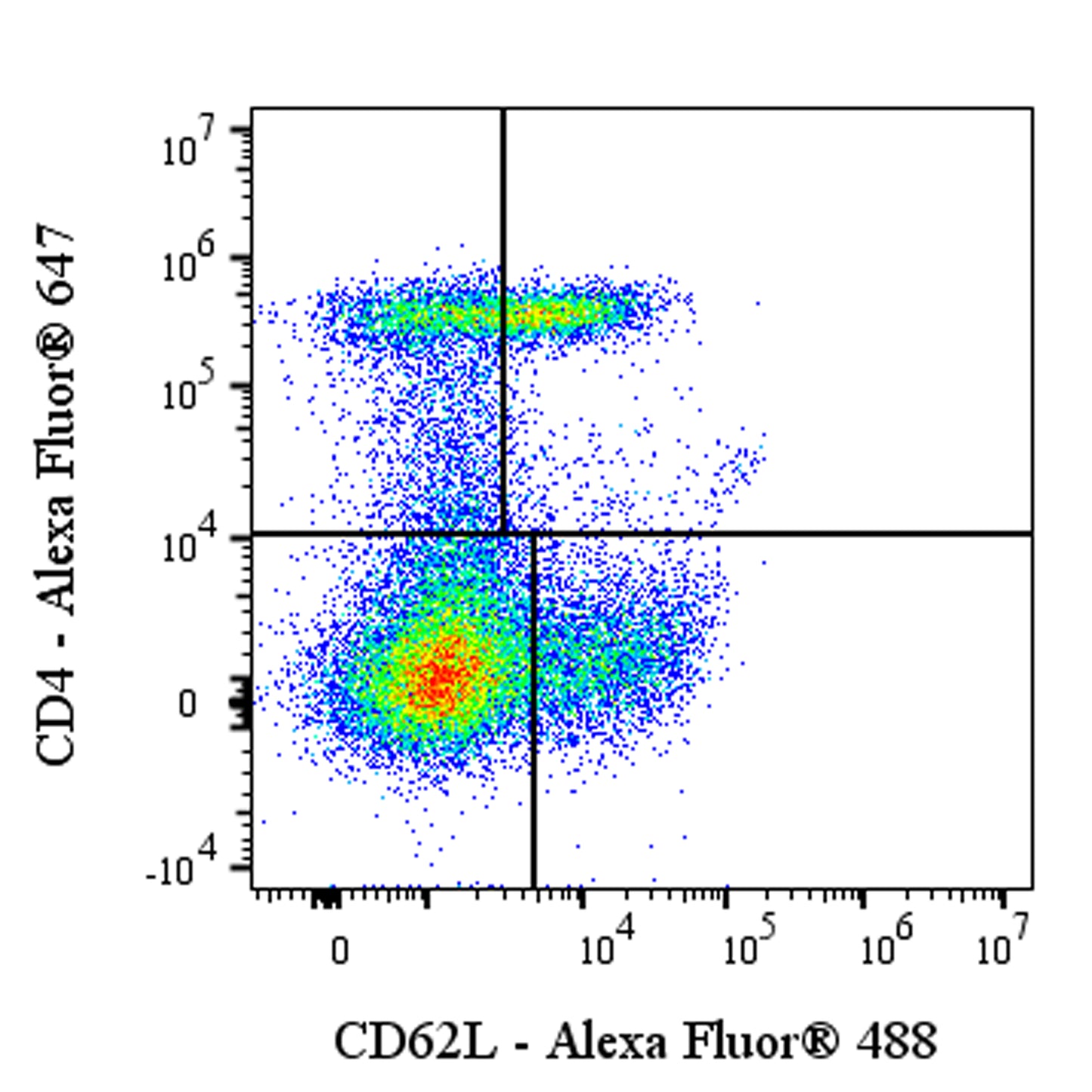
Flow cytometric analysis of C57BL/6 mouse splenocytes labeled with Mouse CD62L antibody at 1/500 dilution (1 μg) / (right panel) compared with a Rat IgG2a, κ Isotype Control / (left panel). Goat Anti-Rat IgG Alexa Fluor® 488 was used as the secondary antibody. Then cells were stained with CD4 - Alexa Fluor® 647 antibody separately. Flow cytometry and data analysis were performed using Agilent NovoCyte Quanteon and FlowJo™ software.
Invivo anti-Mouse CD62L(L-Selectin) Recombinant mAb
Invivo anti-Mouse CD62L(L-Selectin) Recombinant mAb
Price:
Regular price
$175 USD
Regular price
Sale price
$175 USD
Unit price
per
For shipping services or bulk orders, you may request a quotation.
Secure checkout with

View full details
Product Details
Product Details
Product Specification
| Host | Rat |
| Antigen | CD62L |
| Synonyms | L-selectin; CD62 antigen-like family member L; Leukocyte adhesion molecule 1 (LAM-1); Leukocyte-endothelial cell adhesion molecule 1 (LECAM1); Lymph node homing receptor; Lymphocyte antigen 22 (Ly-22); Lymphocyte surface MEL-14 antigen; Lnhr; Ly-22; Ly22; Sell |
| Location | Cell membrane |
| Accession | P18337 |
| Clone Number | MEL-14 |
| Antibody Type | Rat mAb |
| Isotype | Rat IgG2a, κ |
| Isotype Control | Invivo rat IgG2a isotype control, anti-trinitrophenol |
| Application | FCM, in vivo neutralization |
| Reactivity | Ms |
| Positive Sample | C57BL/6 mouse splenocytes |
| Purification | Protein G |
| Concentration | 5 mg/ml |
| Purity | >95% (Determined by SDS-PAGE) |
| Endotoxin | <1EU/mg |
| Conjugation | Unconjugated |
| Physical Appearance | Liquid |
| Storage Buffer | PBS pH7.4, containing no preservative |
| Stability & Storage | 2 to 8 °C for 2 weeks under sterile conditions; |
Dilution
| application | dilution | species |
| FCM | 1:500 | Ms |
Background
CD62L (L-Selectin) is a type-I transmembrane glycoprotein and a member of the selectin family of adhesion molecules, constitutively expressed on most circulating leukocytes, including lymphocytes (except a substantial population of memory T cells), monocytes, and polymorphonuclear cells. It plays a crucial role in the immune response by mediating the rolling adhesion of leukocytes to endothelial cells, which is essential for lymphocyte homing to secondary lymphoid organs and for the migration of monocytes and neutrophils into inflamed tissues. Structurally, L-Selectin consists of an N-terminal C-type lectin domain, an epidermal growth factor (EGF)-like domain, two short consensus repeat (SCR) sequences, a transmembrane region, and a short cytoplasmic tail. The N-terminal lectin domain interacts with specific carbohydrate ligands such as sialyl Lewis X (sLex) to facilitate adhesion. Additionally, L-Selectin is involved in embryonic implantation by aiding the attachment of the blastocyst to the endometrial endothelium.
Picture
Picture
FC