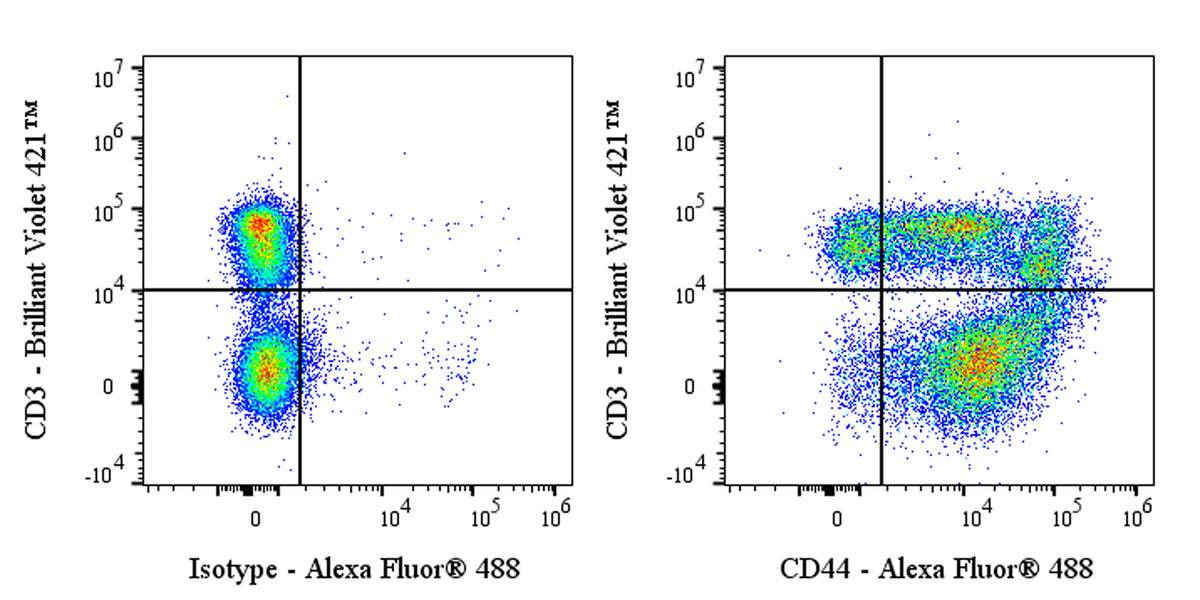
Flow cytometric analysis of C57BL/6 mouse splenocytes labeled with Anti-Mouse CD44 antibody at 1/500 dilution (1 μg) / (right panel) compared with a Rat IgG2a, κ Isotype Control / (left panel). Goat Anti- Rat IgG Alexa Fluor® 488 was used as the secondary antibody. Then cells were stained with CD3 - Brilliant Violet 421™ antibody separately. Flow cytometry and data analysis were performed using Agilent NovoCyte Quanteon and FlowJo™ software.
Invivo Anti-Mouse CD44 Recombinant mAb
Invivo Anti-Mouse CD44 Recombinant mAb
Price:
Regular price
$175 USD
Regular price
Sale price
$175 USD
Unit price
per
For shipping services or bulk orders, you may request a quotation.
Secure checkout with

View full details
Product Details
Product Details
Product Specification
| Host | Rat |
| Antigen | CD44 |
| Location | Cell membrane |
| Accession | P15379 |
| Clone Number | S-5592 |
| Antibody Type | Rat mAb |
| Isotype | Rat IgG2a, κ |
| Isotype Control | S0B0932 |
| Application | FCM, in vivo neutralization, in vitro neutralization |
| Reactivity | Ms |
| Positive Sample | C57BL/6 mouse splenocytes |
| Purification | Protein G |
| Concentration | 5 mg/ml |
| Purity | >95% (Determined by SDS-PAGE) |
| Endotoxin | <1EU/mg |
| Conjugation | Unconjugated |
| Physical Appearance | Liquid |
| Storage Buffer | PBS pH7.4, containing no preservative |
| Stability & Storage | 2 to 8 °C for 2 weeks under sterile conditions; |
Dilution
| application | dilution | species |
| FCM | 1:500 | Ms |
Background
CD44 is a transmembrane glycoprotein that plays crucial roles in various cellular processes. It is a type I transmembrane protein and a member of the cartilage link protein family. The human CD44 gene contains 19 exons and is located on chromosome 11p13. Exons 1–5, 16, 17, and 19 are constant and common to all CD44 isoforms, encoding the standard form of CD44 (CD44s). Variant forms (CD44v) arise from the combination of constant exons with variable exons 7–15 through alternative mRNA splicing. CD44 proteins have a common structure consisting of four major parts: the extracellular hyaluronan-binding domain (HABD), the stem region, the transmembrane segment, and the cytoplasmic region. The HABD confers binding capability to CD44 mainly for hyaluronan (HA), but also for collagen, laminin, and fibronectin. CD44 is involved in cell–cell and cell–matrix adhesion, cell proliferation, migration, hematopoiesis, and lymphocyte activation. It is overexpressed in several cell types, including cancer stem cells, and its variant isoforms are thought to play a role in cancer development and progression.
Picture
Picture
FC