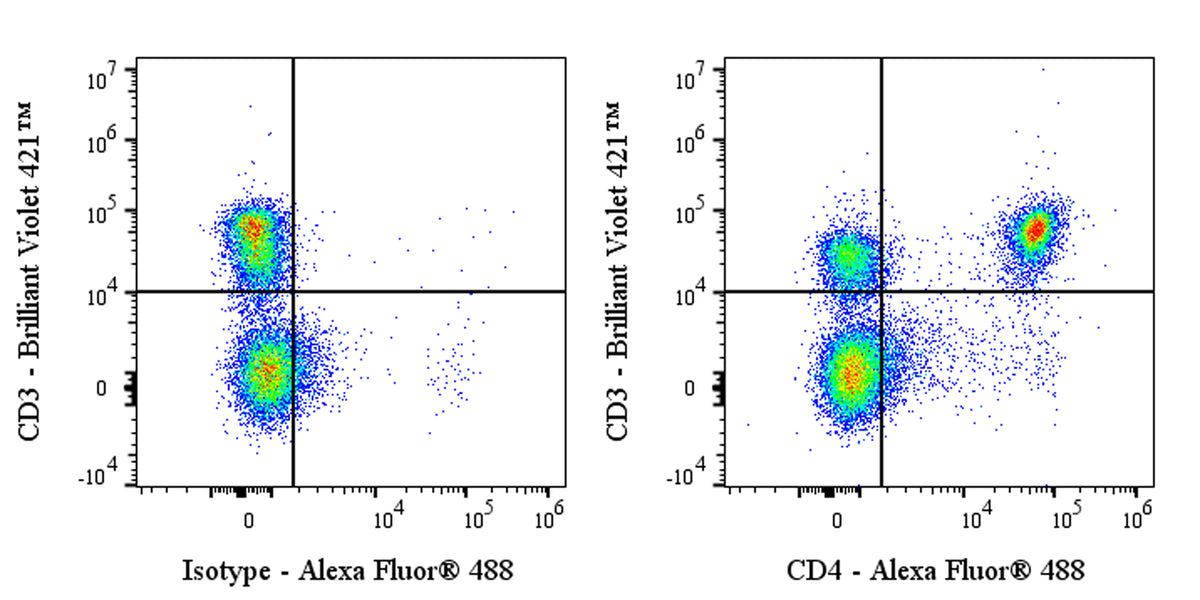
Flow cytometric analysis of C57BL/6 mouse splenocytes labeled with Anti-Mouse CD4 antibody at 1/500 dilution (1 μg) / (right panel) compared with a Rat IgG2a, κ Isotype Control / (left panel). Goat Anti- Rat IgG Alexa Fluor® 488 was used as the secondary antibody. Then cells were stained with CD3 - Brilliant Violet 421™ antibody separately. Flow cytometry and data analysis were performed using Agilent NovoCyte Quanteon and FlowJo™ software.
Invivo Anti-Mouse CD4 Recombinant mAb
Invivo Anti-Mouse CD4 Recombinant mAb
Price:
Regular price
$175 USD
Regular price
Sale price
$175 USD
Unit price
per
For shipping services or bulk orders, you may request a quotation.
Secure checkout with

View full details
Product Details
Product Details
Product Specification
| Host | Rat |
| Antigen | CD4 |
| Location | Cell membrane |
| Accession | P06332 |
| Clone Number | S-5575 |
| Antibody Type | Rat mAb |
| Isotype | Rat IgG2a, κ |
| Isotype Control | S0B0932 |
| Application | FCM, in vivo cell specific depletion |
| Reactivity | Ms |
| Positive Sample | C57BL/6 mouse splenocytes |
| Purification | Protein G |
| Concentration | 5 mg/ml |
| Purity | >95% (Determined by SDS-PAGE) |
| Endotoxin | <1EU/mg |
| Conjugation | Unconjugated |
| Physical Appearance | Liquid |
| Storage Buffer | PBS pH7.4, containing no preservative |
| Stability & Storage | 2 to 8 °C for 2 weeks under sterile conditions; |
Dilution
| application | dilution | species |
| FCM | 1:500 | Ms |
Background
CD4 is a glycoprotein that functions as a co-receptor for the T-cell receptor (TCR) and is primarily expressed on the surface of helper T cells, monocytes, macrophages, and dendritic cells. It is a member of the immunoglobulin superfamily, consisting of four immunoglobulin domains (D1 to D4) that interact with MHC class II molecules on antigen-presenting cells. This interaction, mediated by the D1 domain of CD4, ensures that T cells recognize antigens presented by MHC II. The cytoplasmic tail of CD4 contains motifs that recruit the tyrosine kinase Lck, which amplifies T cell activation signals. Additionally, CD4 is crucial in the immune response, as it helps activate CD4+ T helper cells, which in turn stimulate other immune cells to combat infections. However, CD4 is also the primary receptor for HIV, allowing the virus to enter host T cells and cause immunodeficiency.
Picture
Picture
FC