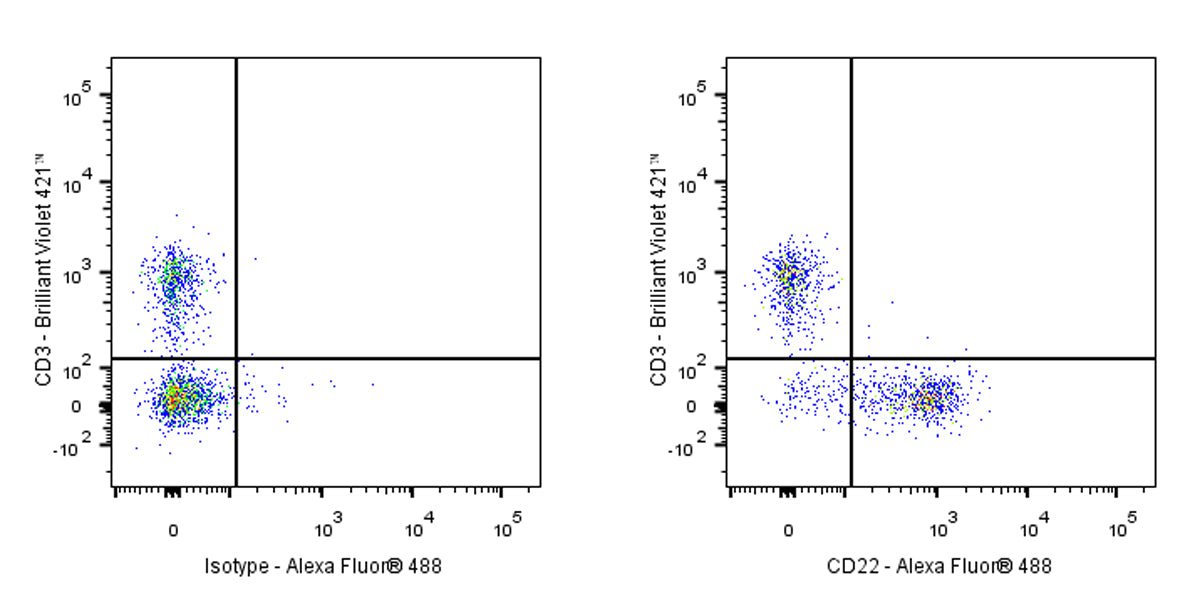
Flow cytometric analysis of BALB/c mouse splenocytes labelling mouse CD22 antibody at 1/500 (1 μg) dilution/ (right panel) compared with a Mouse IgG1, κ Isotype Control / (left panel). Goat Anti-Mouse IgG Alexa Fluor® 488 was used as the secondary antibody. Then cells were stained with CD3 - Brilliant Violet 421™ antibody separately.
Invivo Anti-Mouse CD22 Recombinant mAb
Invivo Anti-Mouse CD22 Recombinant mAb
Price:
Regular price
$175 USD
Regular price
Sale price
$175 USD
Unit price
per
For shipping services or bulk orders, you may request a quotation.
Secure checkout with

View full details
Product Details
Product Details
Product Specification
| Host | Mouse |
| Antigen | CD22 |
| Synonyms | B-cell receptor CD22; B-lymphocyte cell adhesion molecule (BL-CAM); Sialic acid-binding Ig-like lectin 2 (Siglec-2); T-cell surface antigen Leu-14; Lyb-8; Siglec2; Cd22 |
| Location | Cell membrane |
| Accession | P35329 |
| Clone Number | Cy34.1 |
| Antibody Type | Mouse mAb |
| Isotype | Mouse IgG1, κ |
| Isotype Control | Invivo mouse IgG1 isotype control |
| Application | FCM, in vivo cell specific depletion |
| Reactivity | Ms |
| Positive Sample | BALB/c mouse splenocytes |
| Purification | Protein G |
| Concentration | 5 mg/ml |
| Purity | >95%(Determined by SDS-PAGE) |
| Endotoxin | <1EU/mg |
| Conjugation | Unconjugated |
| Physical Appearance | Liquid |
| Storage Buffer | PBS pH7.4 |
| Stability & Storage | 2 to 8 °C for 2 weeks under sterile conditions; |
Dilution
| application | dilution | species |
| FCM | 1:500 | Ms |
Background
CD22, also known as cluster of differentiation 22, is a 140 kDa type I transmembrane glycoprotein and a member of the Siglec (sialic acid-binding immunoglobulin-like lectin) family. It is predominantly expressed on the surface of mature B cells and to a lesser extent on some immature B cells. The extracellular domain of CD22 consists of seven immunoglobulin-like domains, while its cytoplasmic tail contains conserved tyrosine motifs, including immunoreceptor tyrosine-based inhibitory motifs (ITIMs), which play a crucial role in inhibiting B cell receptor (BCR) signaling. CD22 functions as a negative regulator of B cell activation, helping to prevent overactivation of the immune system and the development of autoimmune diseases. Additionally, it is involved in B cell trafficking and maintaining peripheral B cell tolerance. CD22's interaction with sialic acid-containing molecules on various cell types allows it to modulate B cell responses and maintain immune homeostasis.
Picture
Picture
FC