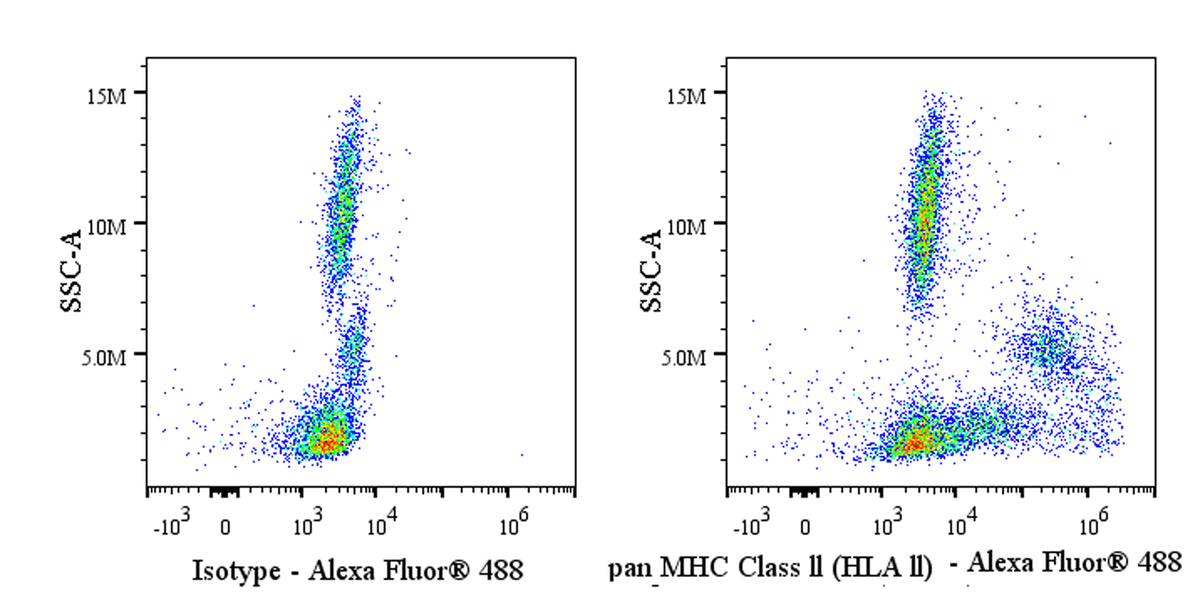
Flow cytometric analysis of human peripheral blood cells labeled with Anti-Human pan MHC Class II (HLA II) antibody at 1/500 dilution (1 μg) / (right panel) compared with a Mouse IgG1, κ Isotype Control / (left panel). Goat Anti-Mouse IgG Alexa Fluor® 488 was used as the secondary antibody. Flow cytometry and data analysis were performed using Agilent NovoCyte Quanteon and FlowJo™ software.
Invivo Anti-Human pan MHC Class II (HLA II) Recombinant mAb
Invivo Anti-Human pan MHC Class II (HLA II) Recombinant mAb
Price:
Regular price
$175 USD
Regular price
Sale price
$175 USD
Unit price
per
For shipping services or bulk orders, you may request a quotation.
Secure checkout with

View full details
Product Details
Product Details
Product Specification
| Host | Mouse |
| Antigen | pan MHC Class II (HLA II) |
| Synonyms | HLA class II histocompatibility antigen, DR alpha chain; MHC class II antigen DRA; HLA-DRA1; HLA-DRA; HLA class II histocompatibility antigen, DP beta 1 chain; HLA class II histocompatibility antigen, DP(W4) beta chain; MHC class II antigen DPB1; HLA-DPB1; HLA-DP1B; HLA class II histocompatibility antigen, DQ beta 1 chain; MHC class II antigen DQB1; HLA-DQB1; HLA-DQB; HLA class II histocompatibility antigen, DQ alpha 2 chain; DX alpha chain; HLA class II histocompatibility antigen, DQ(6) alpha chain; HLA-DQA1; MHC class II DQA2; HLA-DQA2; HLA-DXA |
| Location | Cell membrane |
| Accession | P01903、P04440、P01920、P01906 |
| Clone Number | S-5542 |
| Antibody Type | Mouse mAb |
| Isotype | Mouse IgG1, κ |
| Isotype Control | S0B0760 |
| Application | FCM, in vitro blocking |
| Reactivity | Hu |
| Positive Sample | Human peripheral blood cells |
| Purification | Protein G |
| Concentration | 5 mg/ml |
| Purity | >95% (Determined by SDS-PAGE) |
| Endotoxin | <1EU/mg |
| Conjugation | Unconjugated |
| Physical Appearance | Liquid |
| Storage Buffer | PBS pH7.4, containing no preservative |
| Stability & Storage | 2 to 8 °C for 2 weeks under sterile conditions; |
Dilution
| application | dilution | species |
| FCM | 1:500 | Hu |
Background
Major Histocompatibility Complex Class II (MHC Class II) molecules are polymorphic heterodimeric glycoproteins expressed on the cell surface, encoded by the classical class II genes (HLA-DP, HLA-DQ, and HLA-DR) within the human leukocyte antigen (HLA) gene cluster. Each molecule consists of an α chain and a β chain, each containing a membrane-proximal immunoglobulin-like domain and a membrane-distal peptide-binding domain, which together form an open peptide-binding groove. Unlike MHC Class I molecules that present endogenous antigens, MHC Class II molecules are primarily expressed on the surface of professional antigen-presenting cells (such as dendritic cells, macrophages, and B cells). These cells uptake extracellular antigens through endocytosis or phagocytosis. Within the acidic environment of endosomes/lysosomes, the invariant chain (Ii chain) and its proteolytically cleaved remnant, the CLIP fragment, occupy and bind to the peptide-binding groove. Subsequently, under the catalysis of HLA-DM molecules, CLIP is exchanged for exogenous antigen-derived peptides, typically 13–18 amino acids in length, and the processed antigenic peptides are ultimately presented on the cell surface for recognition by the TCRs of CD4+ helper T cells. This antigen presentation process is essential for initiating and regulating adaptive immune responses, particularly promoting antibody production by B cells and activating other immune cells. However, aberrant expression of MHC Class II molecules—such as ectopic expression on non-professional antigen-presenting cells, or high-affinity binding of specific alleles to self-antigenic peptides—can trigger autoimmune diseases, including rheumatoid arthritis, type 1 diabetes, and multiple sclerosis. Furthermore, the high polymorphism of MHC Class II genes also determines individual variations in immune responses to pathogens and vaccines.
Picture
Picture
FC