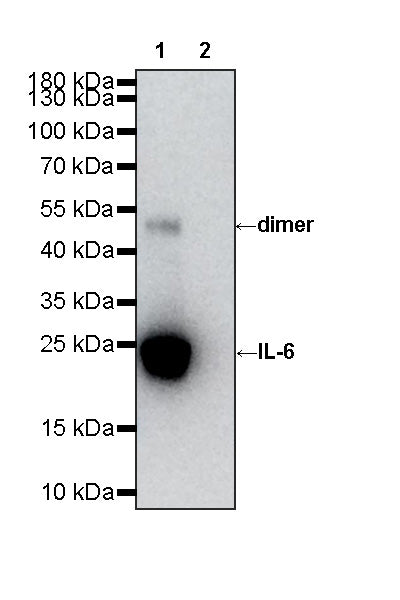
WB result of Invivo Invivo Anti-Human IL-6 Recombinant mAb
Primary antibody: Invivo Anti-Human IL-6 Recombinant mAb at 1/1000 dilution
Lane 1: IL-6 Protein, Human lysate 1 µg
Lane 2: IL-6 Protein, Mouse lysate 1 µg
Secondary antibody: Goat Anti-Rat IgG (H+L), HRP conjugated at 1/10000 dilution
Predicted MW: 24 kDa
Observed MW: 24 kDa
Invivo Anti-Human IL-6 Recombinant mAb
Invivo Anti-Human IL-6 Recombinant mAb
Price:
Regular price
$175 USD
Regular price
Sale price
$175 USD
Unit price
per
For shipping services or bulk orders, you may request a quotation.
Secure checkout with

View full details
Product Details
Product Details
Product Specification
| Host | Rat |
| Antigen | IL-6 |
| Location | Secreted |
| Accession | P05231 |
| Clone Number | S-6127 |
| Antibody Type | Rat mAb |
| Isotype | Rat IgG1 |
| Isotype Control | S0B7122 |
| Application | WB, Functional assays |
| Reactivity | Hu |
| Purification | Protein A |
| Concentration | 5 mg/ml |
| Purity | >95% (Determined by SDS-PAGE) |
| Endotoxin | <1EU/mg |
| Conjugation | Unconjugated |
| Physical Appearance | Liquid |
| Storage Buffer | PBS pH7.4, containing no preservative |
| Stability & Storage | 2 to 8 °C for 2 weeks under sterile conditions; |
Dilution
| application | dilution | species |
| WB | 1:1000 | Hu |
Background
Interleukin-6 (IL-6) is a four-helix bundle type I pleiotropic cytokine encoded by the IL6 gene (located on chromosome 7p21), with a mature molecule of 184 amino acids and a molecular weight of approximately 21–28 kDa. It is rapidly produced by monocytes and macrophages upon infection or tissue injury, and eliminates pathogens and repairs tissue by activating immune, hematopoietic, and acute-phase responses. IL-6 signal transduction features a unique two-pathway design: classical signaling recruits gp130 homodimers through membrane-bound IL-6Rα (expressed only on hepatocytes, certain leukocytes, and epithelial cells) and mainly mediates anti-inflammatory and regenerative functions; trans-signaling, in which a complex formed by soluble IL-6Rα (sIL-6R) and IL-6 activates almost all cells expressing gp130, is considered the principal pathway underlying the pro-inflammatory pathological effects of IL-6. Dimerization of gp130 activates downstream cascades such as JAK/STAT3 and MAPK, and IL-6-induced STAT3 activation can further upregulate IL6 transcription, forming an inflammatory amplification loop. Under physiological conditions, IL-6 participates in hematopoietic regulation, acute-phase protein synthesis (such as CRP, SAA, and fibrinogen), and metabolic regulation; however, when persistently overexpressed, it becomes a key driver of rheumatoid arthritis, Castleman disease, cytokine storms, and various cancers.
Picture
Picture
Western Blot