WB result of INPPL1 Recombinant Rabbit mAb
Primary antibody: INPPL1 Recombinant Rabbit mAb at 1/1000 dilution
Lane 1: RPMI-8226 whole cell lysate 20 µg
Lane 2: K-562 whole cell lysate 20 µg
Lane 3: A549 whole cell lysate 20 µg
Lane 4: HeLa whole cell lysate 20 µg
Lane 5: SK-OV-3 whole cell lysate 20 µg
Low expression control: RPMI-8226 whole cell lysate
Secondary antibody: Goat Anti-Rabbit IgG (H+L), HRP conjugated at 1/10000 dilution
Predicted MW: 139 kDa
Observed MW: 139 kDa
INPPL1 Recombinant Rabbit mAb (S-4567-47)
INPPL1 Recombinant Rabbit mAb (S-4567-47)
Price:
Regular price
$100 USD
Regular price
Sale price
$100 USD
Unit price
per
For shipping services or bulk orders, you may request a quotation.
Secure checkout with

View full details
Product Details
Product Details
Product Specification
| Host | Rabbit |
| Antigen | INPPL1 |
| Synonyms | Phosphatidylinositol 3,4,5-trisphosphate 5-phosphatase 2; Inositol polyphosphate phosphatase-like protein 1 (INPPL-1); Protein 51C; SH2 domain-containing inositol 5'-phosphatase 2Imported (SH2 domain-containing inositol phosphatase 2; SHIP-2); SHIP2 |
| Immunogen | Synthetic Peptide |
| Location | Cytoplasm |
| Accession | O15357 |
| Clone Number | S-4567-47 |
| Antibody Type | Recombinant mAb |
| Isotype | IgG |
| Application | WB |
| Reactivity | Hu |
| Positive Sample | K-562, A549, HeLa, SK-OV-3, mouse heart, rat heart |
| Predicted Reactivity | Pg |
| Purification | Protein A |
| Concentration | 0.5 mg/ml |
| Conjugation | Unconjugated |
| Physical Appearance | Liquid |
| Storage Buffer | PBS, 40% Glycerol, 0.05% BSA, 0.02% sodium azide |
| Stability & Storage | 12 months from date of receipt / reconstitution, -20 °C as supplied |
Dilution
| application | dilution | species |
| WB | 1:1000 | Hu |
Background
INPPL1 is an SH2 domain-containing inositol phosphatase whose core function is to negatively regulate PI3K-AKT signaling pathway activity by hydrolyzing phosphatidylinositol-3,4,5-trisphosphate (PIP3) into PI(3,4)P2. This protein is abundantly expressed in skeletal muscle, heart, and brain, and is widely involved in key physiological processes such as insulin signal regulation, actin cytoskeleton remodeling, cell adhesion, and migration. Mutations in the INPPL1 gene are closely associated with various diseases: loss-of-function mutations are the primary cause of Opsismodysplasia, an autosomal recessive skeletal dysplasia characterized by severe bone malformations and growth retardation in patients; additionally, this gene is also linked to susceptibility to type 2 diabetes mellitus and metabolic syndrome. Interestingly, the role of SHIP2 in cancer is complex—in colorectal cancer, it exhibits oncogenic properties, and its upregulated expression enhances tumor cells' chemoresistance, migration, and invasive capacity, correlating with poorer patient prognosis.
Picture
Picture
Western Blot
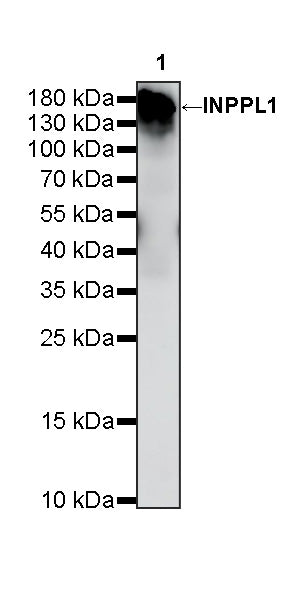
WB result of INPPL1 Recombinant Rabbit mAb
Primary antibody: INPPL1 Recombinant Rabbit mAb at 1/1000 dilution
Lane 1: mouse heart lysate 20 µg
Secondary antibody: Goat Anti-Rabbit IgG (H+L), HRP conjugated at 1/10000 dilution
Predicted MW: 139 kDa
Observed MW: 139 kDa
This blot was developed with high sensitivity substrate
WB result of INPPL1 Recombinant Rabbit mAb
Primary antibody: INPPL1 Recombinant Rabbit mAb at 1/1000 dilution
Lane 1: rat heart lysate 20 µg
Secondary antibody: Goat Anti-Rabbit IgG (H+L), HRP conjugated at 1/10000 dilution
Predicted MW: 139 kDa
Observed MW: 139 kDa
This blot was developed with high sensitivity substrate