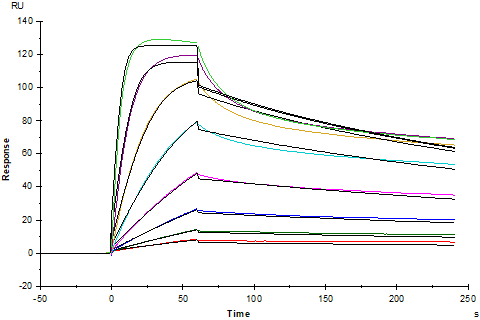
Protein A Chip captured IL1RL1/ST2 Fc Chimera, Human (Cat. No. UA010464), can bind IL-33, Human (Cat. No. UA040036) with an affinity constant of 1.25nM as determined in SPR assay .
IL1RL1/ST2 Fc Chimera Protein, Human
IL1RL1/ST2 Fc Chimera Protein, Human
Price:
Regular price
$580 USD
Regular price
Sale price
$580 USD
Unit price
per
For shipping services or bulk orders, you may request a quotation.
Secure checkout with

View full details
Product Details
Product Details
Product Specification
| Species | Human |
| Antigen | IL1RL1/ST2 |
| Synonyms | DER4, ST2, T1,IL1RL1 |
| Accession | Q01638-2 |
| Amino Acid Sequence | Ala19-Ser515 , with C-terminal Human IgG1 Fc |
| Expression System | HEK293 |
| Molecular Weight | 77-90kDa (Reducing) |
| Purity | >95% by SDS-PAGE |
| Endotoxin | <0.1EU/μg |
| Conjugation | Unconjugated |
| Tag | Human Fc Tag |
| Physical Appearance | Lyophilized Powder |
| Storage Buffer | PBS, pH7.4 |
| Reconstitution | Reconstitute at 0.1-1 mg/ml according to the size in ultrapure water after rapid centrifugation. |
| Stability & Storage | · 12 months from date of receipt, lyophilized powder stored at -20 to -80℃. · 3 months, -20 to -80℃ under sterile conditions after reconstitution. · 1 week, 2 to 8℃ under sterile conditions after reconstitution. · Please avoid repeated freeze-thaw cycles. |
| Reference |
1.Pindon A, Hantai D, Jandrot-Perrus M, Festoff BW.Novel expression and localization of active thrombomodulin on the surface ofmouse brain astrocytes. Glia 1997; 19: 259– 68. 2.Shibata M, Kumar SR, Amar A, Fernandez JA, HofmanF, Griffin JH, Zlokovic BV. Anti-inflammatory, antithrombotic, and neuroprotectiveeffects of activated protein C in a murine model of focal ischemic stroke.Circulation 2001; 103: 1799– 805. |
Background
ST2,also known as IL-1 R4 and T1, is an Interleukin-1 receptor family glycoproteinthat contributes to Th2 immune responses. Human ST2 consists of a 310 aminoacid (aa) extracellular domain (ECD) with three Ig-like domains, a 21 aatransmembrane segment, and a 207 aa cytoplasmic domain with an intracellularTIR domain. ST2 is expressed on the surface of mast cells, activated Th2 cells,macrophages, and cardiac myocytes. It binds IL-33, a cytokine that isupregulated by inflammation or mechanical strain in smooth muscle cells, airwayepithelia, keratinocytes, and cardiac fibroblasts. IL-33 binding induces theassociation of ST2 with IL-1R AcP, a shared signaling subunit that alsoassociates with IL-1 RI and IL-1 R rp2. In macrophages, ST2 interferes withsignaling from IL-1 RI and TLR4 by sequestering the adaptor proteins MyD88 andMal. In addition to its role in promoting mast cell and Th2 dependentinflammation, ST2 activation enhances antigen induced hypernociception andprotects from atherosclerosis and cardiac hypertrophy. Upon tissue injury,induces UCP2-dependent mitochondrial rewiring that attenuates the generation ofreactive oxygen species and preserves the integrity of Krebs cycle required forpersistent production of itaconate and subsequent GATA3-dependentdifferentiation of inflammation-resolving alternatively activated macrophages.
Picture
Picture
Bioactivity
SDS-PAGE
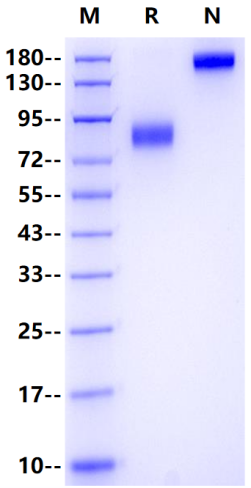
1μg (R: reducing conditions, N: non-reducing conditions).
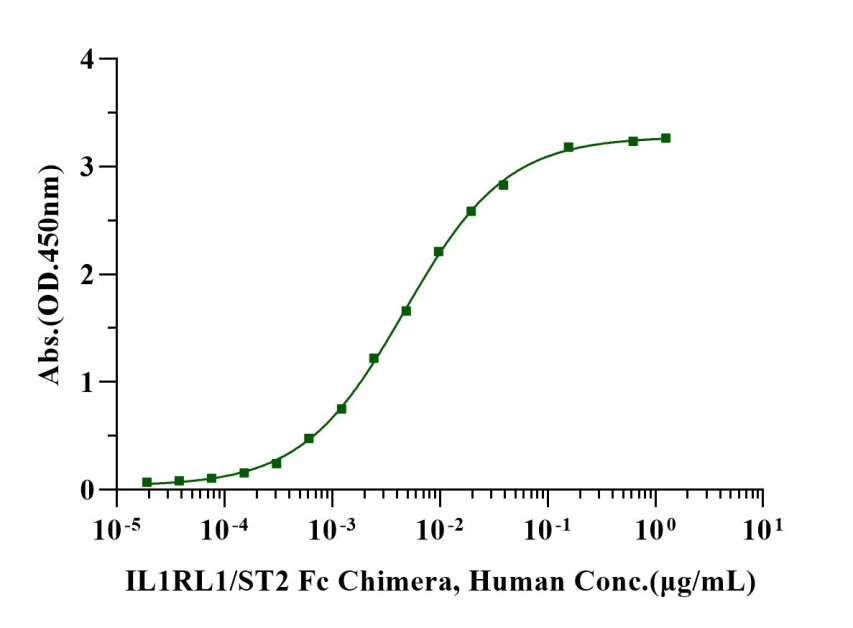
ELISA
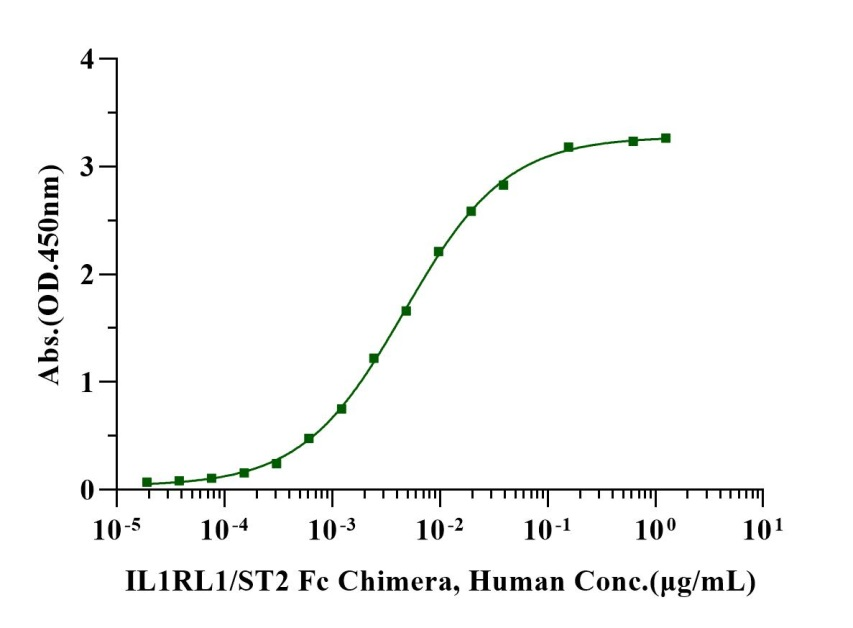
Immobilized IL-33, Human (Cat. No. UA040036) at 2.0μg/mL (100μL/well) can bind IL1RL1/ST2 Fc Chimera, Human (Cat. No. UA010464) with EC50 of 4.42-4.97ng/mL .