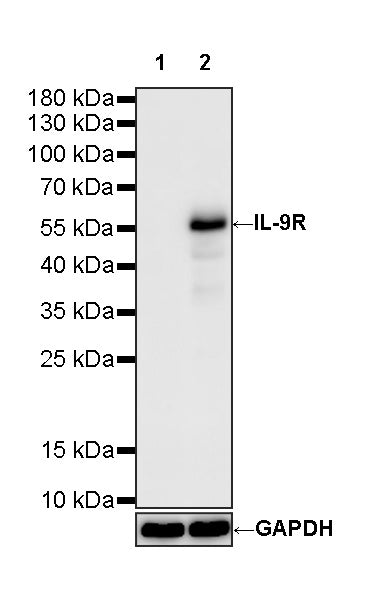
WB result of IL-9R Recombinant Rabbit mAb
Primary antibody: IL-9R Recombinant Rabbit mAb at 1/1000 dilution
Lane 1: 293F transfected with empty vector whole cell lysate 20 µg
Lane 2: 293F transfected with IL-9R-Myc-His fusion protein whole cell lysate 20 µg
Secondary antibody: Goat Anti-Rabbit IgG (H+L), HRP conjugated at 1/10000 dilution
Predicted MW: 57 kDa
Observed MW: 57 kDa
IL-9R Recombinant Rabbit mAb (S-4029-48)
IL-9R Recombinant Rabbit mAb (S-4029-48)
Price:
Regular price
$100 USD
Regular price
Sale price
$100 USD
Unit price
per
For shipping services or bulk orders, you may request a quotation.
Secure checkout with

View full details
Product Details
Product Details
Product Specification
| Host | Rabbit |
| Antigen | IL-9R |
| Synonyms | Interleukin-9 receptor; IL-9 receptor; CD129; IL9R |
| Immunogen | Synthetic Peptide |
| Location | Secreted, Cell membrane |
| Accession | Q01113 |
| Clone Number | S-4029-48 |
| Antibody Type | Recombinant mAb |
| Isotype | IgG |
| Application | WB |
| Reactivity | Hu |
| Purification | Protein A |
| Concentration | 0.5 mg/ml |
| Conjugation | Unconjugated |
| Physical Appearance | Liquid |
| Storage Buffer | PBS, 40% Glycerol, 0.05% BSA, 0.02% sodium azide |
| Stability & Storage | 12 months from date of receipt / reconstitution, -20 °C as supplied |
Dilution
| application | dilution | species |
| WB | 1:1000 | Hu |
Background
Interleukin-9 receptor (IL-9R), also designated as CD129, is a type I transmembrane protein that functions as the specific alpha subunit of the receptor complex for interleukin-9 (IL-9), a multifunctional cytokine primarily associated with Th9 cell responses and allergic inflammation. Structurally, IL-9R consists of an extracellular domain responsible for ligand binding, a single transmembrane helix, and an intracellular domain that lacks intrinsic kinase activity but recruits the common gamma chain (γc, CD132) to form a high-affinity signaling complex; upon IL-9 binding, this heterodimeric assembly activates the Janus kinase (JAK)/Signal Transducer and Activator of Transcription (STAT) pathway, predominantly triggering the phosphorylation of JAK1, JAK3, STAT1, STAT3, and STAT5, which subsequently modulates gene expression involved in cell proliferation, survival, and differentiation. Biologically, IL-9R expression is observed on various hematopoietic cells, including T cells, mast cells, eosinophils, and epithelial cells, playing a critical role in host defense against parasitic infections while simultaneously contributing to the pathogenesis of asthma, atopic dermatitis, and certain malignancies, thereby making it a significant target for therapeutic interventions aimed at inhibiting aberrant immune responses.
Picture
Picture
Western Blot