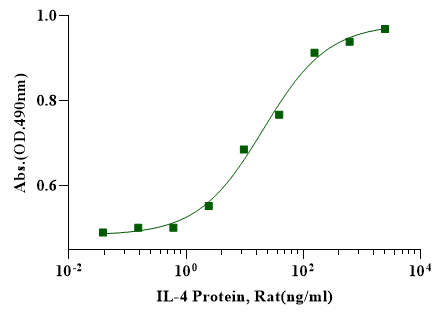
Determined by its ability to stimulate proliferation of TF-1 cells. The expected EC50 is less than 30ng/ml.
IL-4 Protein, Rat
IL-4 Protein, Rat
Price:
Regular price
$250 USD
Regular price
Sale price
$250 USD
Unit price
per
For shipping services or bulk orders, you may request a quotation.
Secure checkout with

View full details
Product Details
Product Details
Product Specification
| Species | Rat |
| Accession | P20096 |
| Amino Acid Sequence | His23-Ser147 |
| Expression System | E.coli |
| Molecular Weight | 14 kDa (Reducing) |
| Purity | >95% by SDS-PAGE and HPLC. |
| Endotoxin | <0.1EU/μg |
| Conjugation | Unconjugated |
| Tag | No Tag |
| Physical Appearance | Lyophilized Powder |
| Storage Buffer | 20mM Tris, 150mM NaCl, pH8.0 |
| Reconstitution | Reconstitute at 0.1-1 mg/ml according to the size in ultrapure water after rapid centrifugation. |
| Stability & Storage | ·12 months from date of receipt, lyophilized powder stored at -20 to -80℃. |
| Reference | J Neuropathol Exp Neurol. 2016 Nov 1;75(11):1058-1071. |
Background
IL-4 is a key regulator in hormone control and adaptive immunity. It is a compact globular protein structure stabilized by three disulphide bonds, forming a four alpha-helix bundle with a left-handed twist and a 2-stranded anti-parallel beta sheet. In rats, IL-4 shares sequence identities with other species, which indicates its conserved role across different mammals. In the industrial sector, IL-4 and its related pathways are of significant interest, particularly in the development of therapeutics for autoimmune diseases, cancer, psoriasis, and arthritis. IL-4 has been applied in the treatment of autoimmune disorders like multiple myeloma, and it is also used to inhibit the detrimental effects of Th1 cells. Furthermore, IL-4 has been shown to promote the growth of epithelial tumors by mediating increased proliferation and survival, which has implications in cancer research and treatment.
Picture
Picture
Bioactivity
SDS-PAGE
2μg (R: reducing condition, N: non-reducing condition).
RP-HPLC
>95% as determined by RP-HPLC.