2μg (R: reducing condition, N: non-reducing condition).
IL-23A(20-189) Fc Chimera Protein, Human
IL-23A(20-189) Fc Chimera Protein, Human
Price:
Regular price
$210 USD
Regular price
Sale price
$210 USD
Unit price
per
For shipping services or bulk orders, you may request a quotation.
Secure checkout with

View full details
Product Details
Product Details
Product Specification
| Species | Human |
| Synonyms | IL23A, IL-23, IL-23A, IL23P19, P19, SGRF |
| Accession | Q9NPF7 |
| Amino Acid Sequence | Arg 20 - Pro 189 with hIgG1 Fc Tag at the C-Terminus |
| Expression System | HEK293 |
| Molecular Weight | 43-55kDa (Reducing) |
| Purity | >95% by SDS-PAGE & |
| Conjugation | Unconjugated |
| Tag | Human IgG1 Fc |
| Physical Appearance | Lyophilized powder |
| Storage Buffer | PBS, PH7.4, 5% trehalose |
| Reconstitution | Reconstitute at 0.1-1 mg/ml according to the size in ultrapure water after rapid centrifugation. |
| Stability & Storage | · 12 months from date of receipt, lyophilized powder stored at -20 to -80℃. |
| Reference | 1. Oppmann, B., et al. (2000). Novel p19 protein engages IL-12p40 to form a cytokine, IL-23, with biological activities similar as well as distinct from IL-12. Immunity, 13(5), 715-725. |
Background
Interleukin-23A (IL-23A) is a key pro-inflammatory cytokine that belongs to the IL-12 cytokine family. It forms a heterodimeric complex with IL-12B (p40 subunit) to create the bioactive IL-23 cytokine (composed of p19 and p40 subunits). IL-23 is primarily produced by activated dendritic cells, macrophages, and monocytes. Its biological function is mediated through binding to a specific receptor complex, IL-23R, which pairs with IL-12Rβ1, expressed mainly on the surface of immune cells such as T helper 17 (Th17) cells, innate lymphoid cells, and macrophages.
The primary role of IL-23 is to stabilize and expand the Th17 cell lineage, which subsequently produces effector cytokines like IL-17A, IL-17F, and IL-22. This IL-23/Th17 axis is a central driver of chronic inflammation and autoimmune pathology. Consequently, dysregulated IL-23 signaling is strongly implicated in the pathogenesis of several immune-mediated inflammatory diseases, including psoriasis, psoriatic arthritis, inflammatory bowel disease (e.g., Crohn's disease), and ankylosing spondylitis. This critical involvement has made IL-23A and its receptor prime therapeutic targets, with several monoclonal antibodies achieving significant clinical success.
Picture
Picture
SDS-PAGE
ELISA
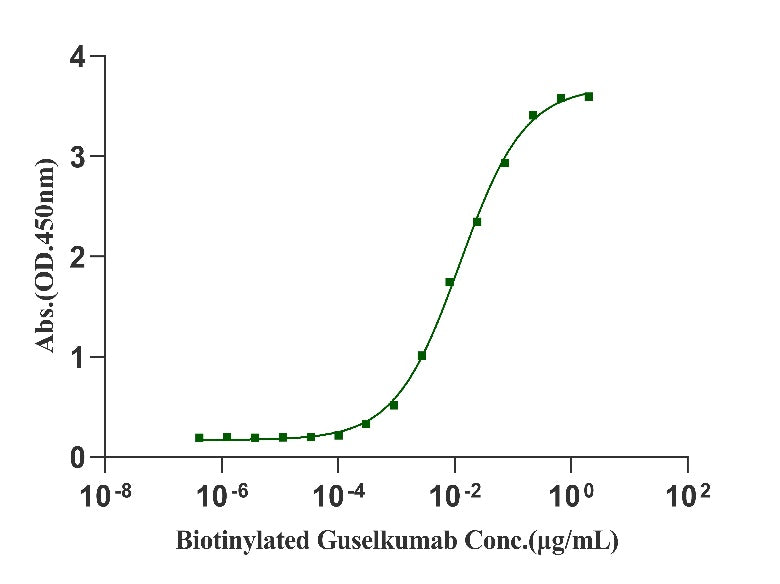
Immobilized IL-23A(20-189) Fc Chimera Protein, Human (Cat. No. UA011357) at 1.0μg/mL (100μL/well) can bind Biotinylated Guselkumab (Cat. No. S0B0563) with EC50 of 10.77-14.25 ug/mL.