2μg (R: reducing condition, N: non-reducing condition).
IL-23 Protein, Human
IL-23 Protein, Human
Price:
Regular price
$200 USD
Regular price
Sale price
$200 USD
Unit price
per
For shipping services or bulk orders, you may request a quotation.
Secure checkout with

View full details
Product Details
Product Details
Product Specification
| Species | Human |
| Synonyms | SGRF, IL-23p19, CLMF p40, IL-12 subunit p40, NKSF2 |
| Accession | Q9NPF7、P29460 |
| Amino Acid Sequence | p19: Arg20-Pro189, with N-terminal His Tag |
| Expression System | CHO |
| Molecular Weight | p19: 18-22 kDa (Reducing)p40: 38-42 kDa (Reducing) |
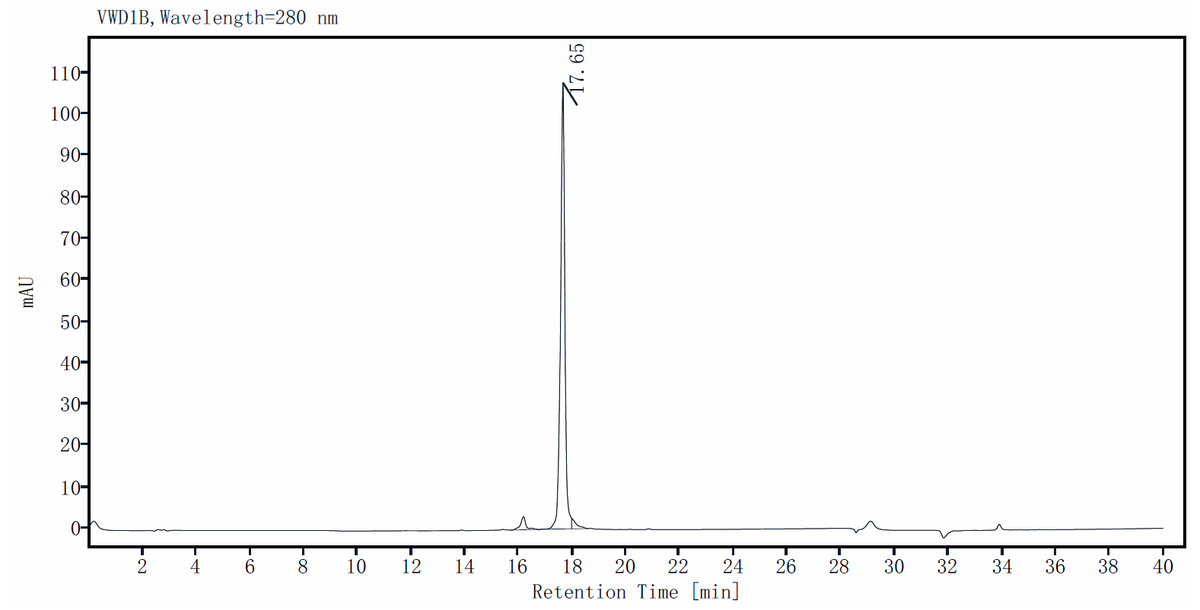
| Purity | >95% by SDS-PAGE and HPLC. |
| Endotoxin | <0.1EU/μg |
| Conjugation | Unconjugated |
| Tag | His Tag |
| Physical Appearance | Lyophilized Powder |
| Storage Buffer | PBS, pH7.4 |
| Reconstitution | Reconstitute at 0.1-1 mg/ml according to the size in ultrapure water after rapid centrifugation. |
| Stability & Storage | ·12 months from date of receipt, lyophilized powder stored at -20 to -80℃. |
| Reference | Nature. 2010 Apr 29;464(7293):1371-5. |
Background
Interleukin-23 (IL-23) is a heterodimeric pro-inflammatory cytokine belonging to the IL-12 family, primarily secreted by dendritic cells and macrophages. Composed of a unique p19 subunit and a shared p40 subunit with IL-12, IL-23 functions through a receptor complex consisting of IL-12Rβ1 and the IL-23-specific receptor subunit IL-23R.
IL-23 is recognized as a key upstream regulator in multiple autoimmune diseases, including psoriasis, inflammatory bowel disease (IBD), rheumatoid arthritis (RA), systemic lupus erythematosus (SLE), and multiple sclerosis (MS). Genome-wide association studies have identified IL-23R gene variants linked to susceptibility for psoriasis, IBD, and Behçet's disease. In the gut, IL-23 exhibits a selective inflammatory profile, controlling local IL-17 production while sparing systemic immunity, making it an attractive therapeutic target that preserves host defense mechanisms.
Picture
Picture
SDS-PAGE
RP-HPLC
>95% as determined by RP-HPLC.
ELISA
Immobilized IL-23 Protein, Human (Cat. No. UA040502) at 2.0μg/mL (100μL/well) can bind IL-12 R beta 1 Fc Chimera Protein, Human (Cat. No. UA010956) with EC50 of 1.26-2.13 ng/mL.