2μg (R: reducing condition, N:non-reducing condition).
IL-21 R His Tag Protein, Human
IL-21 R His Tag Protein, Human
Price:
Regular price
$100 USD
Regular price
Sale price
$100 USD
Unit price
per
For shipping services or bulk orders, you may request a quotation.
Secure checkout with

View full details
Product Details
Product Details
Product Specification
| Species | Human |
| Synonyms | IL21R, CD360, NILR |
| Accession | Q9HBE5-1 |
| Amino Acid Sequence | Cys20-Pro236 with His Tag at the C-Terminus |
| Expression System | HEK293 |
| Molecular Weight | 35-50kDa (Reducing) |
| Purity | >95% by SDS-PAGE & > 95% SEC-HPLC |
| Conjugation | Unconjugated |
| Tag | His Tag |
| Physical Appearance | Lyophilized powder |
| Storage Buffer | PBS, PH7.4, 5% trehalose |
| Reconstitution | Reconstitute at 0.1-1 mg/ml according to the size in ultrapure water after rapid centrifugation. |
| Stability & Storage | · 12 months from date of receipt, lyophilized powder stored at -20 to -80℃. |
| Reference | 1.Andersen KG, Shylakhter I, Tabrizi S, Grossman SR, Happi CT, Sabeti PC. Genome-wide scans provide evidence for positive selection of genes implicated in Lassa fever. Philos Trans R Soc Lond B Biol Sci. 2012 Mar 19;367(1590):868-77. |
Background
IL-21 receptor (IL-21R/CD360/NILR) belongs to the type I cytokine receptor family, subfamily 4. It is a single-pass transmembrane protein composed of two fibronectin type-III domains, a WSXWS folding motif and a Box1 JAK-binding motif, and together with the common γ-chain it forms the high-affinity IL-21 receptor complex. Selectively enriched in thymus and spleen, IL-21R is broadly expressed on T, B and NK cells and, via the JAK-STAT pathway, transduces IL-21 signals that drive proliferation, differentiation and memory formation, thereby bridging innate and adaptive immunity. Clinically, hyper-activation of the IL-21/IL-21R axis promotes autoantibody production and is implicated in multiple autoimmune diseases, making this pathway a key biomarker and therapeutic target for autoantibody-mediated disorders.
Picture
Picture
SDS-PAGE
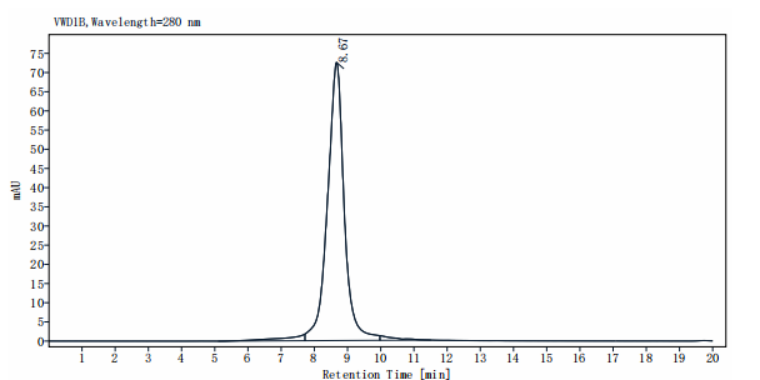
SEC-HPLC
The purity of IL-21 R His Tag Protein, Human is more than 95% determined by SEC-HPLC.
ELISA
Immobilized IL-21 Protein, Human (Cat. No. UA040009) at 1.0μg/mL (100μL/well) can bind IL-21 R His Tag Protein, Human (Cat. No. UA011349) with EC50 of 31.42-83.36 ng/mL.