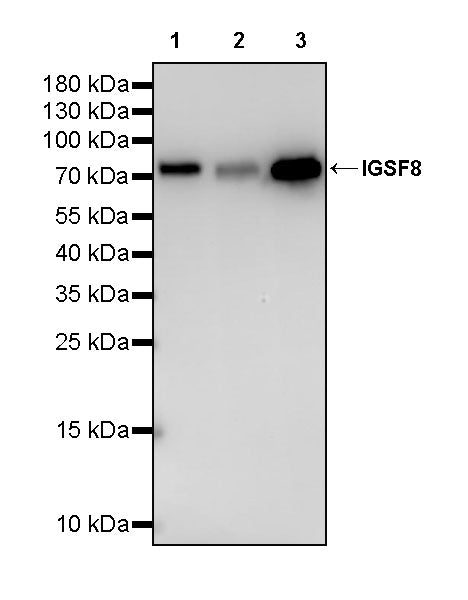
WB result of IGSF8 Recombinant Rabbit mAb
Primary antibody: IGSF8 Recombinant Rabbit mAb at 1/1000 dilution
Lane 1: HepG2 whole cell lysate 20 µg
Lane 2: SK-BR-3 whole cell lysate 20 µg
Lane 3: Jurkat whole cell lysate 20 µg
Secondary antibody: Goat Anti- rabbit IgG, (H+L), HRP conjugated at 1/10000 dilution
Predicted MW: 65 kDa
Observed MW: 72 kDa
IGSF8 Recombinant Rabbit mAb (S-2101-176)
IGSF8 Recombinant Rabbit mAb (S-2101-176)
Price:
Regular price
$100 USD
Regular price
Sale price
$100 USD
Unit price
per
For shipping services or bulk orders, you may request a quotation.
Secure checkout with

View full details
Product Details
Product Details
Product Specification
| Host | Rabbit |
| Antigen | IGSF8 |
| Synonyms | Immunoglobulin superfamily member 8; CD81 partner 3; Glu-Trp-Ile EWI motif-containing protein 2 (EWI-2); Keratinocytes-associated transmembrane protein 4 (KCT-4); LIR-D1; Prostaglandin regulatory-like protein (PGRL); CD316; CD81P3; EWI2; KCT4 |
| Immunogen | Recombinant Protein |
| Location | Cell membrane, Synapse |
| Accession | Q969P0 |
| Clone Number | S-2101-176 |
| Antibody Type | Recombinant mAb |
| Isotype | IgG |
| Application | WB |
| Reactivity | Hu, Mk |
| Positive Sample | HepG2, SK-BR-3, Jurkat |
| Purification | Protein A |
| Concentration | 0.5 mg/ml |
| Conjugation | Unconjugated |
| Physical Appearance | Liquid |
| Storage Buffer | PBS, 40% Glycerol, 0.05% BSA, 0.02% sodium azide |
| Stability & Storage | 12 months from date of receipt / reconstitution, -20 °C as supplied |
Dilution
| application | dilution | species |
| WB | 1:1000 | Hu, Mk |
Background
IGSF8 also known as EWI-2 or CD316, is a single-pass transmembrane protein belonging to the EWI subfamily of the immunoglobulin superfamily. Its core function is to act as an adaptor protein, linking tetraspanin-enriched membrane microdomains (such as CD9, CD81, and CD82) to the cytoskeleton, thereby participating in the regulation of various processes including cell migration, adhesion, and signal transduction. The IGSF8 protein structurally contains an EWI (glutamic acid-tryptophan-isoleucine) motif and multiple immunoglobulin-like domains, with the extracellular immunoglobulin-like domains responsible for interacting with tetraspanins such as CD9 and CD81, while the intracellular region can connect to cytoskeletal proteins. Functionally, IGSF8 plays multifaceted roles: it is a key regulator of the immune system, acting as an inducible receptor for HSPA8 on dendritic cells to regulate their migration, and it can also inhibit the killing of tumor cells by natural killer cells through interaction with their receptors; simultaneously, it is an important tumor suppressor that inhibits cancer cell migration and proliferation by suppressing epidermal growth factor receptor endocytosis and promoting the degradation of growth factor receptors. Furthermore, IGSF8 also plays roles in nervous system development and in resisting viral infections such as hepatitis C virus and HIV-1.
Picture
Picture
Western Blot