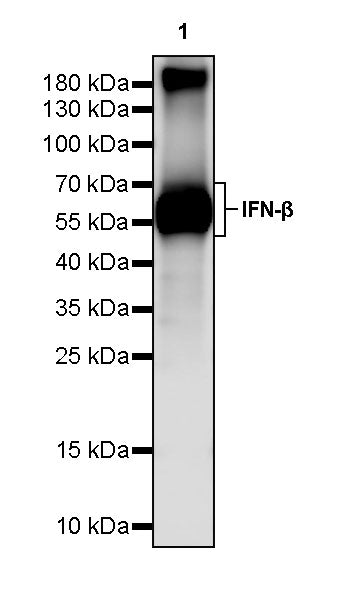
WB result of IFN-β Recombinant mAb
Primary antibody: IFN-β Recombinant mAb at 1/4000 dilution
Lane 1: Mouse IFN-beta Protein, hFc tag 1ug
Secondary antibody: Goat Anti-Armenian Hamster IgG, (H+L), HRP conjugated at 1/10000 dilution
Predicted MW: 22 kDa
Observed MW: 50-70 kDa
IFN-β Recombinant Armenian hamster mAb (S-5238)
IFN-β Recombinant Armenian hamster mAb (S-5238)
Price:
Regular price
$100 USD
Regular price
Sale price
$100 USD
Unit price
per
For shipping services or bulk orders, you may request a quotation.
Secure checkout with

View full details
Product Details
Product Details
Product Specification
| Host | Armenian hamster |
| Antigen | IFN-β |
| Synonyms | Interferon beta; Ifb; Ifnb; Ifnb1 |
| Location | Secreted |
| Accession | P01575 |
| Clone Number | S-5238 |
| Antibody Type | Recombinant mAb |
| Isotype | IgG |
| Application | WB, ELISA |
| Reactivity | Ms |
| Purification | Protein G |
| Concentration | 0.5 mg/ml |
| Conjugation | Unconjugated |
| Physical Appearance | Liquid |
| Storage Buffer | PBS, 40% Glycerol, 0.05% BSA, 0.02% sodium azide |
| Stability & Storage | 12 months from date of receipt / reconstitution, -20 °C as supplied |
Dilution
| application | dilution | species |
| WB | 1:1000 | Ms |
Background
IFN-β (interferon-beta) is a type I interferon induced by viral or pathogen stimulation, primarily secreted by fibroblasts and plasmacytoid dendritic cells, and plays a key antiviral role in the innate immune response. Upon infection triggering pattern recognition receptors such as TLRs or RIG-I, transcription factors including IRF3 and NF-κB are rapidly activated and initiate IFN-β gene expression. The secreted IFN-β binds to the receptor complex composed of IFNAR1/IFNAR2 on the cell surface, inducing the transcription of hundreds of interferon-stimulated genes (ISGs) via the JAK-STAT signaling pathway, thereby establishing an antiviral state, inhibiting viral replication, and promoting apoptotic clearance of infected cells. In addition to its direct antiviral effects, IFN-β also possesses important immunomodulatory functions, including activation of natural killer cells, promotion of dendritic cell maturation, and upregulation of MHC class I molecules to enhance antigen presentation. Clinically, recombinant human IFN-β preparations (such as IFN-β-1a and IFN-β-1b) are widely used in the treatment of multiple sclerosis, where they alleviate autoimmune inflammatory damage in the central nervous system by inhibiting T cell activation, maintaining blood-brain barrier integrity, and downregulating pro-inflammatory cytokines.
Picture
Picture
Western Blot