2μg (R: reducing condition, N:non-reducing condition).
IFN-alpha/beta R1 His Tag Protein, Human
IFN-alpha/beta R1 His Tag Protein, Human
Price:
Regular price
$185 USD
Regular price
Sale price
$185 USD
Unit price
per
For shipping services or bulk orders, you may request a quotation.
Secure checkout with

View full details
Product Details
Product Details
Product Specification
| Species | Human |
| Synonyms | IFNAR1,IFNAR,CRF2-1,IFN-R-1,IFNAR-1,IFNBR |
| Accession | P17181-1 |
| Amino Acid Sequence | Lys28-Lys436 with His Tag at the C-Terminus |
| Expression System | HEK293 |
| Molecular Weight | 70-95kDa (Reducing) |
| Purity | >95% by SDS-PAGE & > 95% by SEC-HPLC |
| Conjugation | Unconjugated |
| Tag | His Tag |
| Physical Appearance | Lyophilized powder |
| Storage Buffer | PBS, PH7.4, 5% trehalose |
| Reconstitution | Reconstitute at 0.1-1 mg/ml according to the size in ultrapure water after rapid centrifugation. |
| Stability & Storage | · 12 months from date of receipt, lyophilized powder stored at -20 to -80℃. |
| Reference | 1.Groen K, Kuratli R, Enkelmann J, Fernbach S, Wendel-Garcia PD, Staiger WI, Lejeune M, Sauras-Colón E, Roche-Campo F, Filippidis P, Rauch A; Swiss HIV Cohort Study; Trkola A, Günthard HF, Kouyos RD, Brugger SD, Hale BG. Type I interferon autoantibody footprints reveal neutralizing mechanisms and allow inhibitory decoy design. J Exp Med. 2025 Jun 2;222(6):e20242039. |
Background
Interferon α/β receptor 1 (IFNAR1) is a key component of the type I interferon (IFN-α/β) receptor. It belongs to the type II cytokine receptor family and is a type I transmembrane protein. Its extracellular region contains four fibronectin type III domains. IFNAR1 must form a functional receptor complex with another subunit, IFNAR2, to mediate type I interferon signal transduction. Upon ligand binding, the receptor activates downstream JAK kinases (such as Tyk2), which in turn phosphorylate transcription factors such as STAT1 and STAT2, initiating the expression of antiviral and immunomodulatory genes. Research suggests that its signaling mechanisms are complex: on the one hand, under specific conditions (such as during IFN-β signaling), IFNAR1 can function independently without relying on IFNAR2, and this pathway may not involve the classical JAK-STAT pathway; on the other hand, Tyk2 can stabilize IFNAR1 expression by inhibiting its endocytosis, while mutations at key tyrosine sites (e.g., Tyr466) can block STAT phosphorylation in a dominant-negative manner, confirming the central role of IFNAR1 in linking JAK and STAT. IFNAR1 itself also possesses direct antiviral activity.As the gateway for type I interferon signaling, IFNAR1 is a critical target in antiviral immunity, autoimmune diseases, and tumor immunotherapy. Hyperactivation or abnormal signaling of the receptor is associated with autoimmune diseases (such as systemic lupus erythematosus), while functional defects may increase susceptibility to viral infections. Modulation of this receptor and its signaling pathway provides important directions for the development of antiviral drugs, therapies for autoimmune diseases, and novel immune adjuvants.
Picture
Picture
SDS-PAGE
SEC-HPLC
The purity of IFN-alpha/beta R1 His Tag Protein, Human is more than 95% determined by SEC-HPLC.
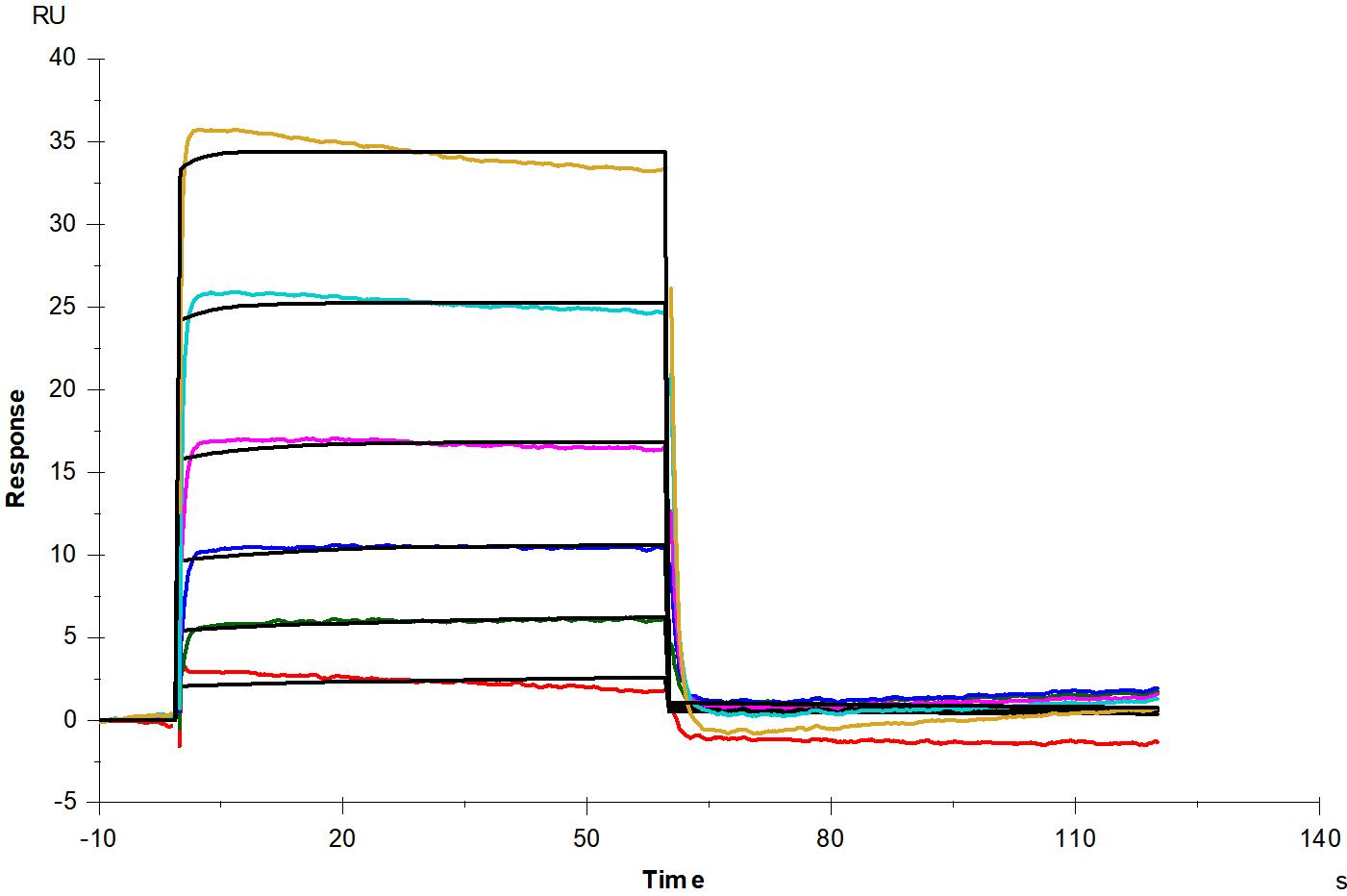
SPR
Anti-His antibody Immobilized on CM5 Chip captured IFN-alpha/beta R1 His Tag Protein, Human (Cat. No. UA011351), can bind IFN-α 2b Protein, Human (Cat. No. UA040399) with an affinity constant of 0.91μM as determined in SPR assay.