IFITM1-Specific Mouse mAb
IFITM1-Specific Mouse mAb
Price:
Regular price
$100 USD
Regular price
Sale price
$100 USD
Unit price
per
For shipping services or bulk orders, you may request a quotation.
Secure checkout with

View full details
Product Details
Product Details
Product Specification
| Host | Mouse |
| Antigen | IFITM1 |
| Synonyms | Interferon-induced transmembrane protein 1; Dispanin subfamily A member 2a (DSPA2a); Interferon-induced protein 17; Interferon-inducible protein 9-27; Leu-13 antigen; CD225; IFI17 |
| Location | Lysosome, Cell membrane |
| Accession | P13164 |
| Antibody Type | Mouse mAb |
| Isotype | IgG2a |
| Application | WB, IHC-P |
| Reactivity | Hu |
| Positive Sample | K-562, HeLa treated with hIFN-α1(10 mg/mL, 16 h) |
| Purification | Protein A |
| Concentration | 2 mg/ml |
| Conjugation | Unconjugated |
| Physical Appearance | Liquid |
| Storage Buffer | PBS, 40% Glycerol, 0.05% BSA, 0.02% sodium azide |
| Stability & Storage | 12 months from date of receipt / reconstitution, -20 °C as supplied |
Dilution
| application | dilution | species |
| WB | 1:2000-1:10000 | Hu |
| IHC-P | 1:1000 | Hu |
Background
IFITM1 (Interferon-Induced Transmembrane Protein 1) is an important member of the IFITM family, a small transmembrane protein strongly induced by interferons that plays a critical role in the innate immune defense against viral infections. Its most well-known function involves effectively inhibiting the entry of a broad range of enveloped viruses—including influenza virus, dengue virus, Ebola virus, and severe acute respiratory syndrome coronaviruses—by blocking the fusion process between the viral envelope and the host cell membrane. The molecular mechanism underlying this antiviral activity primarily relies on IFITM1's ability to alter membrane fluidity, curvature, and cholesterol distribution, thereby physically preventing the formation of viral fusion pores. In recent years, the functional scope of IFITM1 has expanded into the field of tumor biology, where its expression levels are significantly upregulated in various malignancies (such as esophageal squamous cell carcinoma, colorectal cancer, and glioma), and are closely associated with metastatic potential, chemoresistance, and poor patient prognosis. Additionally, it participates in regulating cell adhesion, migration, and remodeling of the immune microenvironment. This dual role in both antiviral immunity and tumorigenesis has made IFITM1 a focal point of interest across infection immunology, oncology, and translational medicine.
Picture
Picture
Western Blot
WB result of IFITM1-Specific Mouse mAb
Primary antibody: IFITM1-Specific Mouse mAb at 1/2000 dilution
Lane 1: A549 whole cell lysate 20 µg
Lane 2: K-562 whole cell lysate 20 µg
Negative control: A549 whole cell lysate
Secondary antibody: Goat Anti-Mouse IgG, (H+L), HRP conjugated at 1/10000 dilution
Predicted MW: 14 kDa
Observed MW: 15 kDa
WB result of IFITM1-Specific Mouse mAb
Primary antibody: IFITM1-Specific Mouse mAb at 1/2000 dilution
Lane 1: untreated HeLa whole cell lysate 20 µg
Lane 2: HeLa treated with hIFN-α1(10 mg/mL, 16 h) whole cell lysate 20 µg
Secondary antibody: Goat Anti-Mouse IgG, (H+L), HRP conjugated at 1/10000 dilution
Predicted MW: 14 kDa
Observed MW: 16 kDa
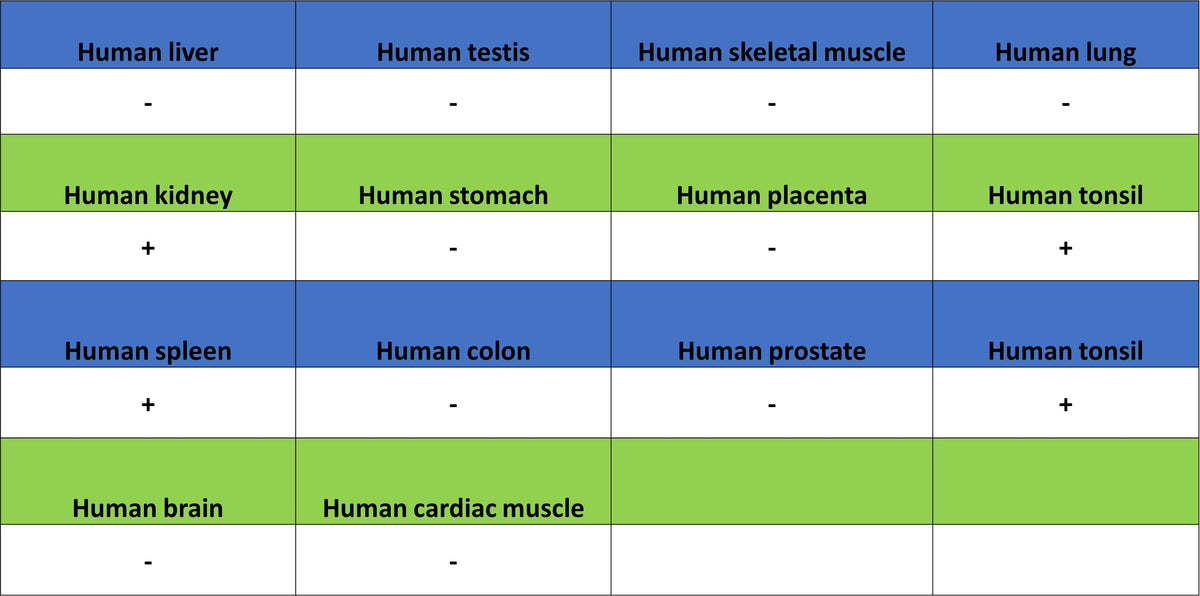
Immunohistochemistry
IHC shows positive staining in paraffin-embedded human tonsil. Anti-IFITM1 antibody was used at 1/1000 dilution, followed by a HRP Polymer for Mouse IgG (ready to use). Counterstained with hematoxylin. Heat mediated antigen retrieval with Tris/EDTA buffer pH9.0 was performed before commencing with IHC staining protocol.
IHC shows positive staining in paraffin-embedded human spleen. Anti-IFITM1 antibody was used at 1/1000 dilution, followed by a HRP Polymer for Mouse IgG (ready to use). Counterstained with hematoxylin. Heat mediated antigen retrieval with Tris/EDTA buffer pH9.0 was performed before commencing with IHC staining protocol.