WB result of IFIT1 Recombinant Rabbit mAb
Primary antibody: IFIT1 Recombinant Rabbit mAb at 1/10000 dilution
Lane 1: untreated HeLa whole cell lysate 20 µg
Lane 2: HeLa treated with 10 ng/ml hIFN-α for 16 hours whole cell lysate 20 µg
Secondary antibody: Goat Anti- rabbit IgG, (H+L), HRP conjugated at 1/10000 dilution
Predicted MW: 55 kDa
Observed MW: 56 kDa
IFIT1 Recombinant Rabbit mAb (S-5120)
IFIT1 Recombinant Rabbit mAb (S-5120)
Price:
Regular price
$100 USD
Regular price
Sale price
$100 USD
Unit price
per
For shipping services or bulk orders, you may request a quotation.
Secure checkout with

View full details
Product Details
Product Details
Product Specification
| Host | Rabbit |
| Antigen | IFIT1 |
| Synonyms | Antiviral innate immune response effector IFIT1; Interferon-induced 56 kDa protein (IFI-56K; P56); Interferon-induced protein with tetratricopeptide repeats 1Imported; G10P1; IFI56; IFNAI1; ISG56 |
| Location | Cytoplasm |
| Accession | P09914 |
| Clone Number | S-5120 |
| Antibody Type | Recombinant mAb |
| Isotype | IgG |
| Application | WB, IHC-P |
| Reactivity | Hu |
| Purification | Protein A |
| Concentration | 0.5 mg/ml |
| Conjugation | Unconjugated |
| Physical Appearance | Liquid |
| Storage Buffer | PBS, 40% Glycerol, 0.05% BSA, 0.03% Proclin 300 |
| Stability & Storage | 12 months from date of receipt / reconstitution, -20 °C as supplied |
Dilution
| application | dilution | species |
| WB | 1:1000-1:5000 | Hu |
| IHC-P | 1:250 | Hu |
Background
IFIT1 (Interferon-Induced Protein with Tetratricopeptide Repeats 1, also known as ISG56) is a core member of the interferon-stimulated gene family and serves as a critical antiviral effector protein, playing a key inhibitory role in the host innate immune response. The canonical structural feature of this protein is its multiple tandem tetratricopeptide repeat (TPR) domains, which form a superhelical structure that mediates protein-protein interactions, enabling the recognition and binding of viral RNA molecules with atypical 5' ends. As a broad-spectrum antiviral factor, IFIT1 specifically recognizes and binds viral RNAs lacking 2'-O-methylation modification or possessing 5'-triphosphate groups, thereby competitively inhibiting the binding of viral mRNA to the host translation initiation complex and blocking viral protein synthesis. Unlike classical enzyme-active effector proteins, IFIT1 lacks catalytic function and instead sequesters foreign RNA molecules directly through a "molecular trapping" mechanism, a mode of action that confers inhibitory effects against a wide range of RNA viruses, including influenza virus, dengue virus, and hepatitis C virus. Furthermore, the expression of IFIT1 is tightly regulated by the type I interferon signaling pathway, and its expression level directly influences the host's ability to resist viral infection. Clinical studies have shown that certain viruses, such as SARS-CoV-2, can encode specific proteases to cleave IFIT1 and evade immune responses, while polymorphisms in the IFIT1 gene are closely associated with susceptibility to various viral infectious diseases and autoimmune disorders, highlighting the dual role of this protein in infection immunity and inflammatory regulation.
Picture
Picture
Western Blot
Immunohistochemistry
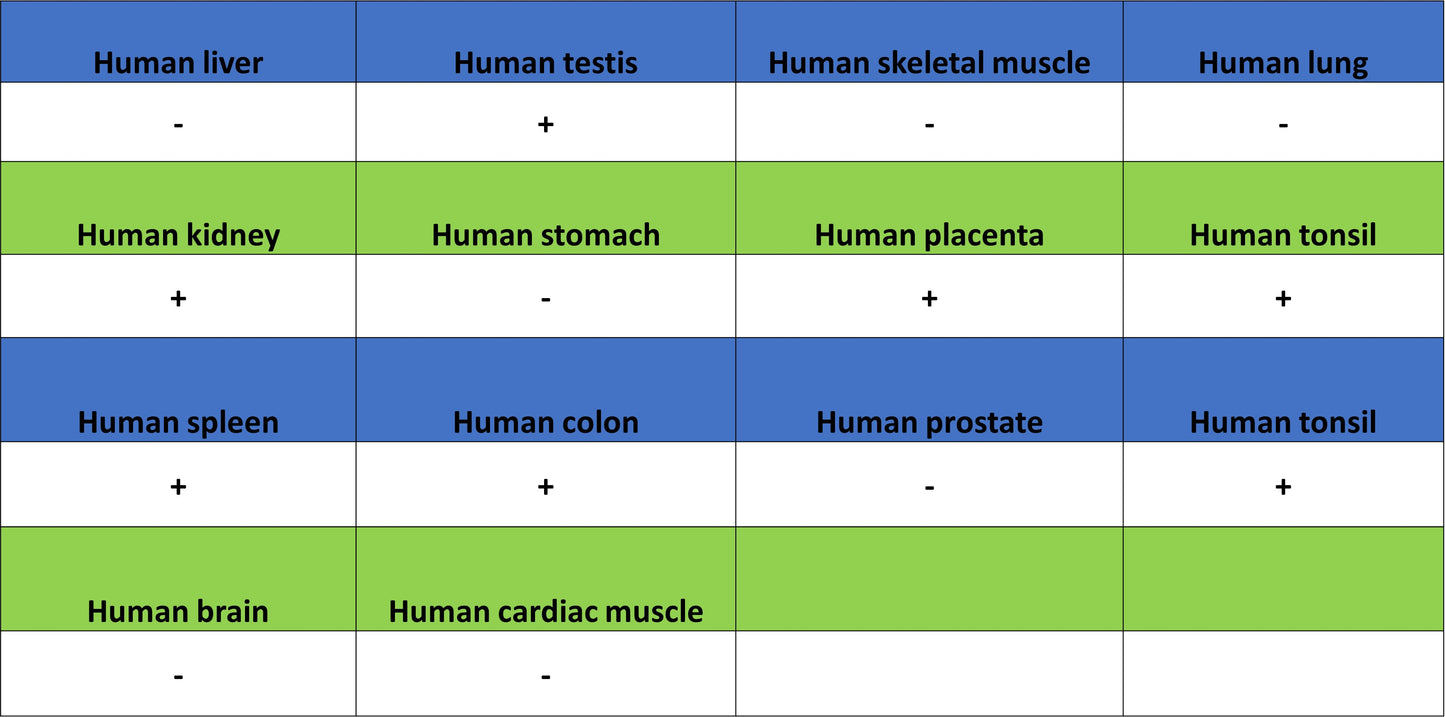
IHC shows positive staining in paraffin-embedded human spleen. Anti-IFIT1 antibody was used at 1/250 dilution, followed by a HRP Polymer for Rabbit IgG (ready to use). Counterstained with hematoxylin. Heat mediated antigen retrieval with Tris/EDTA buffer pH9.0 was performed before commencing with IHC staining protocol.
IHC shows positive staining in paraffin-embedded human colon. Anti-IFIT1 antibody was used at 1/250 dilution, followed by a HRP Polymer for Rabbit IgG (ready to use). Counterstained with hematoxylin. Heat mediated antigen retrieval with Tris/EDTA buffer pH9.0 was performed before commencing with IHC staining protocol.
IHC shows positive staining in paraffin-embedded human colon cancer. Anti-IFIT1 antibody was used at 1/250 dilution, followed by a HRP Polymer for Rabbit IgG (ready to use). Counterstained with hematoxylin. Heat mediated antigen retrieval with Tris/EDTA buffer pH9.0 was performed before commencing with IHC staining protocol.
IHC shows positive staining in paraffin-embedded human cervical squamous cell carcinoma. Anti-IFIT1 antibody was used at 1/250 dilution, followed by a HRP Polymer for Rabbit IgG (ready to use). Counterstained with hematoxylin. Heat mediated antigen retrieval with Tris/EDTA buffer pH9.0 was performed before commencing with IHC staining protocol.