2μg (R: reducing condition, N:non-reducing condition).
ICOS/CD278(C136S, C137S) His Tag Protein, Human
ICOS/CD278(C136S, C137S) His Tag Protein, Human
Price:
Regular price
$245 USD
Regular price
Sale price
$245 USD
Unit price
per
For shipping services or bulk orders, you may request a quotation.
Secure checkout with

View full details
Product Details
Product Details
Product Specification
| Species | Human |
| Synonyms | AILIM, CVID1, inducible T-cell co-stimulator, inducible T-cell costimulatory |
| Accession | Q9Y6W8-1 |
| Amino Acid Sequence | Glu21-Phe141(C136S,C137S)with His Tag at the C-Terminus |
| Expression System | HEK293 |
| Molecular Weight | 25-33kDa (Reducing) |
| Purity | >95% by SDS-PAGE & HPLC |
| Conjugation | Unconjugated |
| Tag | His Tag |
| Physical Appearance | Lyophilized powder |
| Storage Buffer | PBS, PH7.4, 5% trehalose |
| Reconstitution | Reconstitute at 0.1-1 mg/ml according to the size in ultrapure water after rapid centrifugation. |
| Stability & Storage | · 12 months from date of receipt, lyophilized powder stored at -20 to -80℃. |
| Reference | 1.Beier KC, Hutloff A, Dittrich AM, Heuck C, Rauch A, Büchner K, Ludewig B, Ochs HD, Mages HW, Kroczek RA. Induction, binding specificity and function of human ICOS. Eur J Immunol. 2000 Dec;30(12):3707-17. |
Background
ICOS (The inducible T cell co-stimulator) belongs to the CD28 family of co-stimulatory molecules, and it is selectively expressed by activated T-cells, while its ligand is constitutively present on the surface of a variety of cells including dendritic cells, macrophages, B-cells but also on endothelial cells, lung epithelial cells and fibroblasts. ICOS has been implicated in various immune outcomes, including the induction and regulation of Th1, Th2, and Th17 immunity. The triggering of ICOS on T-cells by ICOSL has been shown to modulate lymphocyte cytokine secretion pattern and, in some conditions, to favour regulatory T- cell (Treg) differentiation. In addition to its role in directing effector T cell differentiation, ICOS has also been consistently linked with the induction of thymus-dependent (TD) antibody (Ab) responses and the germinal center (GC) reaction. The initiation of the ICOS pathway begins through ligation of ICOS and its ligand (ICOSL), which is expressed on B cells, macrophages, and dendritic cells. Ligation triggers a downstream pathway that regulates T-cell proliferation and survival, as well as secretion of IL4, IL10, and IFN. OX40 and ICOS cooperate in a nonredundant manner to maximize and sustain Th cell immune responses. In addition, ICOS/ICOSL Interaction plays an important role in the development and differentiation of Follicular T-helper cells (Tfh) in the germinal centres of lymphatic nodes.
Picture
Picture
SDS-PAGE
SEC-HPLC
The purity of ICOS/CD278(C136S, C137S) His Tag Protein, Human is more than 95% determined by SEC-HPLC.
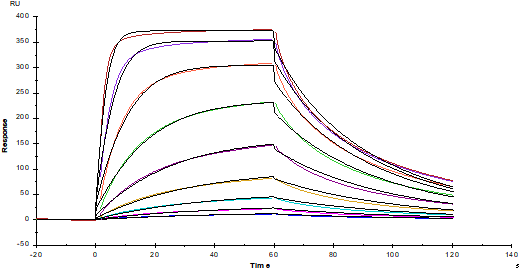
SPR
CM5 Chip captured B7-H2/ICOSLG His Tag Protein, Human (Cat. No. UA010058), can bind ICOS/CD278(C136S, C137S) His Tag Protein, Human (Cat. No. UA011348) with an affinity constant of 45.61nM as determined in SPR assay.