S-RMabMixTM Hypusine Rabbit mAb
S-RMabMixTM Hypusine Rabbit mAb
Price:
Regular price
$200 USD
Regular price
Sale price
$200 USD
Unit price
per
For shipping services or bulk orders, you may request a quotation.
Secure checkout with

View full details
Product Details
Product Details
Product Specification
| Host | Rabbit |
| Synonyms | Hyp, hydroxylysine modification, agmatine, hydrobutylamine modification of lysine |
| Antibody Type | Recombinant mAb Mix |
| Isotype | IgG |
| Application | WB |
| Reactivity | Species Independent |
| Positive Sample | HeLa, HEK-293, mouse liver, mouse spleen |
| Concentration | 2 mg/ml |
| Conjugation | Unconjugated |
| Physical Appearance | Liquid |
| Storage Buffer | PBS, 40% Glycerol, 0.05% BSA, 0.02% sodium azide |
| Stability & Storage | 12 months from date of receipt / reconstitution, -20 °C as supplied |
Dilution
| application | dilution | species |
| WB | 1:500-1:1000 | Species independent |
Background
Hypusine is an extremely special and rare post-translationally modified amino acid. It is not genetically encoded but is generated through a unique "post-translational synthesis" process on an already synthesized protein—the only known substrate to date is the translation initiation factor eIF5A—via a two-step enzymatic reaction. First, deoxyhypusine synthase (DHS) transfers the aminobutyl moiety of spermidine to a specific lysine residue of eIF5A, forming the intermediate deoxyhypusine; subsequently, deoxyhypusine hydroxylase (DOHH) hydroxylates it to generate the mature Hypusine modification. This modification process is evolutionarily highly conserved and is strictly required from yeast to humans, because only Hypusine-modified eIF5A can fulfill its true biological function—specifically promoting the translation elongation of mRNAs containing "rare" codon-rich sequences (such as those encoding cyclins, transcription factors, and components of the mitochondrial respiratory chain), rather than the initiation step as commonly assumed. Therefore, Hypusine modification is vividly regarded as the "gatekeeper" of cell growth. Its biosynthetic pathway serves as a key regulatory node in various diseases: inhibiting DHS or DOHH activity can significantly block tumor cell proliferation and shows anti-inflammatory and antiviral (e.g., against HIV) potential; meanwhile, the eIF5A-Hypusine axis has also been found to be dysregulated in neurodegenerative diseases (such as Alzheimer's disease) and diabetes. For these reasons, this modification pathway has emerged as a promising therapeutic target in the development of novel anticancer and anti-aging drugs.
Picture
Picture
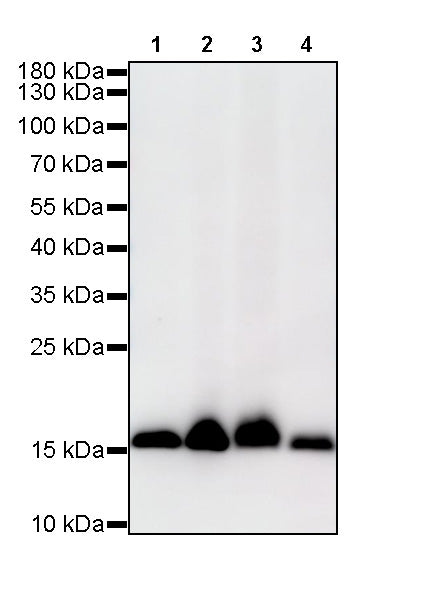
Western Blot
WB result of Hypusine Recombinant Rabbit PAb
Primary antibody: Hypusine Recombinant Rabbit PAb at 1/1000 dilution
Lane 1: HeLa whole cell lysate 20 µg
Lane 2: HEK-293 whole cell lysate 20 µg
Lane 3: mouse liver lysate 20 µg
Lane 4: mouse spleen lysate 20 µg
Secondary antibody: Goat Anti-rabbit IgG, (H+L), HRP conjugated at 1/10000 dilution
Predicted MW: 17 kDa
Observed MW: 16 kDa