S-RMabMixTM β-Hydroxybutyryl Lysine Rabbit mAb
S-RMabMixTM β-Hydroxybutyryl Lysine Rabbit mAb
Price:
Regular price
$200 USD
Regular price
Sale price
$200 USD
Unit price
per
For shipping services or bulk orders, you may request a quotation.
Secure checkout with

View full details
Product Details
Product Details
Product Specification
| Host | Rabbit |
| Synonyms | Kbhb, 3-hydroxybutyrylation, β-hydroxybutyrylation |
| Immunogen | Synthetic Peptide |
| Antibody Type | Recombinant mAb Mix |
| Isotype | IgG |
| Application | WB, Dot blot |
| Reactivity | Species Independent |
| Concentration | 1 mg/ml |
| Conjugation | Unconjugated |
| Physical Appearance | Liquid |
| Storage Buffer | PBS, 40% Glycerol, 0.05% BSA, 0.02% sodium azide |
| Stability & Storage | 12 months from date of receipt / reconstitution, -20 °C as supplied |
Dilution
| application | dilution | species |
| Dot Blot | 1:1000 | Species independent |
| WB | 1:1000 | Species independent |
Background
β-Hydroxybutyryl lysine (abbreviated as Kbhb) is a recently discovered histone lysine acylation modification driven by the ketone body metabolite β-hydroxybutyrate (BHB), which directly links metabolic status to gene expression regulation. Unlike the well-known acetylation and crotonylation, Kbhb formation depends on the covalent attachment of β-hydroxybutyryl groups to histone lysine residues by BHB through specific enzymes such as p300/CBP acyltransferases, while its removal is mediated by deacylases including HDAC1/2 and SIRT3. Functionally, Kbhb possesses a unique structural feature—its additional hydroxyl group enables it to exert distinctly different roles in epigenetic regulation compared to acetylation. Notably, under physiological conditions with significantly elevated ketone levels, such as starvation, fasting, or prolonged exercise, Kbhb is extensively deposited at the promoters and enhancers of active genes, thereby reprogramming gene expression networks. Studies have revealed that a hallmark function of Kbhb is to drive cellular adaptation to metabolic stress by enhancing the transcription of specific genes, such as those involved in oxidative metabolism and antioxidant responses. For example, in the livers of fasted mice, Kbhb modification levels are markedly increased, which in turn upregulates fatty acid oxidation and ketogenesis-related pathways. At the pathological level, dysregulation of this modification is closely associated with various diseases, including cancer, metabolic syndrome, and heart failure, thus positioning Kbhb as a novel molecular bridge connecting nutritional status, epigenetic memory, and disease pathogenesis.
Picture
Picture
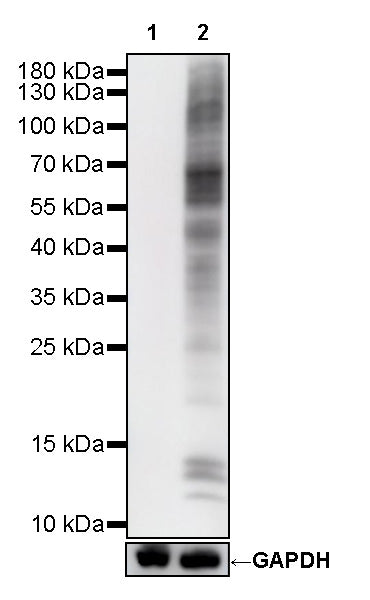
Western Blot
WB result of β-Hydroxybutyryl Lysine Recombinant Rabbit pAb
Primary antibody: β-Hydroxybutyryl Lysine Recombinant Rabbit pAb at 1/1000 dilution
Lane 1: untreated HeLa whole cell lysate 20 µg
Lane 2: HeLa treated with sodium 3-hydroxybutyrate 50 mM for 72 hours whole cell lysate 20 µg
Secondary antibody: Goat Anti-rabbit IgG, (H+L), HRP conjugated at 1/10000 dilution
Predicted MW: multiple bands
Observed MW: multiple bands
Dot Blot
Dot blot result of β-Hydroxybutyryl Lysine Rabbit Polyclonal Antibody
Lane 1: Modified peptide library (β-hydroxybutyryl lysine)
Lane 2: Unmodified peptide library
Lane 3: Modified peptide library (Butyryl lysine)
Lane 4: Modified peptide library (L-lactyl lysine)
Lane 5: Modified peptide library (Fumaryl lysine)
Lane 6: Modified peptide library (Crotonyl lysine)
Lane 7: Modified peptide library (Succinyl lysine)
Lane 8: Modified peptide library (Propionyl lysine)
Lane 9: Modified peptide library (Actyl lysine)
Lane 10: Modified peptide library (Itaconyl lysine)
Primary antibody: β-Hydroxybutyryl Lysine Rabbit Polyclonal Antibody at 1/1000 dilution
Secondary antibody: Goat Anti-rabbit IgG, (H+L), HRP conjugated at 1/10000 dilution