Standard curve
Example of Human Amyloid Beta (aa1-42) standard curve in Assay Diluent AA2.
Human/Monkey/Mouse/Rat Amyloid Beta (aa1-42) Serum & Culture Media OneStep ELISA Kit
Human/Monkey/Mouse/Rat Amyloid Beta (aa1-42) Serum & Culture Media OneStep ELISA Kit
Price:
Regular price
$500 USD
Regular price
Sale price
$500 USD
Unit price
per
For shipping services or bulk orders, you may request a quotation.
Secure checkout with

View full details
Product Details
Product Details
Product Specification
| Antigen | Amyloid Beta (aa1-42) |
| Immunogen | Recombinant Protein |
| Antibody Type | Recombinant mAb |
| Reactivity | Hu, Ms, Rt, Mk |
| Purification | Protein A |
| Stability & Storage | 12 months from date of receipt / reconstitution, 2 to 8°C as supplied. |
Kit
| Precision | Intra-assay: 4.8%; Inter-assay: 7.7% |
| Sample type | Cell Culture Supernatant; Serum |
| Assay type | Sandwich (quantitative) |
| Sensitivity | 1.27 pg/mL |
| Range | 1.56 pg/mL – 100 pg/mL |
| Recovery | Cell culture supernatant: 80% Serum: 87% |
| Assay time | 60 minutes |
| Species reactivity | Human; Monkey; Mouse; Rat |
Background
Amyloid Beta (aa1-42) is a peptide consisting of 42 amino acids, derived from the amyloid precursor protein through sequential proteolytic cleavage by beta- and gamma-secretases. This specific isoform, Aβ(1-42), is highly prone to aggregation due to its two extra hydrophobic residues at the C-terminus, which promote the formation of beta-sheet structures. Once produced, Aβ(1-42) can self-assemble into soluble oligomers, protofibrils, and eventually insoluble amyloid fibrils that deposit as senile plaques in the brain. These aggregates are considered neurotoxic, disrupting synaptic function, triggering inflammatory responses, and inducing oxidative stress. Accumulation of Aβ(1-42) is a hallmark of Alzheimer's disease pathology and is believed to play an initiating role in the neurodegenerative cascade. Moreover, mutations in the amyloid precursor protein or presenilin genes often increase the relative production of Aβ(1-42), leading to early-onset familial Alzheimer's disease. Due to its critical role in disease pathogenesis, Aβ(1-42) serves as a major target for therapeutic interventions, including immunotherapy and small-molecule inhibitors. Understanding the behavior of this peptide at the molecular level is essential for developing strategies to prevent or slow Alzheimer's disease progression.
Picture
Picture
ELISA
Specificity
Example of Human Amyloid Beta (aa1-42) and Human Amyloid Beta (aa1-40) standard curve in Assay Diluent AA2.
Specificity
Test the specificity of different serum.
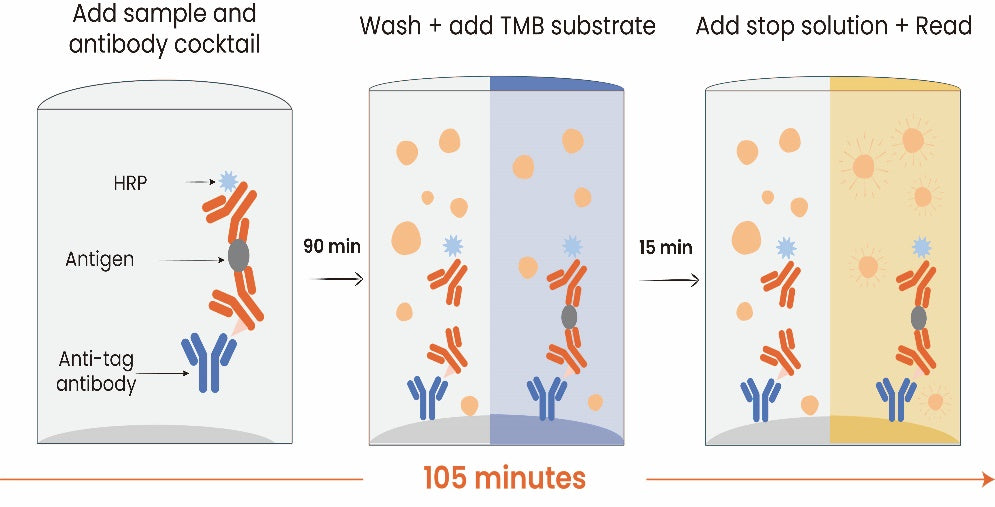
Protocol Diagram