Standard curve
Example of Human Amyloid Beta (aa1-40) standard curve in Assay Diluent AA2.
Human/Monkey/Mouse/Rat Amyloid Beta (aa1-40) Serum & Culture Media OneStep ELISA Kit
Human/Monkey/Mouse/Rat Amyloid Beta (aa1-40) Serum & Culture Media OneStep ELISA Kit
Price:
Regular price
$500 USD
Regular price
Sale price
$500 USD
Unit price
per
For shipping services or bulk orders, you may request a quotation.
Secure checkout with

View full details
Product Details
Product Details
Product Specification
| Antigen | Amyloid Beta (aa1-40) |
| Immunogen | Recombinant Protein |
| Antibody Type | Recombinant mAb |
| Reactivity | Hu, Ms, Rt, Mk |
| Purification | Protein A |
| Stability & Storage | 12 months from date of receipt / reconstitution, 2 to 8°C as supplied. |
Kit
| Precision | Intra-assay: 3.2%; Inter-assay: 3.6% |
| Sample type | Cell Culture Supernatant; Serum |
| Assay type | Sandwich (quantitative) |
| Sensitivity | 1.10 pg/mL |
| Range | 2.34 pg/mL – 150 pg/mL |
| Recovery | Cell culture supernatant: 90% Serum: 93% |
| Assay time | 60 minutes |
| Species reactivity | Human; Monkey; Mouse; Rat |
Background
Amyloid Beta (aa1-40) is a 40-amino-acid peptide derived from the amyloid precursor protein through proteolytic cleavage by beta- and gamma-secretases. As the most abundantly produced isoform of amyloid beta in the brain, Aβ(1-40) constitutes roughly 80-90% of all secreted Aβ peptides under normal physiological conditions. Unlike its more aggregation-prone counterpart Aβ(1-42), Aβ(1-40) exhibits a lower tendency to form beta-sheet structures and insoluble fibrils due to its reduced hydrophobicity at the C-terminus. However, it can still aggregate into soluble oligomers and fibrils, particularly in the presence of certain mutations or lipid environments. Although Aβ(1-40) is less neurotoxic than Aβ(1-42) on a per-molecule basis, its high abundance means it still contributes significantly to amyloid plaque formation in Alzheimer's disease. In fact, Aβ(1-40) is often the predominant species found in cerebral amyloid angiopathy, where it accumulates in blood vessel walls rather than brain parenchyma. This vascular deposition can lead to hemorrhagic strokes and cognitive impairment independent of Alzheimer's pathology. Therefore, understanding Aβ(1-40) is crucial not only for clarifying its role in neurodegenerative diseases but also for developing targeted therapeutic strategies against both parenchymal and vascular amyloid deposits.
Picture
Picture
ELISA
Specificity
Example of Human Amyloid Beta (aa1-40) and Human Amyloid Beta (aa1-42) standard curve in Assay Diluent AA2.
Linearity
The concentrations of Human Amyloid Beta (aa1-40) were measured and interpolated from the target standard curves and corrected for sample dilution.
Sample is undiluted samples are as follows: Human serum was 4-fold dilution. The interpolated dilution factor corrected values are plotted. The mean target concentration was determined to be 40.11 pg/mL in Human serum.
Specificity
Test the specificity of different serum.
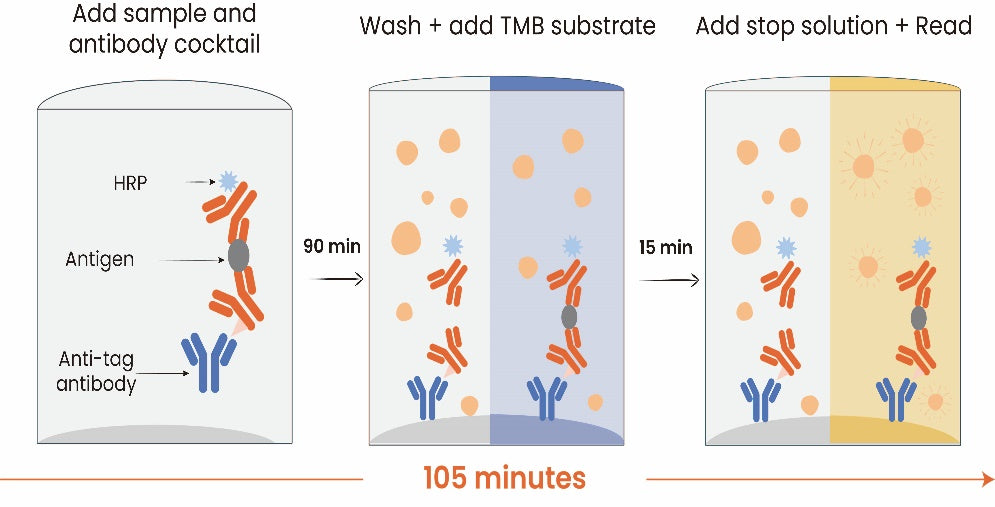
Protocol Diagram