Standard curve
Example of VEGFA standard curve in Assay Diluent .
Human VEGFA Single Plex Kit (Flow Cytometry Bead Assay)
Human VEGFA Single Plex Kit (Flow Cytometry Bead Assay)
Price:
Regular price
$500 USD
Regular price
Sale price
$500 USD
Unit price
per
For shipping services or bulk orders, you may request a quotation.
Secure checkout with

View full details
Product Details
Product Details
Product Specification
| Antigen | VEGFA |
| Reactivity | Human |
| Stability & Storage | 12 months from date of receipt / reconstitution, 2 to 8°C as supplied. |
Kit
| Precision | Intra-assay: 5.33%; Inter-assay: 3.77% |
| Sample type | Serum; Plasma-EDTA; Plasma-Heparin; Plasma-Citrate; Cell Culture Supernatant |
| Assay type | Sandwich (quantitative) |
| Sensitivity | 5.78 pg/mL |
| Range | 2.44 pg/mL-10000 pg/mL |
| Recovery | Serum: 93.28% Plasma-EDTA:80.11% Plasma-Heparin:93.24% Plasma-Citrate:91.32% Cell culture supernatant: 116.30% |
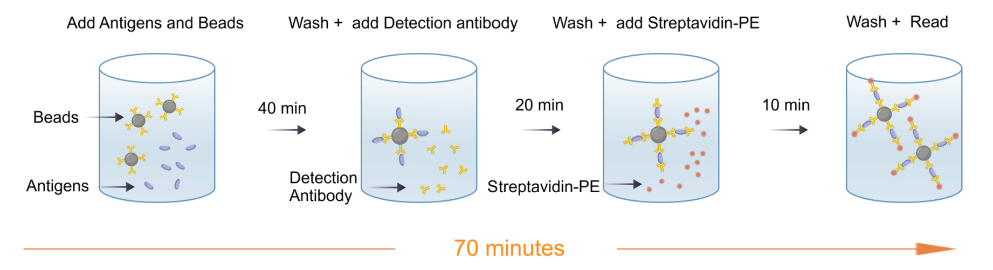
| Assay time | 70 minutes |
| Species reactivity | Human |
Background
Vascular endothelial growth factor (VEGF) is a subfamily of growth factors that play a critical role in stimulating angiogenesis—the formation of new blood vessels. As a key signaling protein, VEGF is involved in both embryonic vascular development and the physiological or pathological growth of existing vasculature. The VEGF family comprises several members, including VEGF-A, VEGF-B, VEGF-C, VEGF-D, and placental growth factor (PlGF), with VEGF-A being the first identified. Prior to the discovery of other isoforms, VEGF-A was commonly referred to as VEGF. Due to its central role in promoting tumor angiogenesis, VEGF is essential for tumor development and metastasis, making it a pivotal target in cancer therapeutics. Accumulating evidence indicates that single nucleotide polymorphisms (SNPs) within the VEGF gene may serve as predictive and prognostic biomarkers for major solid tumors, such as breast cancer, non-small cell lung cancer, colorectal cancer, and prostate cancer.
Picture
Picture
CBA
Quantifiction of human PBMC
Stimulated sample: Human peripheral blood mononuclear cells (PBMCs) were stimulated with 100 ng/mL LPS and 10 ng/mL IL-1α for 16h, and the average concentration of VEGFA in the supernatant was measured to be 202.20 pg/mL.
Unstimulated sample: Human PBMCs were cultured for 16h, and the average concentration of VEGFA in the supernatant was measured to be 18.88 pg/mL.
Linearity
The high-concentration human VEGFA protein was serially diluted using serum, plasma-EDTA, plasma-heparin, plasma-citrate and ccell culture supernatant matrices respectively. Then, the concentration of human VEGFA was determined and interpolated based on the target standard curve, and the sample dilution was corrected.
Protocol Diagram