Standard Curve
Example of Human TRAIL standard curve in Assay Diluent EB9. Plotted are the background-subtracted data.
This standard curve is provided for demonstration only.
Human TRAIL (Serum&Plasma&Cell Culture Media)OneStep ELISA Kit
Human TRAIL (Serum&Plasma&Cell Culture Media)OneStep ELISA Kit
Price:
Regular price
$500 USD
Regular price
Sale price
$500 USD
Unit price
per
For shipping services or bulk orders, you may request a quotation.
Secure checkout with

View full details
Product Details
Product Details
Product Specification
| Antigen | TRAIL |
| Immunogen | Recombinant Protein |
| Antibody Type | Recombinant mAb |
| Reactivity | Hu |
| Purification | Protein A |
| Stability & Storage | 12 months from date of receipt / reconstitution, 2 to 8°C as supplied. |
Kit
| Precision | Intra-assay: 3.0%; Inter-assay: 4.7% |
| Sample type | Serum; Heparin Plasma, Citrate Plasma; Cell Culture Supernatant |
| Assay type | Sandwich (quantitative) |
| Sensitivity | 17.01 pg/mL |
| Range | 62.5 pg/mL -4,000 pg/mL |
| Recovery | Serum: 86% Citrate plasma: 89% Heparin Plasma: 99% Cell Culture Supernatant: 106% |
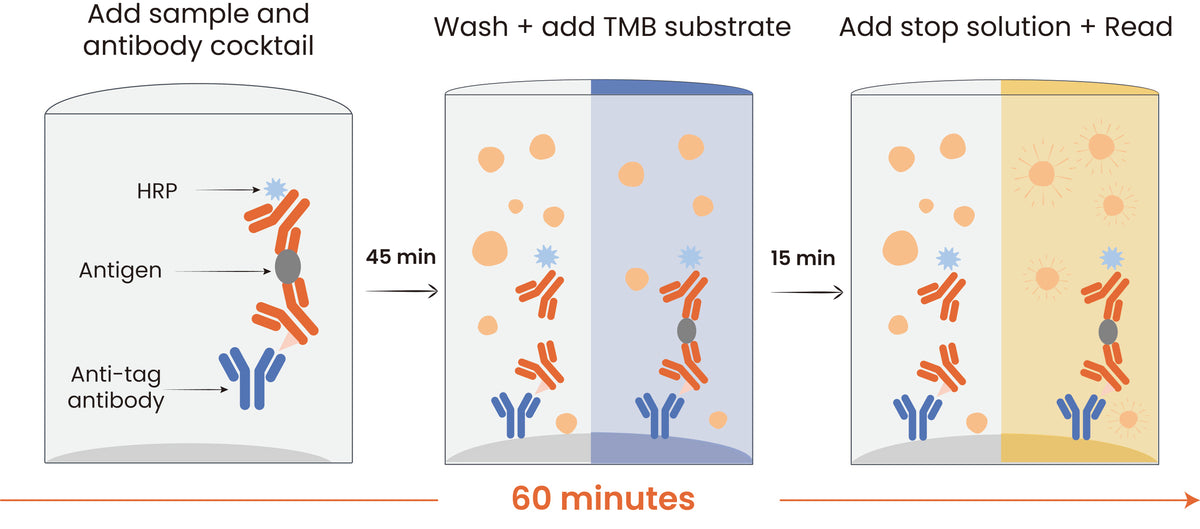
| Assay time | 60 minutes |
| Species reactivity | Hu |
Background
Human TRAIL (TNF-related apoptosis-inducing ligand; TNFSF10; CD253) is a 281-amino-acid type II transmembrane protein of the TNF superfamily that also exists as a biologically active soluble form generated by proteolytic cleavage of its extracellular domain. As a homotrimeric ligand, it engages five distinct receptors: two agonistic death receptors, DR4 (TRAIL-R1) and DR5 (TRAIL-R2), which harbor cytoplasmic death domains, and three antagonistic receptors, the membrane-bound decoy receptors DcR1 (TRAIL-R3) and DcR2 (TRAIL-R4), and the soluble osteoprotegerin (OPG). Upon binding to DR4 or DR5, TRAIL triggers receptor trimerization and assembly of the death-inducing signaling complex (DISC), recruiting FADD and procaspases-8/10; activated caspase-8 then directly cleaves caspase-3 in type I cells or engages the mitochondrial pathway via Bid in type II cells. Physiologically, TRAIL mediates NK cell- and IFN-γ-dependent immune surveillance against tumor cells and virus-infected cells, and contributes to the regulation of T helper responses. Its pro-apoptotic activity is tightly controlled by decoy receptors and by c-FLIP, which competes with caspase-8 at the DISC. Dysregulated TRAIL signaling has been implicated in asthma, sepsis, and autoimmune disorders, and its tumor-selective cytotoxicity has made TRAIL receptor agonists an attractive strategy for cancer therapy.
Picture
Picture
ELISA
Spike Recovery
The recovery of Human TRAIL was evaluated in activated samples spiked with concentrations spanning the entire assay range.
Spike-and-dilution Linearity
To evaluate assay linearity, three samples were spiked with high levels of Human TRAIL in different matrices and serially diluted with the corresponding Calibrator Diluent to fall within the assay's dynamic range.
Intra-Assay Precision (Precision within an assay)
Three samples of known concentration were tested fifteen times on one plate to assess intra-assay precision.
Inter-Assay Precision (Precision between assays).
Three samples of known concentration were tested in separate assays to assess inter-assay precision. Assays were performed with at least three lots of components.
Determination of Minimum Detectable Dose (MDD)
The MDD was determined using three independent lots of assay components. For each lot, 19 replicate measurements of the diluent (zero calibrator) were performed. The mean (AVERAGE) and standard deviation (STDEV) of the 19 replicates were calculated. The MDD for each lot was then calculated according to the following formula:
MDD = 2 × STDEV + AVERAGE
Cross-reactivity
The cross-reactivity between Mouse TRAIL and Human TRAIL was assessed by testing both proteins in the same assay system. Serial dilutions of each protein were measured, and the dose-response curves were compared. No significant cross-reactivity was observed when Mouse TRAIL was tested in the Human TRAIL assay, as the signals remained within the background range of the assay.
HOOK Effect Threshold
The upper limit of the HOOK effect was established at 100× the highest calibrator concentration (equivalent to a 2-log10 increase). No HOOK effect was observed below this threshold, confirming that samples within this concentration range yield reliable quantitative results without signal depression.
Protocol Diagram