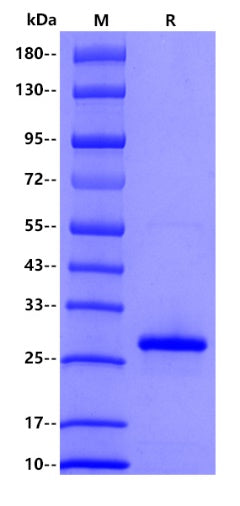
2μg(R: reducing conditions)
Human TMEM119, His tag
Human TMEM119, His tag
Price:
Regular price
$85 USD
Regular price
Sale price
$85 USD
Unit price
per
For shipping services or bulk orders, you may request a quotation.
Secure checkout with

View full details
Product Details
Product Details
Product Specification
| Species | Human |
| Synonyms | Osteoblast induction factor (OBIF) |
| Accession | Q4V9L6 |
| Amino Acid Sequence | Protein sequence (Q4V9L6, Thr118-Val283, with C-10*His)TRQKQKASAYYPSSFPKKKYVDQSDRAGGPRAFSEVPDRAPDSRPEEALDSSRQLQADILAATQNLKSPTRAALGGGDGARMVEGRGAEEEEKGSQEGDQEVQGHGVPVETPEAQEEPCSGVLEGAVVAGEGQGELEGSLLLAQEAQGPVGPPESPCACSSVHPSVGGGGSHHHHHHHHHH |
| Expression System | E. coli |
| Molecular Weight | Predicted MW: 19.1 kDaObserved MW: 30 kDa |
| Purity | >90% by SDS-PAGE |
| Endotoxin | <1EU/μg |
| Tag | with C-His Tag |
| Physical Appearance | Lyophilized powder |
| Storage Buffer | Lyophilized from a 0.2 μm filtered solution of PBS, pH7.4 with 3% trehalose. |
| Reconstitution | Reconstitute no more than 1 mg/mL according to the size in deionized water after rapid centrifugation. |
| Stability & Storage | 12 months from date of receipt, -20 to -70 °C as supplied. |
Background
TMEM119 is known as a microglia-specific and robustly expressed trans-membranous molecule, which is not expressed by other macrophages and immune or neuronal cells, and forms, therefore, the most promising microglia marker to date. TMEM119 has served as a reliable immunohistochemical microglia marker for neurodegenerative diseases since then and was recently stained by an adapted protocol for immunocytochemistry even in postmortem CSF samples of trauma cases.
Picture
Picture
SDS-PAGE