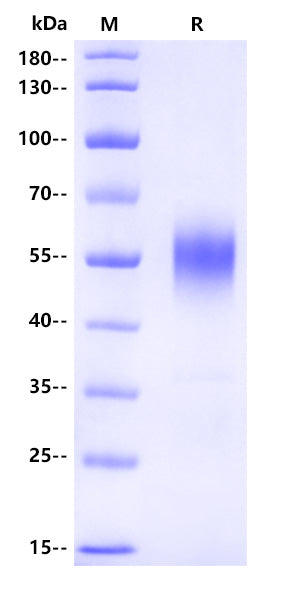
2μg(R: reducing conditions)
Human STAB1 Protein, His Tag
Human STAB1 Protein, His Tag
Price:
Regular price
$45 USD
Regular price
Sale price
$45 USD
Unit price
per
For shipping services or bulk orders, you may request a quotation.
Secure checkout with

View full details
Product Details
Product Details
Product Specification
| Species | Human |
| Synonyms | Stabilin-1, Fasciclin, EGF-like, laminin-type EGF-like and link domain-containing scavenger receptor 1 (FEEL-1), MS-1 antigen, FEEL1, KIAA0246 |
| Accession | Q9NY15 |
| Amino Acid Sequence | Protein sequence (Q9NY15, Asp638-Leu1024, with C-His Tag) DGILLPPTILPILPKHCSEEQHKIVAGSCVDCQALNTSTCPPNSVKLDIFPKECVYIHDPTGLNVLKKGCASYCNQTIMEQGCCKGFFGPDCTQCPGGFSNPCYGKGNCSDGIQGNGACLCFPDYKGIACHICSNPNKHGEQCQEDCGCVHGLCDNRPGSGGVCQQGTCAPGFSGRFCNESMGDCGPTGLAQHCHLHARCVSQEGVARCRCLDGFEGDGFSCTPSNPCSHPDRGGCSENAECVPGSLGTHHCTCHKGWSGDGRVCVAIDECELDMRGGCHTDALCSYVGPGQSRCTCKLGFAGDGYQCSPIDPCRAGNGGCHGLATCRAVGGGQRVCTCPPGFGGDGFSCYGDIFRELEANAHFSIFYQWLKSAGITLPADRRVTAL |
| Expression System | CHO Stable Cells |
| Molecular Weight | Predicted MW: 42.3 kDaObserved MW: 55-60 kDa |
| Purity | >90% by SDS-PAGE |
| Endotoxin | <1EU/μg |
| Conjugation | Unconjugated |
| Tag | with C-His Tag |
| Physical Appearance | Lyophilized powder |
| Storage Buffer | Lyophilized from a 0.2 μm filtered solution of PBS, pH7.4 with 3% trehalose. |
| Reconstitution | Reconstitute no more than 1 mg/mL according to the size in deionized water after rapid centrifugation. |
| Stability & Storage | 12 months from date of receipt, -20 to -70 °C as supplied. |
Background
Stabilin-1 is a large transmembrane glycoprotein primarily expressed on macrophages, sinusoidal endothelial cells (e.g., in liver and spleen), and certain tumor-associated macrophages. It functions as a scavenger receptor and endocytic receptor, mediating the clearance of various ligands from blood and tissue fluids, including acetylated/low-density lipoproteins, advanced glycation end-products (AGEs), and apoptotic cells. By removing harmful molecules and cellular debris, Stabilin-1 contributes to tissue homeostasis, inflammation resolution, and immune regulation. It is also involved in cell adhesion, angiogenesis, and lymphatic vessel development. Dysregulation of Stabilin-1 has been linked to inflammatory diseases, atherosclerosis, and cancer progression, as it facilitates immune evasion in tumors.
Picture
Picture
SDS-PAGE