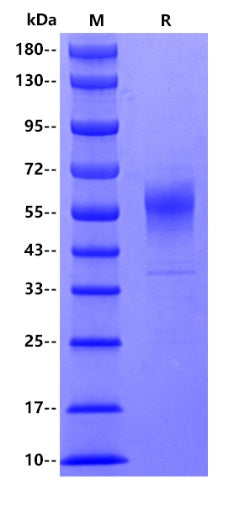
2 μg(R: reducing conditions)
Human PLA2G7, His tag
Human PLA2G7, His tag
Price:
Regular price
$275 USD
Regular price
Sale price
$275 USD
Unit price
per
For shipping services or bulk orders, you may request a quotation.
Secure checkout with

View full details
Product Details
Product Details
Product Specification
| Species | Human |
| Synonyms | Platelet-activating factor acetylhydrolase, PAF acetylhydrolase, 1-alkyl-2-acetylglycerophosphocholine esterase, 2-acetyl-1-alkylglycerophosphocholine esterase, Group-VIIA phospholipase A2 (gVIIA-PLA2), LDL-associated phospholipase A2 (LDL-PLA(2)), PAF 2-acylhydrolase, PAFAH,Lp-PLA2 |
| Accession | Q13093 |
| Amino Acid Sequence | Protein sequence (Q13093, Phe22-Asn441, with C-His tag)FDWQYINPVAHMKSSAWVNKIQVLMAAASFGQTKIPRGNGPYSVGCTDLMFDHTNKGTFLRLYYPSQDNDRLDTLWIPNKEYFWGLSKFLGTHWLMGNILRLLFGSMTTPANWNSPLRPGEKYPLVVFSHGLGAFRTLYSAIGIDLASHGFIVAAVEHRDRSASATYYFKDQSAAEIGDKSWLYLRTLKQEEETHIRNEQVRQRAKECSQALSLILDIDHGKPVKNALDLKFDMEQLKDSIDREKIAVIGHSFGGATVIQTLSEDQRFRCGIALDAWMFPLGDEVYSRIPQPLFFINSEYFQYPANIIKMKKCYSPDKERKMITIRGSVHQNFADFTFATGKIIGHMLKLKGDIDSNVAIDLSNKASLAFLQKHLGLHKDFDQWDCLIEGDDENLIPGTNINTTNQHIMLQNSSGIEKYN |
| Expression System | HEK293 |
| Molecular Weight | Predicted MW: 49.5 kDaObserved MW: 55-70 kDa |
| Purity | >90% by SDS-PAGE |
| Endotoxin | <0.1EU/μg |
| Tag | with C-His Tag |
| Physical Appearance | Lyophilized powder |
| Storage Buffer | Lyophilized from a 0.2 μm filtered solution of PBS, pH7.4 with 3% trehalose. |
| Reconstitution | Reconstitute no more than 1 mg/mL according to the size in deionized water after rapid centrifugation. |
| Stability & Storage | 12 months from date of receipt, -20 to -70 °C as supplied. |
Background
Lipoprotein-associated phospholipase A2 (Lp-PLA2) also known as platelet-activating factor acetylhydrolase (PAF-AH) is a phospholipase A2 enzyme. It is one of several PAF acetylhydrolases that catalyzes the degradation of PAF to inactive products by hydrolysis of the acetyl group at the sn-2 position, producing the biologically inactive products LYSO-PAF and acetate. It is an enzyme produced by inflammatory cells and hydrolyzes oxidized phospholipids in LDL. In the blood Lp-PLA2 travels mainly with low-density lipoprotein (LDL). Less than 20% is associated with high-density lipoprotein HDL. HDL-associated Lp-PLA2 may substantially contribute to the HDL antiatherogenic activities. In human atherosclerotic lesions, 2 main sources of Lp-PLA2 can be identified, including that which is brought into the intima bound to LDL (from the circulation), and that which is synthesized de novo by plaque inflammatory cells (macrophages, T cells, mast cells). It is used as a marker for cardiac disease. Lp-PLA2 levels are positively correlated with increased risk of developing coronary heart disease and stroke.
Picture
Picture
SDS-PAGE