Standard Curve
Example of Human & Monkey beta-NGF standard curve in Assay Diluent TD2. Plotted are the background-subtracted data.
This standard curve is provided for demonstration only.
Human & Monkey beta-NGF OneStep ELISA Kit
Human & Monkey beta-NGF OneStep ELISA Kit
Price:
Regular price
$700 USD
Regular price
Sale price
$700 USD
Unit price
per
For shipping services or bulk orders, you may request a quotation.
Secure checkout with

View full details
Product Details
Product Details
Product Specification
| Antigen | beta-NGF |
| Immunogen | Recombinant Protein |
| Antibody Type | Recombinant mAb |
| Reactivity | Hu, Mk |
| Purification | Protein A |
| Stability & Storage | 12 months from date of receipt / reconstitution, 2 to 8°C as supplied. |
Kit
| Precision | Intra-assay: 4.0%; Inter-assay: 4.6% |
| Sample type | Serum; EDTA Plasma, Citrate Plasma; Cell Culture Supernatant |
| Assay type | Sandwich (quantitative) |
| Sensitivity | 8.37 pg/mL |
| Range | 15.6 pg/mL – 1000 pg/mL |
| Recovery | Human Serum: 99% Human EDTA Plasma: 115% Human Citrate plasma: 117% Cell Culture Supernatant: 107% Monkey Serum: 101% Monkey EDTA Plasma: 93% Monkey Citrate plasma: 113% |
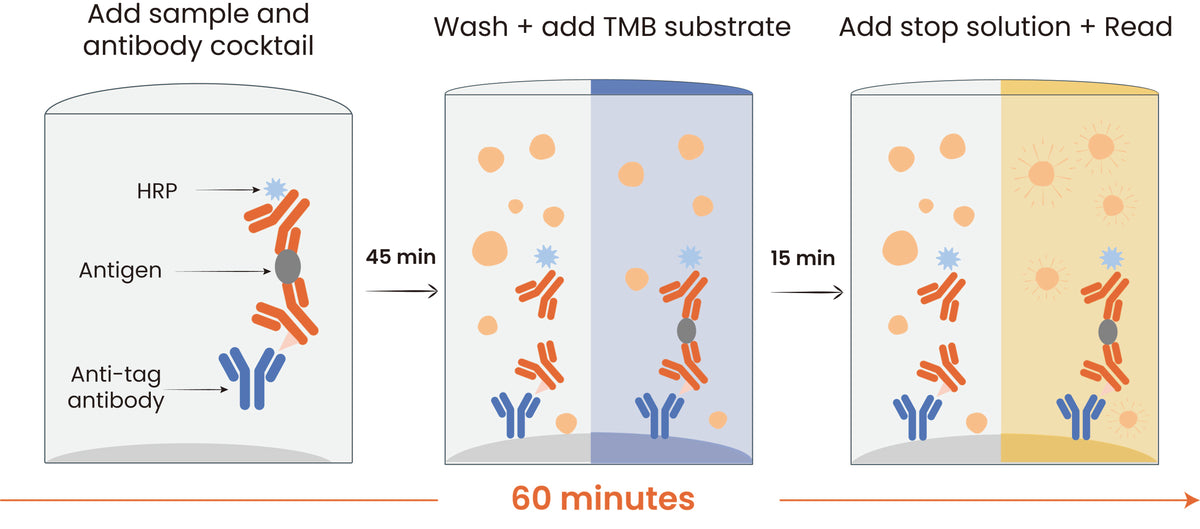
| Assay time | 60 minutes |
| Species reactivity | Hu; Mk |
Background
Human and monkey beta-NGF (β-nerve growth factor) is a highly conserved neurotrophic protein belonging to the neurotrophin family, essential for the survival, development, and maintenance of sympathetic and sensory neurons. Its biologically active form is a homodimer, with each monomer containing three intrachain disulfide bonds critical for its function. In humans, the mature protein is encoded by the NGF gene and consists of 120 amino acids with a molecular weight of approximately 13.5 kDa per monomer. This protein exhibits remarkable sequence conservation across species, including non-human primates such as macaques, reflecting the evolutionary importance of its neurotrophic function. Beta-NGF exerts its biological effects primarily by binding to the high-affinity TrkA receptor, triggering signaling cascades that promote neuronal differentiation, growth, and survival. The critical role of this protein is underscored by the fact that mutations in the human beta-NGF gene are associated with hereditary sensory and autonomic neuropathy type V (HSAN5), characterized by loss of pain perception. Beyond its neural functions, beta-NGF also participates in other physiological contexts; for instance, studies in cynomolgus monkeys have revealed elevated serum beta-NGF levels during pregnancy, suggesting involvement in reproductive biology. Due to its potent neuroprotective properties, recombinant human beta-NGF has been explored as a potential therapeutic candidate for neurodegenerative conditions such as Alzheimer's disease. The high degree of homology between human and monkey beta-NGF further supports the use of primate models in preclinical research aimed at understanding its biological functions and therapeutic applications.
Picture
Picture
ELISA
Spike Recovery
The recovery of Human & Monkey beta-NGF was evaluated in activated samples spiked with concentrations spanning the entire assay range.
Serum levels in healthy individuals
Duplicate measurements were performed on serum samples obtained from eight individual healthy donors. Data are reported as dilution factor-corrected interpolated. The resultant mean Human & Monkey beta-NGF concentration was 24.0 pg/mL, with a distribution spanning 9.5 to 58.4 pg/mL across the donor cohort.
Spike-and-dilution Linearity
To evaluate assay linearity, four samples were spiked with high levels of Human & Monkey beta-NGF in different matrices and serially diluted with the corresponding Calibrator Diluent to fall within the assay's dynamic range.
Intra-Assay Precision (Precision within an assay)
Three samples of known concentration were tested fifteen times on one plate to assess intra-assay precision.
Inter-Assay Precision (Precision between assays).
Three samples of known concentration were tested in separate assays to assess inter-assay precision. Assays were performed with at least three lots of components.
Determination of Minimum Detectable Dose (MDD)
The MDD was determined using three independent lots of assay components. For each lot, 19 replicate measurements of the diluent (zero calibrator) were performed. The mean (AVERAGE) and standard deviation (STDEV) of the 19 replicates were calculated. The MDD for each lot was then calculated according to the following formula:
MDD = 2 × STDEV + AVERAGE
HOOK Effect Threshold
The upper limit of the HOOK effect was established at 100× the highest calibrator concentration (equivalent to a 2-log10 increase). No HOOK effect was observed below this threshold, confirming that samples within this concentration range yield reliable quantitative results without signal depression.
Protocol Diagram