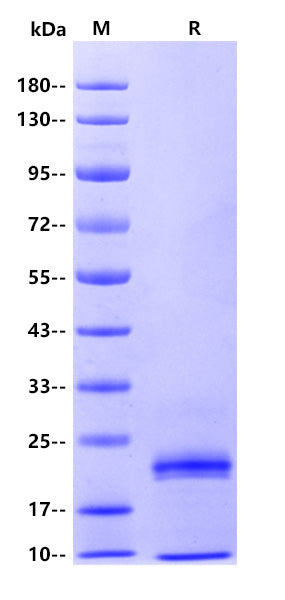
2μg(R: reducing conditions)
Human Kallikrein 6 Protein, His Tag
Human Kallikrein 6 Protein, His Tag
Price:
Regular price
$235 USD
Regular price
Sale price
$235 USD
Unit price
per
For shipping services or bulk orders, you may request a quotation.
Secure checkout with

View full details
Product Details
Product Details
Product Specification
| Species | Human |
| Synonyms | Kallikrein-6, Neurosin, Protease M, SP59, Serine protease 18, Serine protease 9, Zyme, KLK6, PRSS18, PRSS9 |
| Accession | Q92876 |
| Amino Acid Sequence | Protein sequence (Q92876, Glu17-Lys244, with C-His Tag) EEQNKLVHGGPCDKTSHPYQAALYTSGHLLCGGVLIHPLWVLTAAHCKKPNLQVFLGKHNLRQRESSQEQSSVVRAVIHPDYDAASHDQDIMLLRLARPAKLSELIQPLPLERDCSANTTSCHILGWGKTADGDFPDTIQCAYIHLVSREECEHAYPGQITQNMLCAGDEKYGKDSCQGDSGGPLVCGDHLRGLVSWGNIPCGSKEKPGVYTNVCRYTNWIQKTIQAK |
| Expression System | HEK293 |
| Molecular Weight | Predicted MW: 26.8 kDaObserved MW: 10, 20 kDa |
| Purity | >95% by SDS-PAGE |
| Endotoxin | <1EU/μg |
| Conjugation | Unconjugated |
| Tag | with C-His Tag |
| Physical Appearance | Lyophilized powder |
| Storage Buffer | Lyophilized from a 0.2 μm filtered solution of PBS, pH7.4 with 3% trehalose. |
| Reconstitution | Reconstitute no more than 1 mg/mL according to the size in deionized water after rapid centrifugation. |
| Stability & Storage | 12 months from date of receipt, -20 to -70 °C as supplied. |
Background
Kallikrein-6 (KLK6), also known as neurosin or zyme, is a serine protease belonging to the kallikrein family of proteins. It is predominantly expressed in the central nervous system and has been implicated in various physiological and pathological processes, including demyelination, inflammation, and neurodegeneration. Elevated KLK6 levels are associated with multiple sclerosis, Alzheimer's disease, and certain cancers. The protein functions by cleaving extracellular matrix components and myelin basic protein, contributing to tissue remodeling and disease progression. KLK6 is also being explored as a potential biomarker and therapeutic target.
Picture
Picture
SDS-PAGE