Standard curve
Example of Human IL-21 standard curve in Assay Diluent DB4K6.
Human IL-21 Culture medium OneStep ELISA Kit
Human IL-21 Culture medium OneStep ELISA Kit
Price:
Regular price
$500 USD
Regular price
Sale price
$500 USD
Unit price
per
For shipping services or bulk orders, you may request a quotation.
Secure checkout with

View full details
Product Details
Product Details
Product Specification
| Antigen | IL-21 |
| Immunogen | Recombinant Protein |
| Antibody Type | Recombinant mAb |
| Reactivity | Hu |
| Purification | Protein A |
| Stability & Storage | 12 months from date of receipt / reconstitution, 2 to 8'C as supplied. |
Kit
| Precision | Intra-assay: 3.6%; Inter-assay: 4.5% |
| Sample type | Cell culture supernatant |
| Assay type | Sandwich (quantitative) |
| Sensitivity | 40.746 pg/mL |
| Range | 131.7 pg/mL – 1500 pg/mL |
| Recovery | Cell culture supernatant: 112% |
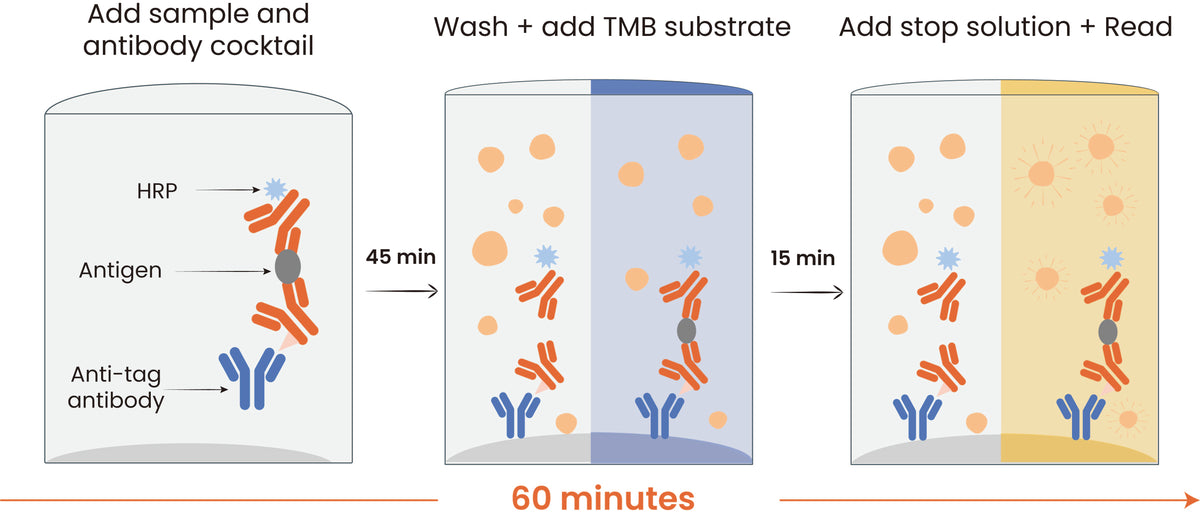
| Assay time | 60 minutes |
| Species reactivity | Hu |
Background
Interleukin-21 (IL-21) is a multifunctional type I cytokine primarily secreted by activated CD4+ T cells, including T follicular helper (Tfh) and Th17 subsets. It signals through a receptor complex consisting of a unique IL-21 receptor (IL-21R) and the common γ-chain, activating JAK-STAT, MAPK, and PI3K pathways. IL-21 plays a central role in modulating both adaptive and innate immune responses: it critically regulates B cell differentiation, class-switching, and antibody production; enhances the activity and expansion of CD8+ cytotoxic T cells and NK cells; and influences CD4+ T cell fate. Due to these potent immunoregulatory functions, IL-21 is deeply involved in the pathogenesis of autoimmune diseases (e.g., systemic lupus erythematosus, rheumatoid arthritis) and promotes anti-tumor immunity. Consequently, the IL-21 pathway is a promising therapeutic target, with strategies ranging from recombinant IL-21 as a potential immunostimulant in oncology to blocking antibodies for treating autoimmune and inflammatory conditions.
Picture
Picture
ELISA
To assess the linearity of the assay, two samples were spiked with high concentrations of Human IL-21 in various matrices and diluted with the appropriate Calibrator Diluent to produce samples with values within the dynamic range of the assay.
Protocol Diagram