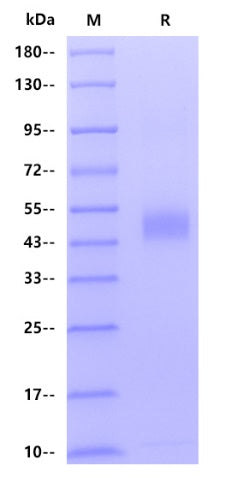
2μg(R: reducing conditions)
Human CD1D Protein, His tag
Human CD1D Protein, His tag
Price:
Regular price
$350 USD
Regular price
Sale price
$350 USD
Unit price
per
For shipping services or bulk orders, you may request a quotation.
Secure checkout with

View full details
Product Details
Product Details
Product Specification
| Species | Human |
| Synonyms | Antigen-presenting glycoprotein CD1d, R3G1, CD1d |
| Accession | P15813 |
| Amino Acid Sequence | Protein sequence (P15813, Val21-Gly296, with C-His tag) VPQRLFPLRCLQISSFANSSWTRTDGLAWLGELQTHSWSNDSDTVRSLKPWSQGTFSDQQWETLQHIFRVYRSSFTRDVKEFAKMLRLSYPLELQVSAGCEVHPGNASNNFFHVAFQGKDILSFQGTSWEPTQEAPLWVNLAIQVLNQDKWTRETVQWLLNGTCPQFVSGLLESGKSELKKQVKPKAWLSRGPSPGPGRLLLVCHVSGFYPKPVWVKWMRGEQEQQGTQPGDILPNADETWYLRATLDVVAGEAAGLSCRVKHSSLEGQDIVLYWG |
| Expression System | HEK293 |
| Molecular Weight | Predicted MW: 33 kDaObserved MW: 43-55 kDa |
| Purity | >90% by SDS-PAGE |
| Endotoxin | <1EU/μg |
| Conjugation | Unconjugated |
| Tag | with C-His Tag |
| Physical Appearance | Lyophilized powder |
| Storage Buffer | Lyophilized from a 0.2 μm filtered solution of PBS, pH7.4 with 3% trehalose. |
| Reconstitution | Reconstitute no more than 1 mg/mL according to the size in deionized water after rapid centrifugation. |
| Stability & Storage | 12 months from date of receipt, -20 to -70 °C as supplied. |
Background
CD1D is a non-classical MHC class I-like glycoprotein specializing in lipid antigen presentation to T cells, particularly natural killer T (NKT) cells. Unlike classical MHC molecules, it presents lipid and glycolipid antigens via a unique binding groove. Expressed on antigen-presenting cells, CD1D bridges innate and adaptive immunity by activating NKT cells to secrete cytokines, influencing responses to infections, autoimmunity, and cancer. Genetic variants are associated with diseases like type 1 diabetes.
Picture
Picture
SDS-PAGE