Standard Curve
Example of Human & Monkey beta-NGF standard curve in Assay Diluent TD2. Plotted are the background-subtracted data.
This standard curve is provided for demonstration only.
Human BCMA/TNFRSF17 OneStep ELISA Kit
Human BCMA/TNFRSF17 OneStep ELISA Kit
Price:
Regular price
$500 USD
Regular price
Sale price
$500 USD
Unit price
per
For shipping services or bulk orders, you may request a quotation.
Secure checkout with

View full details
Product Details
Product Details
Product Specification
| Antigen | BCMA/TNFRSF17 |
| Immunogen | Recombinant Protein |
| Antibody Type | Recombinant mAb |
| Reactivity | Hu |
| Purification | Protein A |
| Stability & Storage | 12 months from date of receipt / reconstitution, 2 to 8°C as supplied. |
Kit
| Precision | Intra-assay: 3.9%; Inter-assay: 5.2% |
| Sample type | Serum; EDTA Plasma, Heparin Plasma, Citrate Plasma; Cell Culture Supernatant |
| Assay type | Sandwich (quantitative) |
| Sensitivity | 4.34 pg/mL |
| Range | 15.6 pg/mL – 1000 pg/mL |
| Recovery | Human Serum: 101% Human EDTA Plasma: 105% Human Heparin plasma: 99% Human Citrate plasma: 107% |
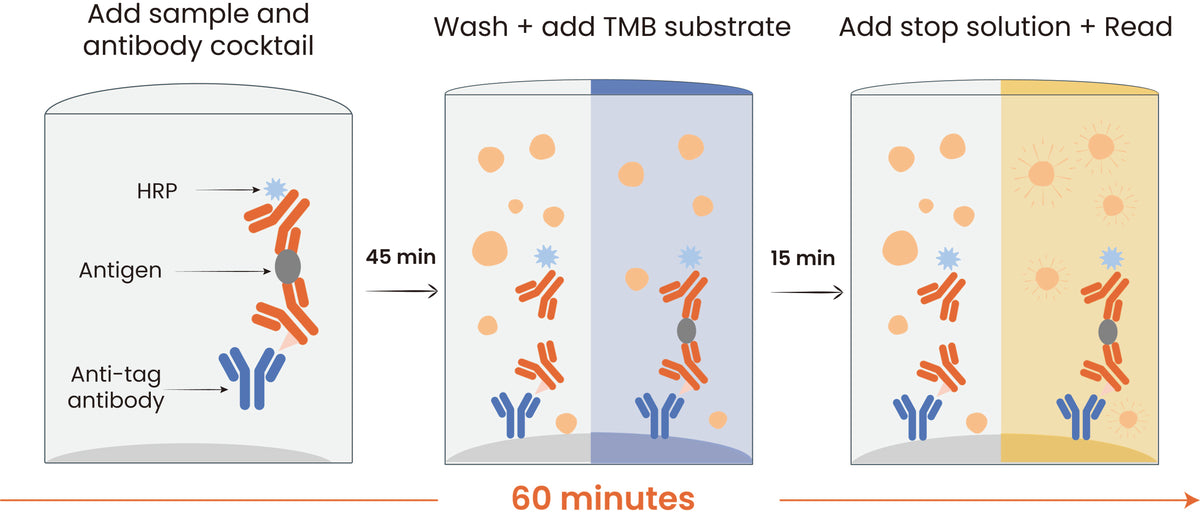
| Assay time | 60 minutes |
| Species reactivity | Hu |
Background
Human BCMA (B-cell maturation antigen), also known as TNFRSF17 or CD269, is a type III transmembrane glycoprotein belonging to the tumor necrosis factor receptor superfamily. Encoded by the TNFRSF17 gene located on human chromosome 16, the protein consists of an extracellular N-terminal cysteine-rich domain, a transmembrane region, and a cytoplasmic C-terminal tail. Its expression is highly restricted, being predominantly found on mature B lymphocytes, particularly long-lived plasma cells, while absent from T cells and monocytes. Functionally, BCMA serves as the receptor for two key ligands, BAFF (B-cell activating factor) and APRIL (a proliferation-inducing ligand). Upon ligand binding, BCMA activates multiple downstream signaling cascades, including the NF-κB and JNK pathways, through the recruitment of TRAF family members. These signals are critical for promoting B-cell survival, proliferation, and differentiation, thereby playing an essential role in humoral immunity. In pathological settings, BCMA has garnered significant clinical attention due to its overexpression on malignant plasma cells in multiple myeloma, where it provides crucial survival signals that protect tumor cells from apoptosis. This restricted expression profile makes BCMA an exceptionally attractive therapeutic target, particularly for chimeric antigen receptor T-cell (CAR-T) therapy, which has shown remarkable efficacy in treating relapsed or refractory multiple myeloma. Additionally, elevated levels of soluble BCMA in serum have emerged as a valuable biomarker for monitoring disease progression and assessing treatment response in myeloma patients, further underscoring the clinical relevance of this protein.
Picture
Picture
ELISA
Spike Recovery
The recovery of Human & Monkey beta-NGF was evaluated in activated samples spiked with concentrations spanning the entire assay range.
Serum levels in healthy individuals
Duplicate measurements were performed on serum samples obtained from eight individual healthy donors. Data are reported as dilution factor-corrected interpolated. The resultant mean Human & Monkey beta-NGF concentration was 24.0 pg/mL, with a distribution spanning 9.5 to 58.4 pg/mL across the donor cohort.
Spike-and-dilution Linearity
To evaluate assay linearity, four samples were spiked with high levels of Human & Monkey beta-NGF in different matrices and serially diluted with the corresponding Calibrator Diluent to fall within the assay's dynamic range.
Intra-Assay Precision (Precision within an assay)
Three samples of known concentration were tested fifteen times on one plate to assess intra-assay precision.
Inter-Assay Precision (Precision between assays).
Three samples of known concentration were tested in separate assays to assess inter-assay precision. Assays were performed with at least three lots of components.
Determination of Minimum Detectable Dose (MDD)
The MDD was determined using three independent lots of assay components. For each lot, 19 replicate measurements of the diluent (zero calibrator) were performed. The mean (AVERAGE) and standard deviation (STDEV) of the 19 replicates were calculated. The MDD for each lot was then calculated according to the following formula:
MDD = 2 × STDEV + AVERAGE
HOOK Effect Threshold
The upper limit of the HOOK effect was established at 100× the highest calibrator concentration (equivalent to a 2-log10 increase). No HOOK effect was observed below this threshold, confirming that samples within this concentration range yield reliable quantitative results without signal depression.
Protocol Diagram