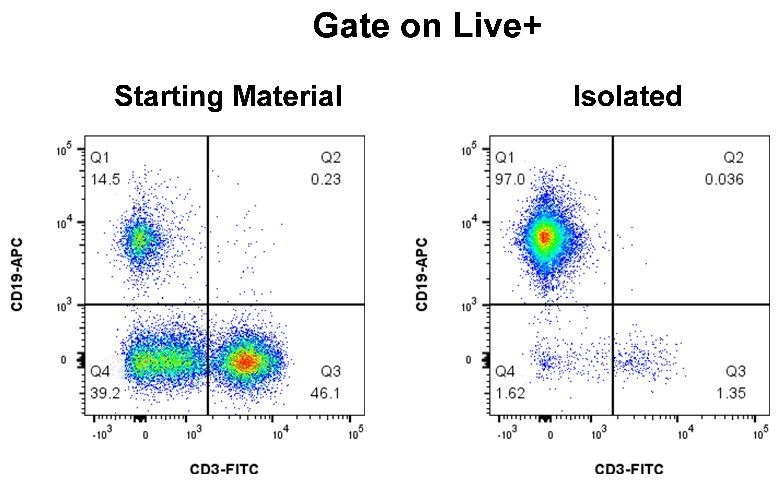
Human B cells were enriched from peripheral blood mononuclear cells (PBMCs), and the sorted cells were stained with CD19-APC (clone: HIB19) and CD3-FITC (clone: UCHT1) fluorescent antibodies. Analysis was performed by gating on live cells (Live+), and the proportion of B cells in the sorted fraction was determined. Flow cytometric analysis revealed that the purity of B cells after this sorting step was 97%.
Human B Cell Isolation Kit (Column-Free)
Human B Cell Isolation Kit (Column-Free)
Price:
Regular price
$920 USD
Regular price
Sale price
$920 USD
Unit price
per
For shipping services or bulk orders, you may request a quotation.
Secure checkout with

View full details
Product Details
Product Details
Product Specification
| Format |
1 mL Human B Cell Biotin-Antibody Cocktail 1mL Streptavidin Beads |
| Capacity | Suitable for a total cell count of 1×10⁹, and can perform up to 100 sorting runs. |
| Principle of Separation | This kit employs a column-based negative selection approach to isolate B cells from human PBMCs. In this negative-selection process, non-B cells are labeled with biotin-conjugated antibodies, and the cells are then incubated with streptavidin-nanomagnetic beads. As a result, the unwanted cells become bound to the beads via the antibody‑antigen complex, while the target B cells remain unlabeled. The cell suspension is subsequently loaded onto a separation column; under the influence of a magnetic field, the magnetically labeled non-target cells are retained within the column, whereas the unlabeled B cells elute by gravity into a collection tube. The resulting supernatant represents the B-cell‑enriched fraction after removal of the non-target cells. |
| Reactivity | Human |
| Magnetic Bead Size | 150 nm |
| Separation Method | Column-Free |
| Selection Strategy | Negative Selection |
| Stability & Storage | Store protected from light at 2–8 °C; do not freeze. |
Background
Human B lymphocytes are the core effectors of adaptive humoral immune responses, performing critical functions such as antigen recognition, processing and presentation, antibody secretion, and maintenance of immunological memory. They play an irreplaceable role in defending against extracellular pathogen infections and regulating the intensity of immune responses. The CD19 molecule is the most representative lineage-specific marker on the B-cell surface; it belongs to the immunoglobulin superfamily and is stably expressed from the early pre-B cell stage through to mature plasma cells. CD19 collaborates with the B-cell receptor to regulate B-cell activation, proliferation, and differentiation, serving as a key regulatory molecule for B-cell development and functional maintenance. Consequently, it is widely used as a specific surface antigen of human B cells. In immunological research, obtaining B cells that are highly pure, highly active, and whose surface molecules remain undisturbed is an essential prerequisite for ensuring the reliability of experimental results. This negative-selection kit is based on the principle of negative sorting, employing a biotin‑labeled antibody panel to specifically label non‑B cells. The identified targets include various interfering cell populations, such as T cells, NK cells, monocytes, macrophages, platelets, and erythroid cells. Streptavidin‑coated nanomagnetic beads are then used to efficiently remove non‑target cells. Throughout the entire sorting process, no antibodies bind to any antigens on the B‑cell surface, thereby maximizing the preservation of the cells' native morphology, the integrity of their surface markers, and their biological functional activity, providing high‑quality cellular material for downstream applications such as gene expression analysis, in vitro culture and expansion, and functional characterization.
Protocol
Note: This kit does not include sorting buffer; please prepare it yourself. The corresponding Stater catalog number isS0D3018
Steps |
Operating Instructions |
Dosage and Time |
1 |
Isolate PBMCs from peripheral blood using density gradient centrifugation with lymphocyte separation solution, or directly thaw cryopreserved PBMC cells, and perform cell counting; Note:It is recommended to count cells after AO/PI staining; PBMCs can be centrifuged at 400 g for 7 minutes; |
Sample Preparation |
2 |
Resuspend 1×10 in 100 μL of MagSep Separation Buffer.7Cells; Note:Adjust the reagents proportionally according to the sample volume; set aside a pre-sorting sample to test the proportion of human B cells; |
1×10⁷cells/100 μL |
3 |
Add 10 μL of Human B cell Biotin Antibody Cocktail to the sample and gently mix. Note:In this step, gentle pipetting 2–3 times can be used to mix thoroughly. |
10 μL/100 μL |
4 |
Incubate the antibodies in the cocktail with the cells at room temperature for 10 min; |
Incubate at room temperature for 10 min |
5 |
Shake for 5–30 s to mix the Streptavidin beads; |
Shake for 5–30 s |
6 |
Add 10 μL of Streptavidin beads to the sample; |
10 μL/100 μL |
7 |
Gently mix the magnetic beads and cells, and incubate at room temperature for 5 minutes; Note:In this step, mixing can be done by gently pipetting up and down 2–3 times; During this step, the magnetic beads may settle at the bottom; you can remix them again at around 2.5 minutes; |
Incubate at room temperature for 5 minutes |
8 |
Add MagSep Separation Buffer to the sample and immediately place it on the magnetic stand to prevent the magnetic beads from settling heavily at the bottom; |
Bring the total volume up to 2.5 mL (for a 5 mL flow cytometry tube) Add the total volume to 7.5 mL (using a 15 mL centrifuge tube) |
9 |
Place the sample on the magnetic stand so that the magnetic beads adhere to the tube wall; |
Adsorb using a single-well magnetic stand (3 min) Adsorb using a multi-well magnetic stand (5 min) |
10 |
Tilt the magnetic stand and pour the sample into a new collection tube to collect it; Note:The sorted cells can be centrifuged at 400 g for 7 minutes, for subsequent culture and analysis. |
Cell sorting successful |
|
Note:For 0.1–1 × 10^8 cells (0.1–1 mL), it is recommended to use a 5 mL single-well magnetic separator (Starter EasyIso Separator) with a total adsorption volume of 2.5 mL. For 2–5 × 10^8 cells (2–5 mL), it is recommended to use a 15 mL multi-well magnetic separator (Starter EasyEights EasyIso Separator) with a total adsorption volume of 7.5 mL. | ||
Picture
Picture
Validation Data