WB result of HSP27/HSPB1 Rabbit pAb
Primary antibody: HSP27/HSPB1 Rabbit pAb at 1/1000 dilution
Lane 1: HT-1080 whole cell lysate 20 µg
Lane 2: HeLa whole cell lysate 20 µg
Lane 3: HepG2 whole cell lysate 20 µg
Lane 4: BxPC-3 whole cell lysate 20 µg
Lane 5: A549 whole cell lysate 20 µg
Lane 6: U-2 OS whole cell lysate 20 µg
Negative control: HT-1080 whole cell lysate
Secondary antibody: Goat Anti- rabbit IgG, (H+L), HRP conjugated at 1/10000 dilution
Predicted MW: 23 kDa
Observed MW: 25 kDa
HSP27/HSPB1 Rabbit Polyclonal Antibody
HSP27/HSPB1 Rabbit Polyclonal Antibody
Price:
Regular price
$100 USD
Regular price
Sale price
$100 USD
Unit price
per
For shipping services or bulk orders, you may request a quotation.
Secure checkout with

View full details
Product Details
Product Details
Product Specification
| Host | Rabbit |
| Antigen | HSP27 |
| Synonyms | Heat shock protein beta-1; 28 kDa heat shock protein; Estrogen-regulated 24 kDa protein; Heat shock 27 kDa protein (HSP 27); Heat shock protein family B member 1; Stress-responsive protein 27 (SRP27); HSP28 |
| Immunogen | Recombinant Protein |
| Location | Cytoplasm, Cytoskeleton, Nucleus |
| Accession | P04792 |
| Antibody Type | Polyclonal antibody |
| Isotype | IgG |
| Application | WB |
| Reactivity | Hu, Mk |
| Positive Sample | HeLa, HepG2, BxPC-3, A549, U-2 OS, COS-7 |
| Purification | Immunogen Affinity |
| Concentration | 2 mg/ml |
| Conjugation | Unconjugated |
| Physical Appearance | Liquid |
| Storage Buffer | PBS, 40% Glycerol, 0.05% BSA, 0.02% sodium azide |
| Stability & Storage | 12 months from date of receipt / reconstitution, -20 °C as supplied |
Dilution
| application | dilution | species |
| WB | 1:1000 | Hu, Mk |
Background
HSP27 (Heat Shock Protein 27, also known as HSPB1) is one of the most representative members of the small heat shock protein family. As an ATP-independent molecular chaperone, it plays a core protective role in maintaining cellular protein homeostasis and enhancing cell survival under stress conditions. The structural features of this protein include a conserved α-crystallin domain at its C-terminus, which mediates the formation of dynamic large-molecular-weight oligomers (typically composed of 16-32 subunits), and an N-terminal WDPF motif responsible for interactions with other small heat shock protein family members and client proteins. When cells are subjected to stimuli such as heat shock, oxidative stress, radiation, or chemotherapeutic agents, HSP27 expression is rapidly upregulated. It recognizes and binds to denatured or misfolded proteins, preventing their irreversible aggregation while creating opportunities for refolding by other ATP-dependent chaperones, such as Hsp70. In addition to its chaperone activity, HSP27 possesses important independent functions: it exerts anti-apoptotic effects by directly binding to cytochrome c and inhibiting caspase activation, while also participating in regulating the dynamic reorganization of the actin cytoskeleton and scavenging intracellular reactive oxygen species. Clinical studies have shown that HSP27 is highly expressed in various tumors (such as breast cancer, liver cancer, and prostate cancer), closely correlating with tumor malignancy, drug resistance, and poor prognosis. Meanwhile, abnormal expression or mutation of this protein is also associated with pathological conditions such as neurodegenerative diseases (e.g., Charcot-Marie-Tooth disease type 2F) and myocardial ischemia-reperfusion injury, making it a potential intervention target in cancer therapy and neuroprotection research.
Picture
Picture
Western Blot
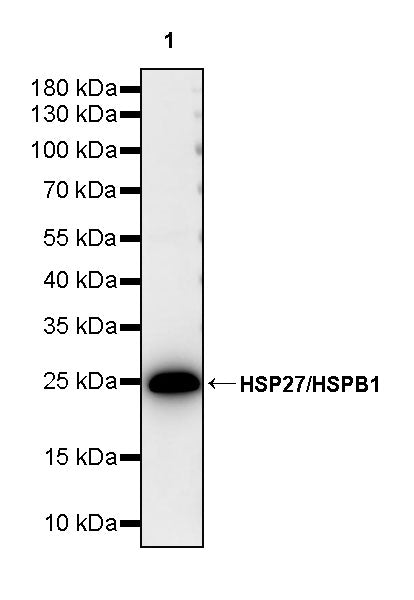
WB result of HSP27/HSPB1 Rabbit pAb
Primary antibody: HSP27/HSPB1 Rabbit pAb at 1/1000 dilution
Lane 1: COS-7 whole cell lysate 20 µg
Secondary antibody: Goat Anti- rabbit IgG, (H+L), HRP conjugated at 1/10000 dilution
Predicted MW: 23 kDa
Observed MW: 25 kDa