WB result of HPD Recombinant Rabbit mAb
Primary antibody: HPD Recombinant Rabbit mAb at 1/1000 dilution
Lane 1: HeLa whole cell lysate 20 µg
Lane 2: HepG2 whole cell lysate 20 µg
Lane 3: A-204 whole cell lysate 20 µg
Secondary antibody: Goat Anti-Rabbit IgG (H+L), HRP conjugated at 1/10000 dilution
Predicted MW: 45 kDa
Observed MW: 39 kDa
HPD Recombinant Rabbit mAb (S-4536-65)
HPD Recombinant Rabbit mAb (S-4536-65)
Price:
Regular price
$100 USD
Regular price
Sale price
$100 USD
Unit price
per
For shipping services or bulk orders, you may request a quotation.
Secure checkout with

View full details
Product Details
Product Details
Product Specification
| Host | Rabbit |
| Antigen | HPD |
| Synonyms | 4-hydroxyphenylpyruvate dioxygenase; 4-hydroxyphenylpyruvic acid oxidase (4HPPD; HPD; HPPDase); N(6)-adenosine-methyltransferase HPD; PPD |
| Immunogen | Synthetic Peptide |
| Location | Cytoplasm, Nucleus |
| Accession | P32754 |
| Clone Number | S-4536-65 |
| Antibody Type | Recombinant mAb |
| Isotype | IgG |
| Application | WB, IHC-P |
| Reactivity | Hu |
| Positive Sample | HeLa, HepG2, A-204 |
| Predicted Reactivity | Bv, Pg |
| Purification | Protein A |
| Concentration | 0.5 mg/ml |
| Conjugation | Unconjugated |
| Physical Appearance | Liquid |
| Storage Buffer | PBS, 40% Glycerol, 0.05% BSA, 0.02% sodium azide |
| Stability & Storage | 12 months from date of receipt / reconstitution, -20 °C as supplied |
Dilution
| application | dilution | species |
| WB | 1:1000-1:2000 | Hu |
| IHC-P | 1:1000 | Hu |
Background
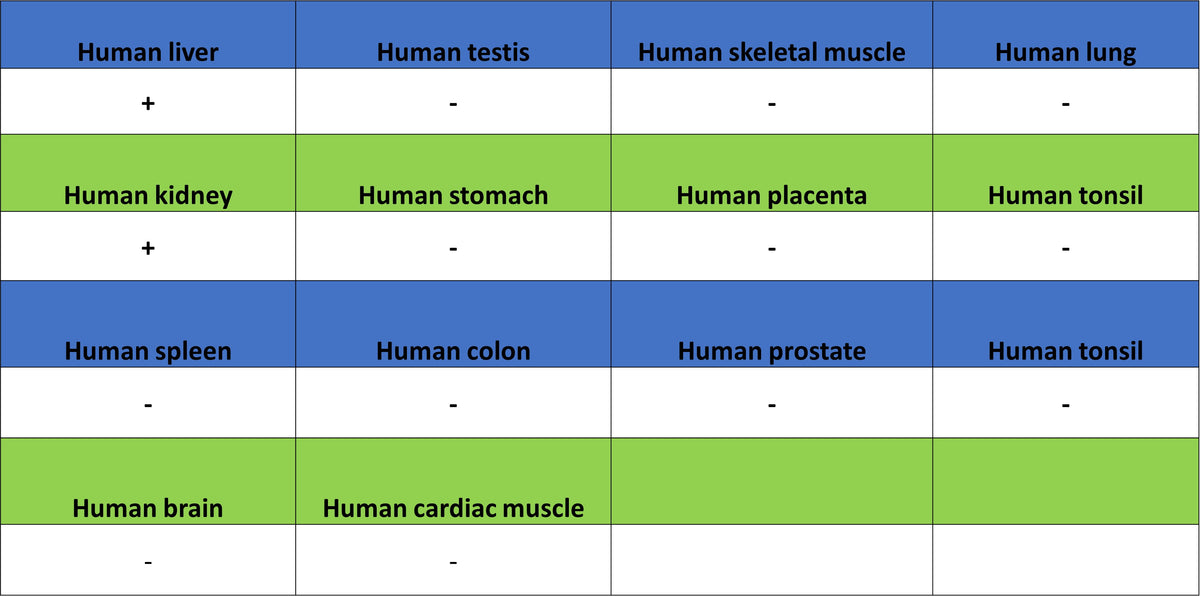
HPD is a key enzyme in the human body responsible for catalyzing the second step of the tyrosine catabolic pathway, converting 4-hydroxyphenylpyruvate into homogentisate. This iron-containing homodimeric protein is most abundantly expressed in human liver and kidney, and is also present in neurons of the cerebral cortex. The physiological function of HPD is crucial; defects in its encoding gene lead to autosomal recessive tyrosinemia type III, characterized by elevated blood tyrosine levels in patients, accompanied by mild intellectual disability and seizures. In addition, specific mutations in this gene can cause another rare tyrosine metabolic disorder—Hawkinsinuria. Beyond its classical metabolic function, recent studies have revealed that HPD is also a copper-binding protein. In colorectal cancer, it responds to copper stress by translocating to mitochondria and interacting with the DLAT protein, delivering copper ions to DLAT to trigger a form of cell death known as "cuproptosis," thereby playing a key role in tumor suppression.
Picture
Picture
Western Blot
Immunohistochemistry
IHC shows positive staining in paraffin-embedded human kidney. Anti-HPD antibody was used at 1/1000 dilution, followed by a HRP Polymer for Rabbit IgG (ready to use). Counterstained with hematoxylin. Heat mediated antigen retrieval with Tris/EDTA buffer pH9.0 was performed before commencing with IHC staining protocol.
IHC shows positive staining in paraffin-embedded human liver. Anti-HPD antibody was used at 1/1000 dilution, followed by a HRP Polymer for Rabbit IgG (ready to use). Counterstained with hematoxylin. Heat mediated antigen retrieval with Tris/EDTA buffer pH9.0 was performed before commencing with IHC staining protocol.
IHC shows positive staining in paraffin-embedded human liver cancer. Anti-HPD antibody was used at 1/1000 dilution, followed by a HRP Polymer for Rabbit IgG (ready to use). Counterstained with hematoxylin. Heat mediated antigen retrieval with Tris/EDTA buffer pH9.0 was performed before commencing with IHC staining protocol.