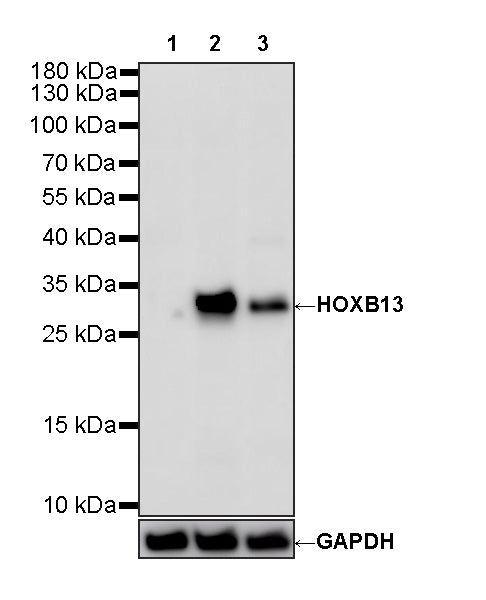
WB result of HOXB13 Rabbit Polyclonal Antibody
Primary antibody: HOXB13 Rabbit Polyclonal Antibody at 1/1000 dilution
Lane 1: DU 145 whole cell lysate 20 µg
Lane 2: LNCaP whole cell lysate 20 µg
Lane 3: PC-3 whole cell lysate 20 µg
Negative control: DU 145 whole cell lysate
Secondary antibody: Goat Anti-Rabbit IgG (H+L), HRP conjugated at 1/10000 dilution
Predicted MW: 30 kDa
Observed MW: 31 kDa
HOXB13 Rabbit Polyclonal Antibody
HOXB13 Rabbit Polyclonal Antibody
Price:
Regular price
$100 USD
Regular price
Sale price
$100 USD
Unit price
per
For shipping services or bulk orders, you may request a quotation.
Secure checkout with

View full details
Product Details
Product Details
Product Specification
| Host | Rabbit |
| Antigen | HOXB13 |
| Synonyms | Homeobox protein Hox-B13 |
| Immunogen | Synthetic Peptide |
| Location | Nucleus |
| Accession | Q92826 |
| Antibody Type | Polyclonal antibody |
| Isotype | IgG |
| Application | WB |
| Reactivity | Hu |
| Purification | Immunogen Affinity |
| Concentration | 2 mg/ml |
| Conjugation | Unconjugated |
| Physical Appearance | Liquid |
| Storage Buffer | PBS, 40% Glycerol, 0.05% BSA, 0.02% sodium azide |
| Stability & Storage | 12 months from date of receipt / reconstitution, -20 °C as supplied |
Dilution
| application | dilution | species |
| WB | 1:1000 | Hu |
Background
HOXB13 is a transcription factor encoded by the HOXB13 gene located on chromosome 17q21-22. It belongs to the homeobox protein family and is primarily involved in establishing positional identity along the anterior-posterior body axis during embryonic development, while also playing regulatory roles in terminally differentiated tissues. The protein contains a highly conserved homeodomain that binds to the major groove of DNA through its third α-helix (the recognition helix), while simultaneously interacting with the minor groove via its N-terminal tail, thereby recognizing specific sequences. Notably, HOXB13 exhibits a marked binding preference for methylated DNA; its Ile262 and Val269 residues can form hydrophobic contacts with 5-methylcytosine at methylated CpG sites, and this methylation sensitivity gives it a special status in epigenetic regulation. Functionally, HOXB13 is indispensable for prostate development and differentiation and is also an important co-regulator of the androgen receptor. Clinically, the most influential finding is its G84E germline mutation, which lies within the conserved MEIS protein-binding domain and is significantly associated with an elevated risk of hereditary prostate cancer. In addition, HOXB13 displays characteristics of a candidate tumor suppressor gene in renal cell carcinoma, whereas in prostate cancer progression it plays a more complex dual role—acting as an androgen receptor co-activator on the one hand, while its loss is associated with tumor metastasis and lipid metabolic reprogramming on the other.
Picture
Picture
Western Blot