WB result of Histone H4 (Lactyl K5) Recombinant Rabbit mAb
Primary antibody: Histone H4 (Lactyl K5) Recombinant Rabbit mAb at 1/1000 dilution
Lane 1: untreated HeLa whole cell lysate 20 µg
Lane 2: HeLa treated with 100 mM Lactate sodium for 24 hours whole cell lysate 20 µg
Secondary antibody: Goat Anti- rabbit IgG, (H+L), HRP conjugated at 1/10000 dilution
Predicted MW: 11 kDa
Observed MW: 14 kDa
Histone H4 (Lactyl K5) Recombinant Rabbit mAb (S-3220-73)
Histone H4 (Lactyl K5) Recombinant Rabbit mAb (S-3220-73)
Price:
Regular price
$100 USD
Regular price
Sale price
$100 USD
Unit price
per
For shipping services or bulk orders, you may request a quotation.
Secure checkout with

View full details
Product Details
Product Details
Product Specification
| Host | Rabbit |
| Antigen | Histone H4 (Lactyl K5) |
| Immunogen | Synthetic Peptide |
| Location | Nucleus |
| Accession | P62805 |
| Clone Number | S-3220-73 |
| Antibody Type | Recombinant mAb |
| Isotype | IgG |
| Application | WB, IHC-P, ICC, ChIP |
| Reactivity | Hu, Ms |
| Positive Sample | HeLa treated with 100 mM Lactate sodium for 24 hours, NIH/3T3 treated with 100 mM Lactate sodium for 24 hours |
| Purification | Protein A |
| Concentration | 0.5 mg/ml |
| Conjugation | Unconjugated |
| Physical Appearance | Liquid |
| Storage Buffer | PBS, 40% Glycerol, 0.05% BSA, 0.03% Proclin 300 |
| Stability & Storage | 12 months from date of receipt / reconstitution, -20 °C as supplied |
Dilution
| application | dilution | species |
| WB | 1:1000-1:2000 | Hu, Ms |
| IHC-P | 1:500 | Hu |
| ICC | 1:500 | Hu |
| ChIP | 1:20-1:50 | Hu |
Background
Histone H4 (Lactyl K5), denoted as H4K5la, is a specific post-translational modification where a lactyl group derived from cellular lactate is covalently attached to the 5th lysine residue of the histone H4 N-terminal tail. As a critical component of the recently discovered "histone lactylation" code, this mark functions as a direct epigenetic sensor linking high glycolytic flux and lactate accumulation to chromatin regulation. Unlike the well-studied acetylation at the same site (H4K5ac), which is generally associated with active transcription and nucleosome assembly during DNA replication, H4K5la has been increasingly implicated in distinct pathological and physiological contexts, such as the pro-inflammatory activation of microglia following ischemic stroke, where it promotes the transcription of key immunometabolic genes (e.g., HK1, Fads2) to drive fatty acid-dependent inflammatory responses. The dynamic deposition of H4K5la, potentially regulated by specific writers like GCN5 in response to metabolic stress, establishes a unique mechanistic bridge between cellular metabolism (particularly the Warburg effect or hypoxia-induced glycolysis) and the fine-tuning of gene expression programs involved in inflammation, tissue injury, and potentially tumor progression, offering novel therapeutic targets for diseases characterized by metabolic-epigenetic dysregulation.
Picture
Picture
Western Blot
WB result of Histone H4 (Lactyl K5) Recombinant Rabbit mAb
Primary antibody: Histone H4 (Lactyl K5) Recombinant Rabbit mAb at 1/1000 dilution
Lane 1: untreated NIH/3T3 whole cell lysate 20 µg
Lane 2: NIH/3T3 treated with 100 mM Lactate sodium for 24 hours whole cell lysate 20 µg
Secondary antibody: Goat Anti- rabbit IgG, (H+L), HRP conjugated at 1/10000 dilution
Predicted MW: 11 kDa
Observed MW: 14 kDa
Dot Blot
Dot blot result of Histone H4 (Lactyl K5) Recombinant Rabbit mAb
Lane 1: Histone H4 (Lactyl K5) modified peptide
Lane 2: Histone H4 (Lactyl K5) unmodified peptide control
Primary antibody: Histone H4 (Lactyl K5) Recombinant Rabbit mAb at 1/1000 dilution
Secondary antibody: Goat Anti-rabbit IgG, (H+L), HRP conjugated at 1/10000 dilution
Immunohistochemistry
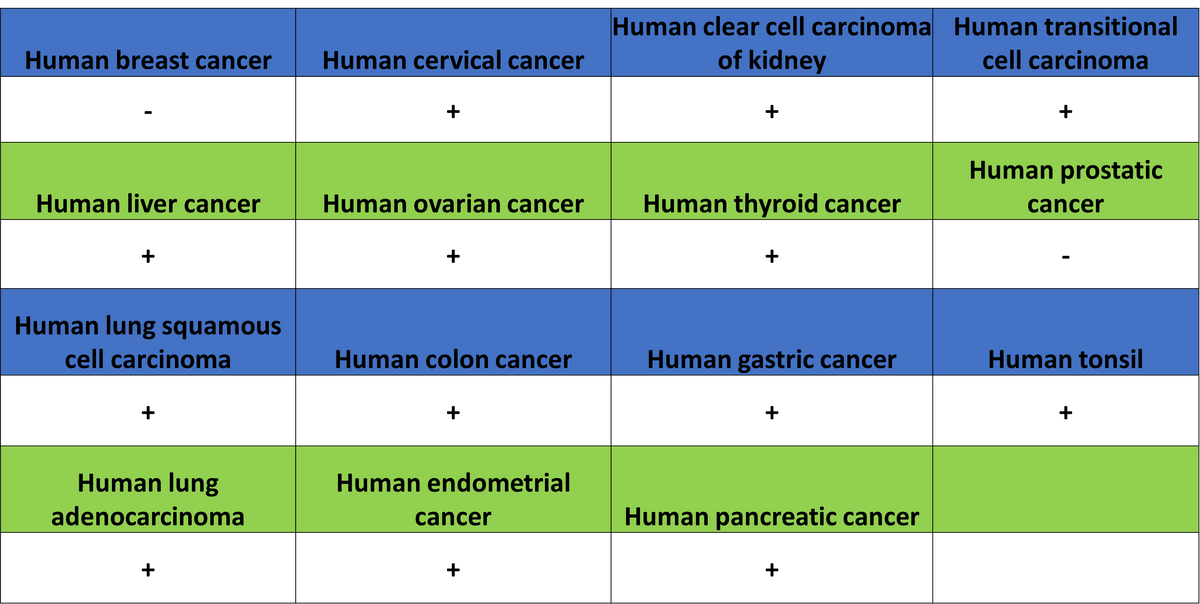
IHC shows positive staining in paraffin-embedded human tonsil. Anti-Histone H4 (Lactyl K5) antibody was used at 1/500 dilution, followed by a HRP Polymer for Rabbit IgG (ready to use). Counterstained with hematoxylin. Heat mediated antigen retrieval with Tris/EDTA buffer pH9.0 was performed before commencing with IHC staining protocol.
IHC shows positive staining in paraffin-embedded human lung squamous cell carcinoma. Anti-Histone H4 (Lactyl K5) antibody was used at 1/500 dilution, followed by a HRP Polymer for Rabbit IgG (ready to use). Counterstained with hematoxylin. Heat mediated antigen retrieval with Tris/EDTA buffer pH9.0 was performed before commencing with IHC staining protocol.
IHC shows positive staining in paraffin-embedded human prostatic cancer. Anti-Histone H4 (Lactyl K5) antibody was used at 1/500 dilution, followed by a HRP Polymer for Rabbit IgG (ready to use). Counterstained with hematoxylin. Heat mediated antigen retrieval with Tris/EDTA buffer pH9.0 was performed before commencing with IHC staining protocol.
Immunocytochemistry
ICC analysis of HeLa cells treated with Lactate sodium (100 mM, 24 hours) (top panel) and untreated HeLa cells (below panel). Anti-Histone H4 (Lactyl K5) antibody was used at 1/500 dilution (Green) and incubated overnight at 4°C. Goat polyclonal Antibody to Rabbit IgG - H&L (Alexa Fluor® 488) was used as secondary antibody at 1/1000 dilution. The cells were fixed with 100% ice-cold methanol and permeabilized with 0.1% PBS-Triton X-100. Nuclei were counterstained with DAPI (Blue). Counterstain with tubulin (Red).
ChIP
Chromatin immunoprecipitation (ChIP) was performed on HeLa + Lactate sodium
(100 mM, 24 hours) cells cross-linked with 1% formaldehyde for 10 min, then chromatin was fragmented by sonication. Parallel reactions used Histone H4 (Lactyl K8) Recombinant Rabbit mAb (S-3243-36) and Rabbit mAb IgG Isotype Control (SDT-R173) at 1:50 for immunoprecipitation. Post- immunoprecipitation, both samples were washed, eluted, and cross-links reversed. Purified DNA was analyzed by qPCR.
qPCR showed the enrichment of RPL30, GAPDH, MYOD-1, AFM, SAT-α and SAT-2 in
Histone H4 (Lactyl K5) Recombinant Rabbit mAb (S-3220-73)-immunoprecipitated
sample.